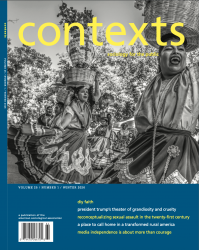
issues > Winter 2008 > pp. 3     

From the Editors

Since it debuted in 2002, we’ve seen Contexts as one of the most ambitious, exciting, and downright important publications in the American Sociological Association portfolio. Not only because of its core mission to bring sociology to a wider public audience, but also because of our conviction that a publicly engaged sociology constantly reinvents and reinvigorates itself, and in so doing produces new knowledge and insight.

We’re thus honored to take over a venture which, in a few short years, has won awards, built a deeply loyal constituency and solid subscription base, and now produced an exciting new classroom reader.

Our first and most important goal, therefore, is to not screw things up—or put more professionally, to maintain the standards of excellence on features, photo essays, and reviews established by previous editors Claude Fischer, Jim Jasper, and JeffGoodwin, and the various contributing editors who have organized the magazine’s sections over the years.

We want to expand and diversify the types of sociology in our pages and the sociologists who contribute to them. That in mind, we welcome a new group of scholars to our Editorial Board, each of whom was chosen specifically to lend new voices, visions, and expertise. And we’ll look forward to welcoming your submission, too.

Our inaugural issue introduces what they call in the business a “freshened design” intended to streamline and unify some of the content and design innovations of recent years. We’re also adding a few wrinkles of our own, among them the Reflected Appraisals section, a new back page column titled One Thing I Know, and a reconceived approach to book reviews intended to better complement the academic functions of our sister publication Contemporary Sociology.

Then there’s the redesigned website, contexts.org. It’s now up and running, and we have high hopes Contexts’ online presence will provide a forum for further exchange and become a key access point to sociology for both the general public and the media.

The next couple years will be crucial as we come to the conclusion of the 10-year plan ASA used to launch Contexts. Working with our publisher and ASA’s Executive Office, we plan to test a series of ideas for dramatically increasing the circulation and visibility of the whole Contexts enterprise. So stay tuned on that.

Let us know what you think. And what you’d like to write. With your scholarship and contributions, Contexts will reflect the breadth of its ASA membership and all that sociology has to offer.

issues > Winter 2008 > pp. 6-9     

Discoveries

‘…but some of my best friends are black’

If you think spending time with diverse friends keeps your prejudices in check, Eileen O’Brien and Kathleen Odell Korgen might encourage you to think again.

Face-to-face contact can challenge racial prejudice by forcing us to re-think our beliefs about racial groups based on relationships with individual members of those groups. However, O’Brien and Odell Korgen argue that America’s “colorblind” ideology can actually make interracial interaction have the opposite effect (Sociological Inquiry, August 2007).

The authors interviewed whites who have close black friends and whites participating in anti-racism activism. Traditional “contact theory” would predict that whites with black friends would have strong anti-racist views, and that anti-racism activists would have close personal ties to blacks.

The authors actually found the opposite for each group. They attribute this finding to colorblind attitudes. “Colorblindness” encourages Americans to treat all people purely as individuals and not as members of racial or ethnic groups. As a result, their respondents didn’t re-evaluate their view of a racial group after positive individual contact: they simply exempted that individual from what they thought about the racial group.

Perhaps the surest route to challenging racist stereotypes is to, well, challenge racist stereotypes—no matter how many black friends you have. J.S.

unnecessary roughness

Kids get plenty of benefits from playing team sports, but some sports seem to create more violent kids outside the locker room.

In a recent study of adolescent males, Derek A. Kreager (American Sociological Review, October 2007) found that boys who play football are 41 percent more likely to get into a serious physical fight than their non-athletic peers. For wrestlers, it’s 45 percent. These patterns hold even after controlling for a host of background factors, including past violence and delinquency.

Not only are football players more likely to fight, but so are their friends. Peer group influence, on top of playing sports, affects the likelihood of getting into a serious physical fight. At the same time, playing tennis, a non-contact, less stereotypically masculine sport, decreases the risk of fighting by 35 percent.

These findings have paradoxical implications for how schools treat and view their athletes. On the one hand, as Kreager says, communities expect their athletes to set a standard and act in conventional ways; on the other, they put athletes in situations that “support violence as a means of attaining ‘battlefield’ victories, increasing peer status, and asserting ‘warrior’ identities.” H.M.

richer is better

Being smart might make you healthier. But being rich is even better.

Bruce Link and colleagues (Journal of Health and Social Behavior, March 2008) report that socioeconomic status trumps intelligence when predicting better health, a finding that provides new fodder for public debate about the underlying causes of health disparities.

We need some degree of mental agility to make sense of the barrage of medical information we receive everyday from the news, Internet, and pharmaceutical commercials. However, Link and his co-authors found intelligence had little to no effect on health outcomes when they took income and education into account.

Rather, the underlying causes of better health remain the resources bestowed on those with higher socioeconomic standing, such as more money, more power, and more friends with medical expertise. These people also tend to live in neighborhoods with less pollution, less crime, and better gyms and parks.

If intelligence isn’t the missing link on the road to better health, then initiatives like consumer-based healthcare miss the mark. Drawing upon our wits to sort through complicated health options may have little impact if we can’t afford screening tests or ask the neighborhood doc for friendly advice. W.L.

issues > Winter 2008 > pp. 54-63     

Culture Reviews

Comment dit-on ‘do’h!’ en français?

by giselinde kuipers

Every once in a while a comedy manages to transcend cultural boundaries. Today, the most successful of the few American television comedies that work outside the United States is probably The Simpsons. To see America, smug and powerful, ridiculed from the inside is gratifying for outsiders, who see their criticisms and suspicions corroborated by a reliable source. This means that sometimes, non-Americans like The Simpsons for exactly the same reasons some Americans don’t—it makes fun of America.

Purchase this article from UC Press

The Lie of Heroism

by matthew desmond

Several elements combined to make the California fires a mega story. And most prominent among the media attention were stories of firefighters that, for the most part, treated “hero” and “firefighter” as synonymous. In fact, little else was said about those men and women on the fireline. The firefighter apotheosized, hallowed and revered, is the dominant image of firefighters we have nowadays. And with this image comes a set of beliefs about what makes firefighters tick, what makes them deploy themselves on the seam between life and death. Firefighting requires courage and selflessness enough, but in referring to firefighters always and only as heroes, do we not look straight through them?

Purchase this article from UC Press

Sociology at the Stove

by priscilla ferguson and gary alan fine

Ratatouille is a treasure trove for sociologists because it lays out an organization with its attendant work roles and then shows how it functions in its cultural logic. In effect, the film is an animated organization chart. The kitchen is resolutely a collective enterprise.

Purchase this article from UC Press

The Word is Egalitarian

by corinne kirchner

The larger trend that includes Akeelah and the Bee has catapulted the once esoteric activity of spelling competitions into commercial pop culture. Cable television and ABC have covered the national bee and since 2000 there have been two bee-related books three bee-related movies, and a bee-themed Broadway musical. Of course, the bee trend isn’t really about a sudden celebratory interest in the practice of spelling. It’s about values. But even without the vast evidence for inequality of opportunity sociologists often point to, looking at actual bee demographics suggests Akeelah and its surrounding ideals is, more than anything else, a myth.

Purchase this article from UC Press

issues > Winter 2008 > pp. 64-69     

Book Reviews

Be Still and Know that I am Bright

by penny edgell

Breaking the Spell coverDaniel C. Dennet’s Breaking the Spell mixes a careful review of some excellent work with a poorly conceived and executed polemic. Slipshod in reviewing scholarship inconvenient to his argument, Dennett levels petty outbursts throughout toward particular scholars and general categories of people. The “brights” are scientific elites, aggressively bumping shoulders with religious elites, vying for power as part of an historic struggle. They, and we, should ask the tough questions about where religious ideas are best addressed in society, and none of us should be pilloried for asking, or for a strong secularist answer. But the brights have not been pilloried.

Purchase this article from UC Press

The Most Dangerous Crime Rankings

by richard rosenfeld and janet l. lauritsen

City Crime Rankings coverThe information contained in the City Crime Rankings, which is less a book and more a compendium of statistical tables, provides an important opportunity. It allows us to discuss the appropriate uses and limitations of the FBI’s Uniform Crime Reports data and the role responsible social scientists and journalists can play in starting a meaningful conversation about this nation’s crime policy. There’s nothing objectionable about organizing and disseminating crime data in tabular form. The problem comes in using those data to designate the residents of some cities as “safe” and the residents of others as in “danger” based on an undisclosed, proprietary scoring methodology applied to the FBI’s crime statistics.

Purchase this article from UC Press

A Big Take on the World’s ‘Little People’

by alford young jr.

Poor People CoverPublic attention directed toward the wealthy seems to take the form of intrigue about what they do. The impoverished, however, seem to attract attention for their perceived lack of meaningful employment opportunities or prospects for pursuing upward mobility, their perpetual struggle with destitution and despair. We wonder whether they ascribe blame to others or themselves for their life situations, what they think they can do about their plight, or what they think about the more privileged in society. In Poor People, William T. Vollmann attempts to answer this first question and, in doing so, offer some insight into the others. Vollmann intends to address what’s in the minds of poor people by literally trekking across the globe to meet and interview them. His succinct title severely contrasts with the enormity of the task at hand in this volume.

Purchase this article from UC Press

issues > Winter 2008 > pp. 72     

Immigration’s Complexities, Assimilation’s Discontents

In the inaugural column of our new series, One Thing I Know, Rubén Rumbaut addresses the gap between public perception and facts on immigration. For this inaugural column, you can download the PDF or continue reading the full column below.

one thing i know

One thing I know is that popular conceptions about immigrants and their assimilation don’t square with the facts.

Of the 6.5 billion people in the world today, 191 million—just under 3 percent—are international migrants. The rest, 97 percent of humanity, are “stayers” living in the countries where they were born.

Moving to a foreign country isn’t easy, even under the most propitious circumstances. Those who do tend to be young and intrepid souls, which is what makes migration the selective process it is. Still, though, the total global migrant stock is up from 155 million in 1990 and 81 million in 1970.

More immigrants come to the United States than to any other country. In 2005 there were 38 million here, one fifth of the world’s immigrant total. But, only 12.9 percent of the U.S. population is foreign-born. Many other countries exceed that percentage and the United States itself did, too, in each decennial census from 1860 through 1920.

These days immigrants to the United States come from extraordinarily diverse backgrounds. In fact, by far both the most and least educated groups in the United States today are immigrants. They’re anything but the homogeneous lot implied in popular stereotypes.

issues > Winter 2008 > pp. 70-71     

Normality

Despite its general neglect, normality has an extraordinarily powerful effect on how people behave. Even those who want to be different use a conception of the normal as a guide.

Purchase this article from UC Press

issues > Winter 2008 > pp. 52-53     

Keeping the Faith

After the 2004 election, political pundits credited the religious right with ushering George W. Bush into office. Adherents to the culture war thesis—that political conflict results from the conflicting values of traditionalists and progressives—view the intensifying conservatism of evangelical Christians over the past two decades as responsible for the election of other anti-stem cell research, antichoice, anti-gay marriage candidates.

The subtle message underlying these debates is that people’s religions and their politics are inextricably intertwined. But we ought to consider whether it’s really that simple, whether religion really is a proxy for political views (or vice versa).

Purchase this article from UC Press

issues > Winter 2008 > pp. 44-51     

Life, Death, and Music in West Africa

The gyil is a 14-key frame xylophone played during funerals by the Lobi people from Ghana’s northwestern region. Gyil music combines overlapping melodies and bass patterns enveloped by a dense layer of buzzing. The keys are cut from the liga, a red hardwood tree, and strung above gourds that are modified with thin paper or spider silk to create a sympathetic drone. Playing the instrument with the two heavy mallets takes great endurance, and a musician may be expected to play for several hours before another takes over.

Mourning and celebrating reaffirm to the participants that their lives will be honored in the same way. Photographing this topic led me to appreciate the difficulty of describing something as complex as music in the service of social celebrations. The photos show how the gyil is a means to socialize the young into eventual roles as respected musicians as well as a means to create social space. Most importantly, we see the power of musical performance to articulate collective mourning and the celebration of life.

Purchase this article from UC Press

music from ghana

In addition to photographs, Colter Harper made audio recordings of the funeral music in Ghana. Colter agreed to give us a quick audio tour to accompany his photo essay in the print magazine. To listen, just click the “+” icon for each clip.

Funeral Sounds:

These clips were all recorded near the village of Kalba in the Upper West Region of Ghana. The funeral took place in the courtyard and the adjacent fields.

In this first clip, Lobi villagers sit and talk as musicians play and a group of older women seated near the body wail. At the beginning, you can hear the xylophone (gyil), drum (gangar), and bell playing. The musicians finish the piece allowing the listener to focus on the overlapping of conversations and the “wailing” songs of mourners:

In this clip, a xylophonist sits and tests the instrument while playing an extended solo piece. The sound of the instrument blends with the sound of women wailing near the body of the deceased:

This clip features a Lobi ensemble (xylophone, drums, and bell) in the midst of a performance. Faint wailing can be heard in the background:

This clip features a Lobi ensemble (xylophone, drums, and bell) in the midst of a performance. This is the first night of the funeral and a great crowd has assembled. The only light comes from small fires and the moon. Men drink and converse as teens take turns dancing in a long circle around the musicians:

Ground Xylophone:

This clip features the sounds of the ground xylophone. This instrument is built over a trough in the earth in the courtyard of the family compound. Because the frame xylophone can only be played in the event of a funeral, the ground xylophone provides a medium for practice and entertainment:

Gyil Master:

This clip features the xylophone (gyil) master Thomas Vuurl playing one summer night in his home near Kalbaa. The sounds of the instrument reverberate in the small chamber of the mud built compound. Bats fly through the dark rooms eating mosquitos as the extended family crowds in to hear the old master:

Lobi Boys Singing:

Several young boys sing in the courtyard of their family compound near Kalba. It is December with the dry season underway. The night is cool and dry and a thin haze covers the stars:

issues > Winter 2008 > pp. 10-11     

David Brooks Looks for a Few Good Sociologists

While more conservative in his politics than many sociologists, Brooks often writes about topics of interest to the field and its practitioners while alternating between columns on Washington-based politics and essays on broad cultural and social issues.

Given Brooks’ interest in the social sciences in general and sociology in particular, former American Sociological Review editor Jerry A. Jacobs spoke with him about his work and how the field might facilitate more reporting on sociology.

Purchase this article from UC Press

issues > Winter 2008 > pp. 34-37     

Sociologists on the Colorblind Question

Sociologists today are increasingly questioning the colorblind ideology and what effects it has on American culture and law. Their interest is due in no small part to the fact that colorblindness is used to support two very different social agendas that are in direct conflict. And there is no arena in which the struggle over the meaning of colorblindness is more consequential than in the nation’s courts, where the fate of affirmative action programs and other racially based initiatives hang in the balance.

Purchase this article from UC Press

online resources

More information on sociologists cited in this article:

Katherine Beckett studies the American criminal justice system and its relationship with inequality. Key Work: “Race, Drugs and Policing: Understanding Disparities in Drug Delivery Arrests,” Criminology, 44:1.

Eduardo Bonilla-Silva studies the changing nature of racism and racial stratification in the United States. Key Work: “‘They should hire the one with the best score’: White sensitivity to qualification differences in affirmative action hiring decisions,” Ethnic and Racial Studies, February 2008.

Charles A. Gallagher studies racial and social inequality and representations of race in the media and popular culture. Key Work: “Color-Blind Privilege: The Social and Political Functions of Erasing the Color Line in Post Race America,” Race, Gender and Class 10:4.

Brian Lowery examines subconscious racial attitudes and individuals’ perception of inequality. Key Work: “Framing Inequity Safely: The Motivated Denial of White Privilege,” Personality and Social Psychology Bulletin, 33: 1237.

Devah Pager studies the impact of institutions on racial inequality. Key Work: “Walking the Talk? What Employers Say Versus What They Do,” American Sociological Review, 70:3.

Victoria Plaut investigates different approaches to racial diversity and the implication of these approaches for race relations. Key Work: “Cultural models of diversity: The psychology of difference and inclusion.” in Engaging cultural differences: The multicultural challenge in liberal democracies.

John D. Skrentny studies the development of public policy and law and affecting the rights of minorities in the United States. Key Work: The Minority Rights Revolution, Harvard University Press, 2002.

Next Page »

About the Author

Elaine McArdleElaine McArdle is a journalist and writer based in Cambridge, Massachusetts. She is the co-author of The Migraine Brain.

Other Articles in Winter 2008