Rethinking Crime and Immigration
As an online special, we’re making this article available in its entirety. You may choose to read either the html version or a PDF version.
The summer of 2007 witnessed a perfect storm of controversy over immigration to the United States.
After building for months with angry debate, a widely touted immigration reform bill supported by President George W. Bush and many leaders in Congress failed decisively. Recriminations soon followed across the political spectrum.
Just when it seemed media attention couldn’t be greater, a human tragedy unfolded with the horrifying execution-style murders of three teenagers in Newark, N.J., attributed by authorities to illegal aliens.
Presidential candidate Rep. Tom Tancredo (R–Colorado) descended on Newark to blame city leaders for encouraging illegal immigration, while Newt Gingrich declared the “war at home” against illegal immigrants was more deadly than the battlefields of Iraq. National headlines and outrage reached a feverish pitch, with Newark offering politicians a potent new symbol and a brown face to replace the infamous Willie Horton, who committed armed robbery and rape while on a weekend furlough from his life sentence to a Massachusetts prison. Another presidential candidate, former Tennessee senator Fred Thompson, seemed to capture the mood of the times at the Prescott Bush Awards Dinner: “Twelve million illegal immigrants later, we are now living in a nation that is beset by people who are suicidal maniacs and want to kill countless innocent men, women, and children around the world.”
Now imagine a nearly opposite, fact-based scenario. Consider that immigration—even if illegal—is associated with lower crime rates in most disadvantaged urban neighborhoods. 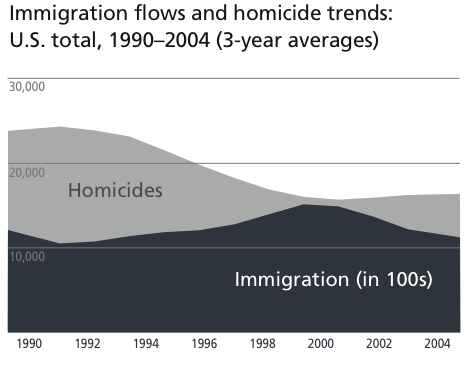 Or that increasing immigration tracks with the broad reduction in crime the United States has witnessed since the 1990s.
Well before the 2007 Summer of Discontent over immigration, I proposed we take such ideas seriously. Based on hindsight I shouldn’t have been surprised by the intense reaction to what I thought at the time was a rather logical reflection. From the right came loud guffaws, expletive-filled insults, angry web postings, and not-so-thinly veiled threats. But the left wasn’t so happy either, because my argument assumes racial and ethnic differences in crime not tidily attributable to material deprivation or discrimination—the canonical explanations.
Although Americans hold polarizing and conflicting views about its value, immigration is a major social force that will continue for some time. It thus pays to reconsider the role of immigration in shaping crime, cities, culture, and societal change writ large, especially in this era of social anxiety and vitriolic claims about immigration’s reign of terror.
some facts
Consider first the “Latino Paradox.” Hispanic Americans do better on a wide range of social indicators—including propensity to violence—than one would expect given their socioeconomic disadvantages. To assess this paradox in more depth, my colleagues and I examined violent acts committed by nearly 3,000 males and females in Chicago ranging in age from 8 to 25 between 1995 and 2003. The study selected whites, blacks, and Hispanics (primarily Mexican-Americans) from 180 neighborhoods ranging from highly segregated to very integrated. We also analyzed data from police records, the U.S. Census, and a separate survey of more than 8,000 Chicago residents who were asked about the characteristics of their neighborhoods.
Notably, we found a significantly lower rate of violence among Mexican-Americans compared to blacks and whites. A major reason is that more than a quarter of those of Mexican descent were born abroad and more than half lived in neighborhoods where the majority of residents were also Mexican. In particular, first-generation immigrants (those born outside the United States) were 45 percent less likely to commit violence than third-generation Americans, adjusting for individual, family, and neighborhood background. Second-generation immigrants were 22 percent less likely to commit violence than the third generation. This pattern held true for non-Hispanic whites and blacks as well. Our study further showed living in a neighborhood of concentrated immigration was directly associated with lower violence (again, after taking into account a host of correlated factors, including poverty and an individual’s immigrant status). Immigration thus appeared “protective” against violence.
Consider next the implications of these findings when set against the backdrop of one of the most profound social changes to visit the United States in recent decades. Foreign immigration to the United States rose sharply in the 1990s, especially from Mexico and especially to immigrant enclaves in large cities. Overall, the foreign-born population increased by more than 50 percent in 10 years, to 31 million in 2000. A report by the Pew Hispanic Center found immigration grew most significantly in the mid-1990s and hit its peak at the end of the decade, when the national homicide rate plunged to levels not seen since the 1960s. Immigrant flows have receded since 2001 but remain high, while the national homicide rate leveled off and seems now to be creeping up. Both trends are compared over time at left.
The pattern upends popular stereotypes. Among the public, policy makers, and even many academics, a common expectation is that the concentration of immigrants and the influx of foreigners drive up crime rates because of the assumed propensities of these groups to commit crimes and settle in poor, presumably disorganized communities. This belief is so pervasive that in our Chicago study the concentration of Latinos in a neighborhood strongly predicted perceptions of disorder no matter the actual amount of disorder or rate of reported crimes. And yet immigrants appear in general to be less violent than people born in America, particularly when they live in neighborhoods with high numbers of other immigrants.
We are thus witnessing a different pattern from early 20th century America, when growth in immigration from Europe, along with ethnic diversity more generally, was linked with increasing crime and formed a building block for what became known as “social disorganization” theory. New York today is a leading magnet for immigration, yet it has for a decade ranked as one of America’s safest cities. Crime in Los Angeles dropped considerably in the late 1990s (45 percent overall) as did other Hispanic influenced cities such as San Jose, Dallas, and Phoenix. The same can be said for cities smack on the border like El Paso and San Diego, which have long ranked as low-crime areas. Cities of concentrated immigration are some of the safest places around.
counterpoint
There are criticisms of these arguments, of course. To begin, the previous figure juxtaposes two trends and nothing more—correlation doesn’t equal causation. But it does demonstrate the trends are opposite of what’s commonly assumed, which is surely not irrelevant to the many, and strongly causal, claims that immigration increases crime. Descriptive facts are at the heart of sound social science, a first step in any causal inquiry.
Perhaps a bigger concern is that we need to distinguish illegal from legal immigration and focus on the many illegal aliens who allegedly are accounting for crime waves across the country—the “Newark phenomenon.” By one argument, because of deportation risk illegal immigrants are afraid to report crimes against them to the police, resulting in artificially low official estimates in the Hispanic community. But no evidence exists that reporting biases seriously affect estimates of the homicide victimization rate—unlike other crimes there is a body. At the national level, then, the homicides committed by illegal aliens in the United States are reflected in the data just like for everyone else. The bottom line is that as immigrants poured into the country, homicides plummeted. One could claim crime would decrease faster absent immigration inflows, but that’s a different argument and concedes my basic point.
There is also little disputing that in areas and times of high legal immigration we find accompanying surges of illegal entrants. It would be odd indeed if illegal aliens descended on areas with no other immigrants or where they had no pre-existing networks. And so it is that areas of concentrated immigration are magnets for illegal concentration. Because crime tends to be negatively associated with undifferentiated immigration measures, it follows that we can disconfirm the idea that increasing illegal immigration is associated with increasing crime.
Furthermore, our Chicago study did include both legal and illegal immigrants. I would estimate the illegal status at roughly a quarter—but in any case no group was excluded from the analysis. The other important point is that the violence estimates were based on confidential self-reports and not police statistics or other official sources of crime. Therefore, police arrest biases or undercounts can’t explain the fact that first generation immigrants self-report lower violence than the second generation, which in turn reports less than the third generation.
So let us proceed on the assumption of a substantial negative association across individuals, places, and time with respect to immigration and violence. What potential mechanisms might explain the connections and are they causal? Thinking about these questions requires attention be paid to confounding factors and competing explanations.
Social scientists worry a lot about selection bias because individuals differ in preferences and can, within means, select their environments. It has been widely hypothesized that immigrants, and Mexicans in particular, selectively migrate to the United States on characteristics that predispose them to low crime, such as motivation to work, ambition, and a desire not to be deported. Immigrants may also come from cultures where violence isn’t rewarded as a strategy for establishing reputation (to which I return below).
This scenario is undoubtedly the case and central to the argument—social selection is a causal mechanism. Namely, to the extent that more people predisposed to lower crime immigrate to the United States (we now have some 35 million people of foreign-born status), they will sharply increase the denominator of the crime rate while rarely appearing in the numerator. And in the neighborhoods of U.S. cities with high concentrations of immigrants, one would expect on selection grounds alone to find lower crime rates. Selection thus favors the argument that immigration may be causally linked to lower crime.
Another concern of social scientists is common sources of causation, or “competing” explanations. One candidate is economic trends. After all, potential immigrants respond to incentives and presumably choose to relocate when times are better in their destinations. Although a legitimate concern, economics can’t easily explain the story. Depending on the measure, economic trends aren’t isomorphic with either immigration or crime at either the beginning or end of the time series. Real wages were declining and inequality increasing in the 1990s by most accounts, which should have produced increases in crime by the logic of relative deprivation theory, which says that income gaps, not absolute poverty, are what matters. Broad economic indicators like stock market values did skyrocket but collapsed sharply while immigration didn’t.
Scholars in criminology have long searched for a sturdy link between national economic trends and violence, to little avail. The patterns just don’t match up well, and often they’re in the opposite direction of deprivation-based expectations. The best example is the 1960s when the economy markedly improved yet crime shot up. Don’t forget, too, the concentrated immigration and crime link remains when controlling for economic indicators.
Finally, the “Latino Paradox” in itself should put to rest the idea that economics is the go-to answer: Immigrant Latinos are poor and disadvantaged but at low risk for crime. Poor immigrant neighborhoods and immigrant-tinged cities like El Paso have similarly lower crime than their economic profile would suggest.
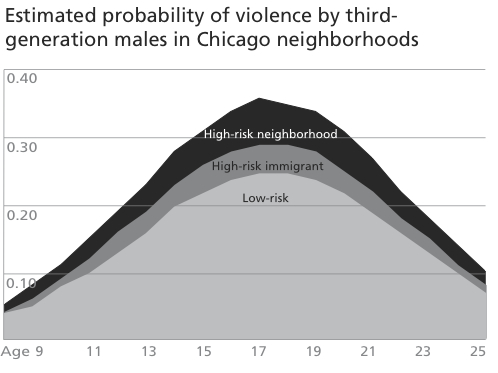 Competing explanations also can’t explain the Chicago findings. Immigrant youths committed less violence than natives after adjustment for a rich set of individual, family, and neighborhood confounders. Moreover, there’s an influence of immigrant concentration beyond the effects of individual immigrant status and other individual factors, and beyond neighborhood socioeconomic status and legal cynicism—previously shown to significantly predict violence. We estimated male violence by age for three types of neighborhoods (below):
- “Low-risk,” where a very high percentage of people work in professional and managerial occupations (90th percentile), few people hold cynical attitudes about the law and morality (10th percentile), and there are no immigrants;
- “High-risk,” where professional/managerial jobs are scarce, cynicism is pervasive, and there are also no immigrants;
- “High-risk, immigrant neighborhoods,’ defined by similarly low shares of professional/managerial workers and high legal cynicism, but where about one-half of the people are immigrants.
 The estimated probability an average male living in a high-risk neighborhood without immigrants will engage in violence is almost 25 percent higher than in the high-risk, immigrant neighborhood, a pattern again suggesting the protective, rather than crime-generating, influence of immigrant concentration.
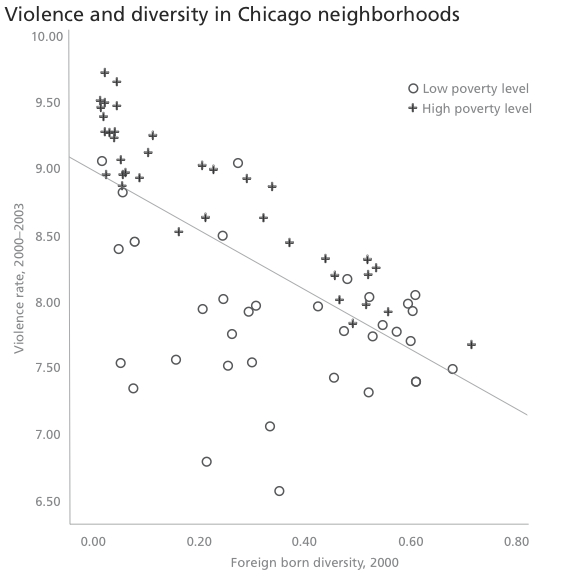
Finally, we examined violence in Chicago neighborhoods by a foreign-born diversity index capturing 100 countries of birth from around the world (page 32). In both high- and low-poverty communities, foreign-born diversity is clearly and strongly linked to lower violence. Concentrated poverty predicts more violence (note the high poverty areas above the prediction line) but violence is lower as diversity goes up for low- and high-poverty neighborhoods alike. Interestingly, the link between lower violence and diversity is strongest in the most disadvantaged neighborhoods.
crime declines among non-hispanics
A puzzle apparently remains in how immigration explains the crime decline among whites and blacks in the 1990s. One agitated critic, for example, charged that my thesis implies that for every Mexican entering America a black person would have to commit fewer crimes. But immigration isn’t the only cause of the crime decline. There are many causes of crime—that declines ensued for blacks and whites doesn’t in itself invalidate the immigration argument. This critique also exposes a misconception about immigrant diversity. Immigration isn’t just about Mexicans, it’s about the influx of a wide range of different groups. The previous figure, for example, represents 100 countries, a conservative template for many places. In cities such as Los Angeles and New York, immigrant flows are erasing simple black-white-brown scenarios and replacing them with a complex mixture of immigrant diversity.
Even the traditionally black-white city of Chicago reflects evidence of immigration’s broad reach. When we looked at whites and blacks we still found surprising variation in generational status, with immigration protective for all racial/ethnic groups except Puerto Ricans/other Latinos. In fact, controlling for immigrant generation reduced the gap between African Americans and whites by 14 percent, implying one reason whites have lower levels of violence than African Americans is that whites are more likely to be recent immigrants. The pattern of immigrant generational status and lower crime is thus not just restricted to Latinos, and it extends to helping explain white-black differences as well.
Added to this is substantial non-Latino immigration into the United States from around the world, including Russia, Poland, India, and the Caribbean, to name just a few countries. Black and white populations are increasingly characterized by immigrants (Poles and Russians among whites in Chicago, for example, and Caribbeans and West Africans among blacks in New York). According to Census 2000, the Chicago area has more than 130,000 Polish immigrants, so we aren’t talking about trivial numbers. Perhaps more important, focusing on the “what about whites and blacks” question misses the non-selection-based component of a broader immigration argument. We’re so used to thinking about immigrant adaptation (or assimilation) to the host society we’ve failed to fully appreciate how immigrants themselves shape the host society. Take economic revitalization and urban growth. A growing consensus argues immigration revitalizes cities around the country. Many decaying inner-city areas gained population in the 1990s and became more vital, in large part through immigration. One of the most thriving scenes of economic activity in the entire Chicagoland area, for example, second only to the famed “Miracle Mile” of Michigan Avenue, is the 26th Street corridor in Little Village. A recent analysis of New York City showed that for the first time ever, blacks’ incomes in Queens have surpassed whites’, with the surge in the black middle class driven largely by the successes of black immigrants from the West Indies. Segregation and the concentration of poverty have also decreased in many cities for the first time in decades.
Such changes are a major social force and immigrants aren’t the only beneficiaries—native born blacks, whites, and other traditional groups in the United States have been exposed to the gains associated with lower crime (decreases in segregation, decreases in concentrated poverty, increases in the economic and civic health of central cities, to name just a few). There are many examples of inner-city neighborhoods rejuvenated by immigration that go well beyond Queens and the Lower West Side of Chicago. From Bushwick in Brooklyn to Miami, and from large swaths of south central Los Angeles to the rural South, immigration is reshaping America. It follows that the “externalities” associated with immigration are multiple in character and constitute a plausible mechanism explaining some of the variation in crime rates of all groups in the host society.
There are important implications for this line of argument. If it is correct, then simply adjusting for things like economic revitalization, urban change, and other seemingly confounding explanations is illegitimate from a causal explanation standpoint because they would instead be mediators or conduits of immigration effects—themselves part of the pathway of explanation. Put differently, to the extent immigration is causally bound up with major social changes that in turn are part of the explanatory process of reduced crime, estimating only the net effects of immigration will give us the wrong answer.
cultural penetration and societal renewal
A related cultural implication, while speculative and perhaps provocative, is worth considering. If immigration leads to the penetration into America of diverse and formerly external cultures, then this diffusion may contribute to less crime if these cultures don’t carry the same meanings with respect to violence and crime.
It’s no secret the United States has long been a high-violence society, with many scholars positing a subculture or code of the streets as its main cause. In one influential version, shared expectations for demanding respect and “saving face” lead participants in the “street culture” of poor inner cities to react violently to perceived slights, insults, and otherwise petty encounters that make up the rounds of daily life. But according to the logic of this theory, if one doesn’t share the cultural attribution or perceived meaning of the event, violence is less likely. Outsiders to the culture, that is, are unlikely to be caught in the vicious cycles of interaction (and reaction) that promote violence.
The massive penetration of immigrant (particularly, but not only, Mexican) populations throughout the United States, including rural areas and the South, can properly be thought of as a diffusion-like process. One possible result is that over time American culture is being diluted. Some of the most voracious critiques of immigration have embraced this very line of argument. Samuel Huntington, in one well-known example, claims the very essence of American identity is at stake because of increasing diversity and immigration, especially from Mexico. He may well be right, but the diagnosis might not be so bad if a frontier mentality that endorses and perpetuates codes of violence is a defining feature of American culture.
A profound irony in the immigration debate concedes another point to Huntington. If immigration can be said to have brought violence to America, it most likely came with (white) Irish and Scottish immigrants whose cultural traditions emphasizing honor and respect were defended with violent means when they settled in the South in the 1700s and 1800s. Robert Nisbett and Dov Cohen have presented provocative evidence in favor of this thesis, emphasizing cultural transmission in the form of Scotch-Irish immigrants, descendants of Celtic herdsman, who developed rural herding communities in the frontier South. In areas with little state power to command compliance with the law, a tradition of frontier justice carried over from rural Europe took hold, with a heavy emphasis on retaliation and the use of violence to settle disputes, represented most clearly in the culture of dueling.
In today’s society, then, I would hypothesize that immigration and the increasing cultural diversity that accompanies it generate the sort of conflicts of culture that lead not to increased crime but nearly the opposite. In other words, selective immigration in the current era may be leading to the greater visibility of competing non-violent mores that affect not just immigrant communities but diffuse and concatenate through social interactions to tamp down violent conflict in general. Recent findings showing the spread of immigration to all parts of America, including rural areas of the Midwest and South, give credence to this argument. The Willie Hortinization of illegal aliens notwithstanding, diversity and cultural conflict wrought by immigration may well prove healthy, rather than destructive, as traditionally believed.
recommended resources
Richard Nisbett and Dov Cohen. Culture of Honor: The Psychology of Violence in the South (Westview, 1996). A fascinating take on the cultural roots of violence in the United States, including the culture of honor posited to afflict the South disproportionately and traced to European immigration.
Eyal Press. “Do Immigrants Make Us Safer?” New York Times Magazine, December 3, 2006. A New York Times writer considers the questions raised in this article, taking to the streets of Chicago.
Rubén G. Rumbaut and Walter A. Ewing. “The Myth of Immigrant Criminality and the Paradox of Assimilation: Incarceration Rates among Native and Foreign-Born Men,” Immigration Policy Center Special Report, 2007. A recent synthesis of the empirical facts on immigration and crime, with a special focus on incarceration.
Thorsten Sellin. Culture Conflict and Crime (Social Science Research Council, 1938). Widely considered the classical account of immigration, culture, and crime in the early part of the 20th century.
further reading online
When Robert Sampson argued that Open Doors Don’t Invite Criminals on the New York Times Op-Ed page, Sampson’s argument made waves. Alex Koppelman at Salon.com interviewed Sampson in response to Bill O’Reilly’s comments about criminality among immigrants, and Christopher Dickey with Newsweek cited Sampson’s research in response to Presidential candidates’ tendency to “get tough” on immigration to win votes.
Of course, all the responses weren’t so positive. Sampson received large amounts of hate mail in response to his Op-Ed piece as well. We asked Sampson to share some samples of this mail with us. Sampson warned us many of them were too crude to publish, but here are two of his favorites:
Dear Professor Sampson:
I met your article with not merely a chuckle, but guffaws – uncontrollable, hysterical laughter.
On what planet did you study sociology — Buck Rogers’ Mongo?
I have never read a collection of convoluted “statistics” and fabricated claptrap such as you espouse — not in my 65 years — that even BEGAN to approach the level of absurdity you puff. My golden era of fact and truth, unlike your Alice-in-Wonderland missive, included and includes being an author, writer, intensive research as an investigative reporter, and ongoing creation and maintenance of websites that bring instead of your style of puffery, TRUTH.
I don’t know from where you get your alleged facts, but I lived with your precious Mexican Americans in Phoenix Arizona and several other large cities. I regularly witnessed drunken brawls, defecation in public streets, destruction of public property, violent fights with knives, guns and machetes, assault on innocents, a level of burglary and theft never before seen (until Mexicans moved into the area), drunk-driving Mexicans who didn’t have an idea of how or where to obtain either a drivers license or insurance and didn’t care… And my son, a police sergeant, escorted so many Mexicans to jail that he wore out 60,000-mile-per-year tires three times a year!
Mexicans are “less violent” than Americans? Did you get that absurd distortion of truth from Viva Zapata or el Presidente Fox?
Six or eight decades ago, BEFORE criminal, indigent Mexicans began to fill our cities and towns, immigrants were studious, energetic, eager to assimilate and peaceful. They CONTRIBUTED to this nation. Today’s immigrants, however, especially Mexicans, are generally lazy, criminal, have no intention of assimilating (and do not assimilate), are uneducated beyond perhaps mid grade school, have no trade, and are here for what they can suck from the lifeblood of our country. They are a blight!
Your idiotic assertion that they are less violent than Americans or are in any way contributing to our nation because they live in Mexican ghettos is IDIOTIC!
You and your Ivy League-educated ilk live in a counterfeit utopian sphere of fantasy and lunacy. Your hot air would fill all of the balloons at the New Mexico balloon fest, leaving enough to launch the next space shuttle! No matter how often or how vehemently you blow, no matter how hard you try — you will never make your regurgitated gibberish so!
And most importantly, using a conduit like the New York Times DIMINISHES any credibility your imaginative article might have had. The New York Times has not a modicum of respect or credibility among real people who live in the real world, and has not had any since its editors embarked on an ongoing campaign of smear, hate, and imagination. Your silliness falls into the latter. But then, no CREDIBLE newspaper would HAVE your brand of madness.
The public would be better served if you printed handbills, on them reproduced your article, and distributed them to the Mexicans you so boldly embrace, suggesting that they use them to wipe their asses when they shit on our public streets! At least then SOME part of them might be clean.
And another example:
Dear Prof. Sampson:
I really hope you don’t teach this nonsense to your students. Your conclusions are irrational, unscientific and contrary to years of studies by the Department of Justice, the F.B.I., the former U.S. Customs Service, the former Immigration and Naturalization Service and a pantheon of other agencies with EXPERIENCE in the field of criminal justice.
Within the past week, a federal task force arrested about 400 key gangsters from the M-13 Salvadorian ethnic gang and related criminal organizations, which are acknowledged to be THE most violent criminal enterprises operating in the United States. All of them were illegal aliens.
Almost all drug traffic (other than methamphetamine) in the United States is now controlled by Mexican crime cartels which freely operate in the U.S. – Mexican border areas and which send illegal aliens across the border for a variety of anti-social purpose, including murder, robbery and distribution of narcotics.
Violent crime by illegal workers in New York, for example is on the rise. In the small county where I live, which has been one of the safest in the nation, almost all violent crime involves illegal aliens from Mexico and Central America, including a recent notorious rape, robbery, home invasion and murder of a white resident by an Guatemalan illegal immigrant. The defendant’s main claim to fame was that he was an accountant in his home country.
The decrease in crime in the United States is not everywhere. Los Angeles which has the highest population of Hispanic illegals has had increasing problems with gang violence and other violent crime—a rising, not declining crime rate. Similar problems are seen in Phoenix and Tucson and the liberal governor of Arizona has responded by putting national guard troops at the border. And Boston, your home metropolitan area, is not seeing a decrease in crime, but rather an alarming growth, with much of it attributed to illegal immigrants. I could give you a myriad of other examples as to why your “statistics” are inane or fabricated, but it is not worth my time, since I doubt you will change your mind.
What has helped to stem crime in the United States are better standards for policing, the employment of more law enforcement officers (these are what crushed the crime in NYC), stiffer sentencing of convicted criminals and the enactment by 36 states of laws that allow citizens to own and carry concealed weapons (with a permit). I can tell you from my personal experience that nothing gives a thug second thoughts about attacking a citizen the possibility that the citizen may be armed. Criminals are cowards and they prey on the weak not the strong. But then, isn’t that the history of the world?
I think you owe an apology to the public for fostering this op-ed piece upon them.

Comments 28
Rethinking Crime and Immigration
March 19, 2008[...] Huerta at UC Berkeley points out this thought provoking article on crime and immigration by Robert J. Sampson. It suggests that the cultural diffusion of [...]
Contech » Notes on from the MSS Meetings
April 1, 2008[...] should have a broader sense of the discipline and be more comfortable relaying, I don’t know, a fact or two about immigration and crime, even if that’s not their specific [...]
Misinformation, Misunderstandings, and Outright Lies About Immigration — bloggyfiend
May 5, 2008[...] Pipe (Insert Phallic Symbol Comment Here) I just finished reading an article about immigration (in Contexts) by Robert J. Sampson, a Harvard sociologist. It is amazing how [...]
crime and immigration
May 14, 2008[...] choose to read either the html version or a PDF version . If you read the PDF version or have ...http://contexts.org/articles/winter-2008/sampson/Wilson & Co - specialists in Immigration, crime and family lawSolicitors specialising in [...]
Hollow Blog » ICE Operation Endgame: An expensive, ultimately futile cat-and-mouse game
July 19, 2008[...] and sanctuaries, and work hard (while maintaining superb work ethics) to satisfy their employers. The science and math/stats is on their side, God is on their side, the force is with [...]
Human Rights Facts (60): The “Criminal Immigrant” Stereotype « P.A.P. Blog - Politics, Art and Philosophy
September 18, 2008[...] (source) [...]
2008 Neighborhood Demographics Report. | 7Wins.eu
March 7, 2009[...] Novato Real Estate Market Update (July 2008 Home Sales Report) | Marin Real Estate -- Homes For SaleFatMixx » Blog Archive » In the Neighborhood » Blog Archive » West Hartford Real Estate Report- Single Family ResidentialJanuary Market Report: Katy Texas Real Estate | The Katy Texas Blog That Never Runs DryDay two, becoming a model urban neighborhood: what does Downtown Austin need? « Downtown AustinAnn Arbor Area Real Estate Statitics for 2008 in Washtenaw County » It’s Official: Denver was the strongest housing market in 2008 according to the S&P/Case-Shiller Home Price Indices | FlatGrassBlog.comNeighborhood Spotlight: New Park | Three Rivers ReconContexts Magazine » Rethinking Crime and Immigration [...]
Immigration Impact » Blog Archive » CIS Report Attempts to Erase 100 Years of Research
November 19, 2009[...] Consider Robert J. Sampson, Chair of the Sociology Department at Harvard University, who writes that “immigration—even if illegal—is associated with lower crime rates in most disadvantaged [...]
Afton Branche: Arizona’s Message to Immigrants: Take Your Billions and Run | What's hot right now....
May 3, 2010[...] immigrants are less likely than native-born residents to commit crimes, and presence in the US without papers is a civil, not a [...]
Safety in the Melting Pot » Contexts Discoveries
May 19, 2010[...] by Dave KnapikIn the Winter 2008 issue of Contexts, Robert Sampson explained that immigration is leading to lower crime rates in the U.S. Now he and Corina Graif are figuring [...]
More Immigrants=Less Crime » Public Criminology
June 1, 2010[...] experienced the largest reductions in violent crime. Wadsworth tests an earlier argument made in Contexts (and elsewhere) by Rob Sampson of Harvard. The possible explanations for the ‘more immigrants [...]
A Crime Puzzle « MADE IN AMERICA
June 3, 2010[...] popular stereotypes to the contrary — the largest drops in criminal violence. (See, e.g., here and here.) Thus, increased immigration may explain part of the crime drop since [...]
A crime puzzle: Violent crime declines in America « The Berkeley Blog
June 16, 2010[...] despite popular stereotypes to the contrary — the largest drops in criminal violence. (See, e.g., here and here.) Thus, increased immigration may explain part of the crime drop since [...]
The Social Periodical » Does Illegal Immigration = Violence? A look at the facts
June 22, 2010[...] renown study by Robert J. Sampson show significant and surprising results when it comes to Hispanic immigrants [...]
EXCLUSIVE Women Need Immigration Reform: What You Can Do About It – WMC Blog
June 24, 2010[...] in the country for a minimum of five years. And, contrary to the myth of the criminal immigrant, studies show that immigrants commit fewer crimes than citizens and contribute to the stabilization of [...]
OrganicFarmstead.com » Blog Archive » Ten Reasons Wisconsin Shouldn’t Follow Arizona’s Lead on Immigration
November 12, 2010[...] hard-working folks who simply want to earn a living. In fact, Harvard professor Robert Sampson has found that immigrants are actually less likely to commit crimes than other people. Undocumented [...]
The Public Intellectual » A crime puzzle
May 1, 2011[...] stereotypes to the contrary – the largest drops in criminal violence. (See, for example here and here. Thus, increased immigration may explain part of the crime drop since [...]
Robert sampson | Questionhypothesis
May 31, 2011[...] Rethinking Crime and Immigration » Contexts [...]
Top 10 reasons WI does not want to copy AZ « FSPA for Justice and Peace
June 7, 2011[...] hard-working folks who simply want to earn a living. In fact, Harvard professor Robert Sampson has found that immigrants are actually less likely to commit crimes than other people. Undocumented [...]
City Crime; Country Crime « MADE IN AMERICA
June 15, 2011[...] (By the way, the authors’ analysis shows that a growing Hispanic population is associated with a decline in violent and property crime. See also here.) [...]
City crime, country crime « The Berkeley Blog
June 15, 2011[...] (By the way, the authors’ analysis shows that a growing Hispanic population is associated with a decline in violent and property crime. See also here.) [...]
Diversity Stats for 2011-2012 TV Season And More… « Welcome to the Doctor's Office
June 22, 2011[...] (By the way, the authors’ analysis shows that a growing Hispanic population is associated with a decline in violent and property crime. See also here.) [...]
Alabama’s Farmegeddon: They’re Not Taking Our Jobs After All | ALABAMA
October 21, 2011[...] sorts of jobs typically done by illegal immigrants are backbreaking. Illegal immigrants aren’t for the most part dangerous. They aren’t taking our jobs. Yes, they are in America illegally. So what? We have become so [...]
Does the Supreme Court Think Most Immigrants are Criminals? » Immigration Impact
June 26, 2012[...] J. Sampson, Chair of the Sociology Department at Harvard University, writes that “immigration—even if illegal—is associated with lower crime rates in most disadvantaged [...]
Иммиграция понижает уровень преступности | ScienceEdge.net
October 22, 2012[...] и по всей стране. Свои выводы он опубликовал в статье в журнале Американской социологической ассоциации [...]
a national discussion on safety « Peter Levine
December 20, 2012[...] Online, you can find many comparisons of the numbers of children killed in Newtown and in Chicago this year. In Chicago, the 2012 toll is said to be 58, although I can’t confirm that from official statistics. In any case, 290 school-age children were shot in Chicago in 2009, and that is completely unacceptable. As I’ve written before, “If the fundamental responsibility of a government is protect citizens’ lives, then such violence puts the very legitimacy of the regime in question, to say nothing of the human tragedy that each gunshot represents.” But teen homicide rates have generally been falling, and although Chicago draws appropriate attention because of its recent spike, New York City has had declining numbers of homicides for 20 years. A productive discussion would not assume the premise that violence is rapidly increasing, because that can lead to irrelevant solutions. By the way, plausible explanations for the general decrease in violent crime include lead-paint abatement and immigration: [...]
Migration and Human Rights (46): The “Criminal Immigrant” Stereotype, Ctd. | P.a.p.-Blog, Human Rights Etc.
March 10, 2013[...] data are here and here. In the U.S., crime rates have gone down when at the same time immigration rates have gone [...]
Perception vs. Reality: How Psychology Debunks Myths about Immigrants in America | Psychology Benefits Society
October 21, 2013[…] Immigrants do not add to the crime problem. There is strong evidence that immigrants demonstrate lower levels of criminal involvement than comparable non-immigrant populations. […]