
I’m reposting this piece from 2008 in solidarity with Lisa Wade (no relation), whose (non-white) child was described by his teacher as “the evolutionary link between orangutans and humans.” It’s an amateur history of the association of Black people with primates. Please feel free to clarify or correct my broad description of many centuries of thought.
The predominant colonial theory of race was the great chain of being, the idea that human races could be lined up from most superior to most inferior. That is, God, white people, and then an arrangement of non-white people, with blacks at the bottom.
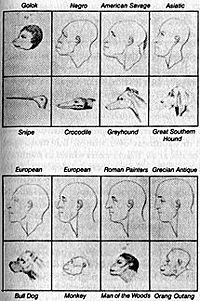
Consider this drawing that appeared in Charles White’s An Account of the Regular Gradation in Man, and in Different Animals and Vegetables (1799). On the bottom of the image (but the top of the chain) are types of Europeans, Romans, and Greeks. On the top (but the bottom of the chain) are “Asiatics,” “American Savages,” and “Negros.” White wrote: “In whatever respect the African differs from the European, the particularity brings him nearer to the ape.”
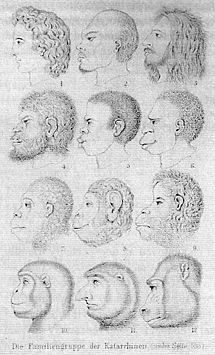
Nearly 70 years later, in 1868, Ernst Haeckel’s Natürliche Schöpfungsgeschichte was published. in the book, this image appeared (his perfect person, by the way, was German, not Greek):
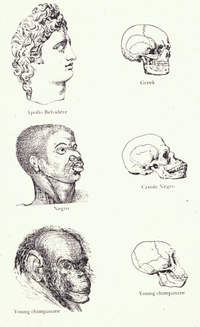
In this image, we see a depiction of the great chain of being with Michelangelo’s sculpture of David Apollo Belvedere at the top (the most perfect human), a black person below, and an ape below him.
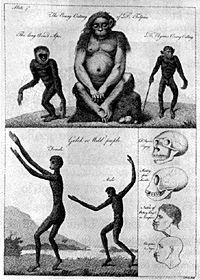
Notice that there seems to be some confusion over where the chain ends. Indeed, there was a lot of discussion as to where to draw the line. Are apes human? Are blacks? Carolus Linneaus, that famous guy who developed the classification system for living things, wasn’t sure. In his book Systema Naturae (1758), he published this picture, puzzling over whether the things that separating apes from humans were significant.
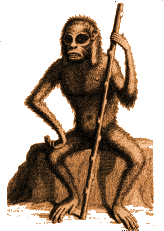
In this picture (also appearing in White 1799) are depictions of apes in human-like positions (walking, using a cane). Notice also the way in which the central figure is feminized (long hair, passive demeanor, feminized body) so as to make her seem more human.
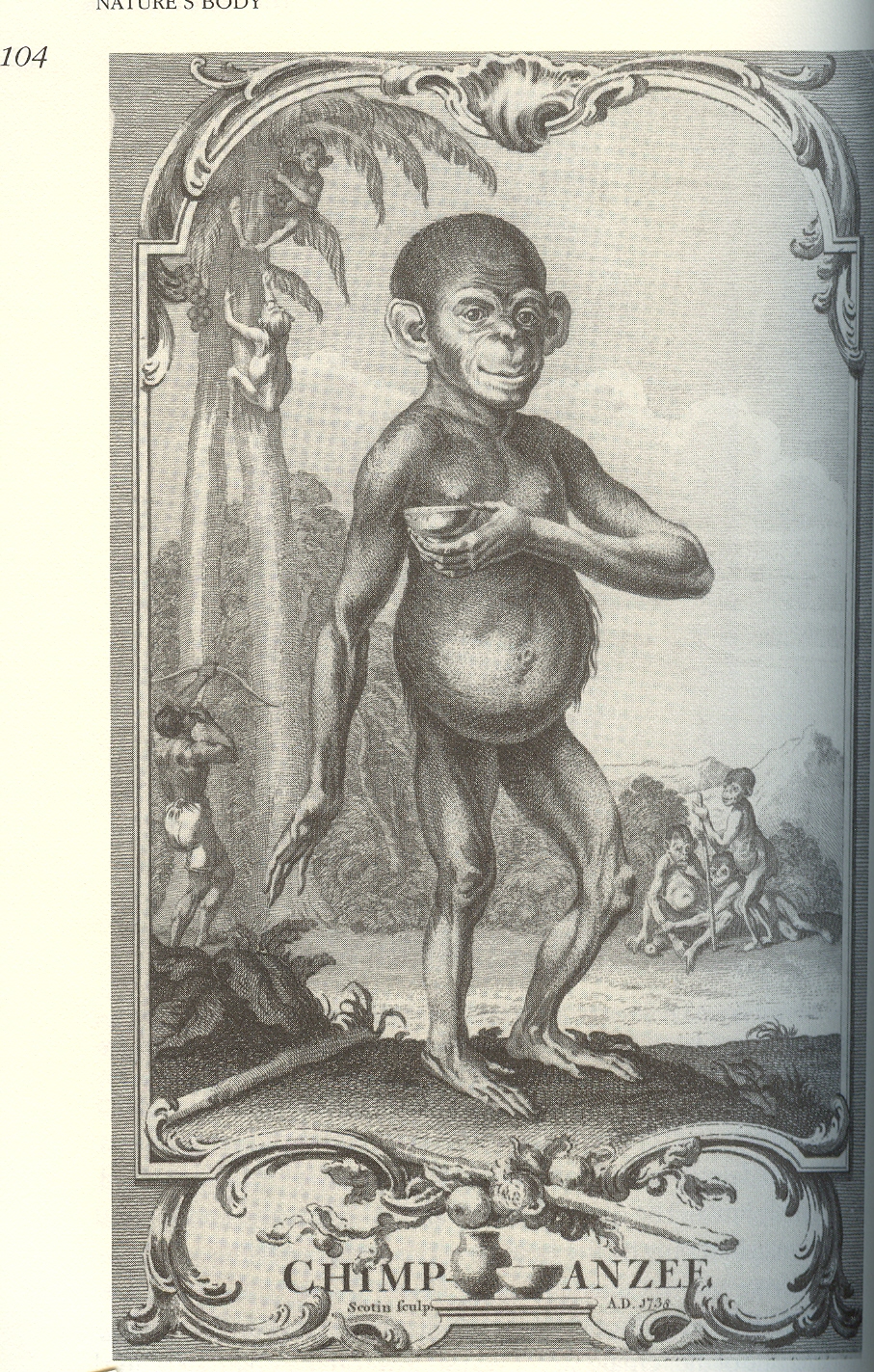
Here we have a chimpanzee depicted drinking a cup of tea. This is Madame Chimpanzee. She was a travelling attraction showing how human chimps could be.
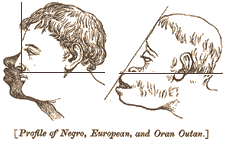
In any case, while they argued about where to draw the line, intellectuals of the day believed that apes and blacks were very similar. In this picture, from a book by Robert Knox called The Races of Men (1851), the slant of the brow is used to draw connections between the “Negro” and the “Oran Outan” and differences between those two and the “European.”
The practice of depicting the races hierarchically occurred as late as the early 1900s as we showed in a previous post.
NEW! Nov ’09) The image below appeared in the The Evolution of Man (1874 edition) as part of an argument that blacks are evolutionarily close to apes (source):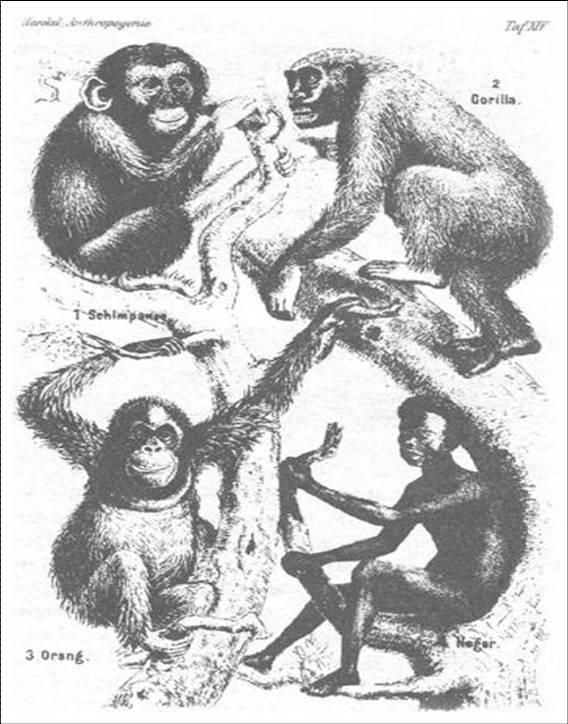
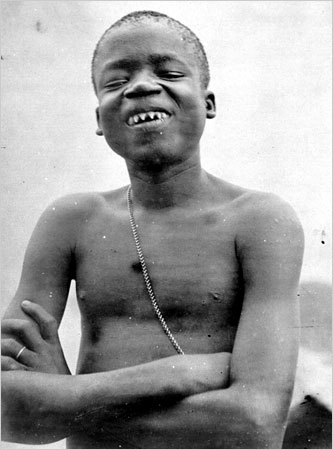
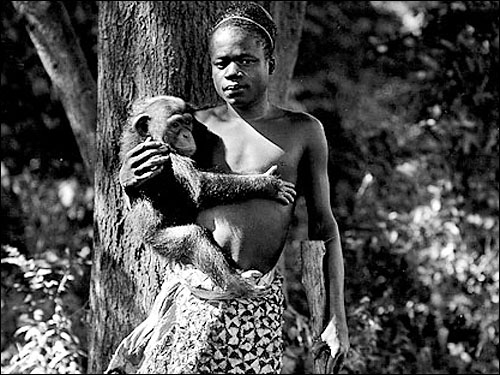
During this same period, African people were kept in zoos alongside animals. These pictures below are of Ota Benga, a Congolese Pygmy who spent some time as an attraction in a zoo in the early 1900s (but whose “captivity” was admittedly controversial at the time). (There’s a book about him that I haven’t read. So I can’t endorse it, but I will offer a link.) Ota Benga saw most of his tribe, including his wife and child, murdered before being brought to the Bronx Zoo. (It was customary for the people of his tribe to sharpen their teeth.)
The theorization of the great chain of being was not just for “science” or “fun.” It was a central tool in justifying efforts to colonize, enslave, and even exterminate people. If it could be established that certain kinds of people were indeed less than, even less than human, then it was acceptable to treat them as such.
This is a “generalizable tactic of oppression,” by the way. During the period of intense anti-Irish sentiment in the U.S. and Britain, the Irish were routinely compared to apes as well.
So, there you have it. Connections have been drawn between black people and primates for hundreds of years. Whatever else you want to think about modern instances of this association — the one Wade and her child are suffering now, but also the Obama sock monkey, the Black Lil’ Monkey doll, and a political cartoon targeting Obama — objections are not just paranoia.
(I’m sorry not to provide a full set of links. I’ve collected them over the years for my Race and Ethnicity class. But a lot of the images and information came from here.)
Lisa Wade, PhD is an Associate Professor at Tulane University. She is the author of American Hookup, a book about college sexual culture; a textbook about gender; and a forthcoming introductory text: Terrible Magnificent Sociology. You can follow her on Twitter and Instagram.
Comments 99
Tim — June 18, 2008
In Valades' picture there doesn't appear to be any racial variation in the human tier.
That isn't Michelangelo's David, that is Apollo Belvedere, it even says it right below the picture. Notice it says Greek underneath the corresponding skull. The illustration is not of the great chain of being. Discussion of this pic and book it comes from here: http://books.google.com/books?id=WRL6MbBO024C&pg=PA190&lpg=PA190&dq=apollo+belvedere+negro&source=web&ots=h7tEKg5C79&sig=tvKjbkfYIWtftgQ2XVErMsr2Zg8&hl=en&sa=X&oi=book_result&resnum=1&ct=result
For more on the great chain of being peep the references for this:
http://en.wikipedia.org/wiki/Great_Chain_of_Being
Tim — June 18, 2008
Valades' drawing has humans horizontal, not vertical and there is no apparent racial variation.
"The predominant colonial theory of race was [inspired by] the great chain of being" Arthur Lovejoy: The Great Chain of Being: A Study of the History of an Idea
"In this image, we see a depiction of the great chain of being with Michelangelo’s sculpture of David at the top (the most perfect human), a black person below, and an ape below him."
That's Apollo Belvedere, it says so right under it. It is not a depiction of the great chain of being but an illustration from Types of Mankind, a book from 1854.
Gomi — June 18, 2008
In the first image, from Valades, I only see one rank of people. God -> Angels -> Human -> Birds -> Fish -> Land animals -> Plants.
I also see no horizontal ranking among the humans in that image, as I see European monks in robes to both sides of the chain (immediate left and far right, in relation to the chain and reclining woman). I can't quite distinguish the other individuals, but I would not expect the monks to be scattered in any ranking.
No denying the intent of most of the other images, though.
Red Jenny — June 18, 2008
Good post. I used one of the same images in my post here: http://redjenny.blogspot.com/2008/01/argument-against-essentialist-modes-of.html where I note we still use Linnaeus' system of classification today. These ideas seems so archaic to us (we laugh and think "how silly!"), but they still have purchase, as can be seen by the Obama sock doll.
Elena — June 18, 2008
See also the sad story of Saartjie Baartman, the "Hottentot Venus".
Lisa Wade, PhD — June 18, 2008
Hi all,
The term "great chain of being" was, indeed, used to describe the relationship between God, humans, and the other animals and plants, as well as the relationship among humans. So that's what you see in the first image and you can find more like that. Sorry I didn't make that more clear.
Tim, that's for the correction on David/Apollo. I fixed it in the text.
Will — June 18, 2008
If I may be excused for being a pedant for just one moment, I should point out that it is not hard to draw a connection between people of color - or any person, for that matter - and primates, because humans are primates!
That said, an interesting post. When considering discrimination, it seems like it can be helpful to understand the background of it. I found the inclusion of "American Savages" alongside "Negroes" interesting. It seems to me that Native Americans were also considered subhuman and treated as such, although they were never used wholesale as slaves. I wonder which was thought closer to the primordial source - one suitable only for manual labor, the other only for extinction.
Sad stuff.
Sociological Images » OBAMA SOCK MONKEY TOY — June 19, 2008
[...] Slutcake on STRAWBERRY SHORTCAKE: EXTREME MAKEOVER EDITIONWill on BREAKFAST… IN BED?Will on WHITES, BLACKS, & APES IN THE GREAT CHAIN OF BEINGDamon on OBAMA SOCK MONKEY [...]
Sociological Images » “AFRICANS” AS PROPS FOR WHITE FEMININITY — October 9, 2008
[...] I would write for this post here. You might also want to look here and here and here and also here for historical context. I will only add [...]
Sociological Images » NEW YORK POST MONKEY/STIMULUS BILL CARTOON — February 18, 2009
[...] course, there’s some historical context here. As this post illustrates, there is a long history of Africans and African Americans being portrayed as ape-like, [...]
Allan — April 23, 2009
i believe one day all of u who link humans to ape will be accountable to God.black and white have two eyes,two ears,a nose, 32teeth,10fingers,10toes,an anus,a dick or pussy.we all shit,we all eat,we think,we smell, we touch,we fuck and bring out off spring.with all these similarities idots like some of u will believe that whites are better thank blacks.to the extent of comparing blacks to apes?some of u will pay dearly by comparing God to apes,because he created everyone in his image and likeness.
V for Vegan: easyVegan.info » Blog Archive » Intersectionality ‘Round the Interwebs, No. 4 — July 8, 2009
[...] black people, especially black women, with animals (see here, here, here, and here), as well as the historical roots of this discourse. But, in this case, the advertising uses both black and white, male and female models. [...]
Black “Lil’ Monkey” Baby Doll » Sociological Images — August 16, 2009
[...] of black people with monkeys and apes have been used for centuries to make them seem less-than-human and justify hatred and exploitation. This associations continue [...]
From the Publisher – Costco pulled the Black “Lil’ Monkey” baby doll from its shelves, along with its white “Pretty Panda” « The Political Agitator — September 10, 2009
[...] of black people with monkeys and apes have been used for centuries to make them seem less-than-human and justify hatred and exploitation. This associations [...]
Can’t Pay The Phone Bill, Can’t Pay The Rent « I Wanna Do Right But Not Right Now — December 8, 2009
[...] Whites, Blacks & Apes [...]
Racism in Bull Durham Tobacco Ads » Sociological Images — December 31, 2009
[...] see these posts: one, twp, three, four, five, six, seven, eight, nine, ten, eleven, thirteen, fourteen, fifteen, sixteen, seventeen, and [...]
The Walmart Barbie Scandal » Sociological Images — March 12, 2010
[...] in three different races, but the black doll carried connotations that the others did not because black people have been compared to primates for centuries in an effort to dehumanize them. A black Lil’ Monkey is wholly inappropriate in a way that [...]
W.P. — May 12, 2010
Our specie can be prejudice, and ignorant.....maybe one day we will realize we are not as important as we would like to think we are...
Some humans still make slaves out of girls and boys, and it doesn't matter the color.....
Barry Watson — January 9, 2011
Jean Vanier writes:
The history of humanity is a history of wars, oppression, slavery, and rejection. Every society in every time has created its own form of exclusion.
There is an endless list of those whom we may exclude; every one of us, we may be sure, is on someone’s list: the homeless, the sick, the dying, the young, the old, the weak, the disable, the immigrant, those with AIDS… FEAR IS AT THE BASIS OF PREJUDICE AND EXCLUSION..
Commentary: we all desire to ‘belong’ to society, but when we are blatantly excluded and become victim to it, we become prey, so try to chose how we belong, as Jean Vanier states ‘belong to humanity’ not groups, for groups reflect ‘like mindedness’. Read more from ‘Becoming Human’ by Jean Vanier.
quick thing to print | Elmercqegs's Blog — April 8, 2011
[...] http://thesocietypages.org/socimages/2008/06/18/whites-blacks-apes-in-the-great-chain-of-being/ lisa wade [...]
Because there are no racists « Irene's Daughters — April 16, 2011
[...] [ht Sociological Images] [...]
Hermit980 — June 22, 2011
Race theories were perhaps inspired by the Great Chain of Being, but the GCoB says nothing about races. It is the "order" of nature "created by God" and tending to follow the six days of creation. Man is on top because that is what the bible says (not that I agree, just historically that is what is). Thus the GCoB goes from minerals to God. There are some images that break down man in to men and women (guess who is closer to god in that one??), but none that depict the races.
I would add that there were some important figures during the period who were not racists, specifically Petrus Camper, who invented the facial angle, and John Hunter, who also claimed to have invented the same angle. That Robert Knox would misuse it does not impugn Camper or Hunter. Camper went so far as to suggest that we are all Black, that in fact, being white may be the "other."
And where in all this are the lovely views of Buffon?
“Ape Has Killed Ape”… Again! « Notes from the Margins — September 24, 2011
[...] scientific reality under religious dogma. It was because of such a duality that the cosmological “Great Chain of Being” influenced the thinking of Swedish botanist Carolus Linneaus when in the early 1700s he devised the [...]
Bijelci, crnci i majmuni u velikom lancu postojanja » Centar za društveno-humanistička istraživanja — January 22, 2012
[...] Lisa Wade Prevela: Marija Šarić Izvor: http://thesocietypages.org/socimages/2008/06/18/whites-blacks-apes-in-the-great-chain-of-being/ Posted by Admin on siječanj 22, 2012 at 7:47 poslijepodne var addedComment = [...]
Major_Ray — March 21, 2012
My beloved brothers and Sisters:
This ungodly exploitation of man in the name of science is unfortunate. The bible describes man as a "fool" for good reason. Man's belief in evolution shows you how misguided he is under the guise of intelligence. True wisdom only comes from God. My greatest joy is being a Genesis creationist with a PhD in chemistry from one of America's best universities. My book, the Genesis molecule 2012, uses over 700 references to proof that we were created from the "dust of the earth". Science is proven using the Genesis hypothesis and not the traditional way where man's so-called wisdom is used to prove God. Original man gave birth to two seeds (good and evil)and from himself, the woman was formed. In this way Jesus redeemed all who enters the matrix as a unique soul. Any other version of this is a lie! Stop relying on the foolish intellect of fallen men and seek wisdom from the Word of God through His Holy Spirit. Science, which is partial truth, can lead one to self-righteousness and eternal dealth. The lie of evolution and racial thought is being challenged by very intelligent scientists, who know God.
Peace Brothers and Sisters
Tony Thannisch — May 1, 2012
ha ha ha the entire world know it.
SarahSonic — July 12, 2012
Hi all. I have been keeping a board on pinterest on the "ascent of man" - images of human evolution. Interesting how in every scheme the skin gets lighter from "monkey" to "man". Also continues to be ubiquitous in advertising, etc. Would love contributions to the board.
http://pinterest.com/sarcl5/ascent-of-man-images/
Thanks Lisa for another interesting post!
SarahSonic — July 12, 2012
Hi all. I have been keeping a board on pinterest on the "ascent of man" - images of human evolution. Interesting how in every scheme the skin gets lighter from "monkey" to "man". Also continues to be ubiquitous in advertising, etc. Would love contributions to the board.
http://pinterest.com/sarcl5/ascent-of-man-images/
Thanks Lisa for another interesting post!
SarahSonic — July 12, 2012
Hi all. I have been keeping a board on pinterest on the "ascent of man" - images of human evolution. Interesting how in every scheme the skin gets lighter from "monkey" to "man". Also continues to be ubiquitous in advertising, etc. Would love contributions to the board.
http://pinterest.com/sarcl5/ascent-of-man-images/
Thanks Lisa for another interesting post!
Sarah — July 12, 2012
Hi all. I have been keeping a board on pinterest on the "ascent of man" - images of human evolution. Interesting how in every scheme the skin gets lighter from "monkey" to "man". Also continues to be ubiquitous in advertising, etc. Would love contributions to the board.
http://pinterest.com/sarcl5/ascent-of-man-images/
Thanks Lisa for another interesting post!
Gilbert Pinfold — July 12, 2012
My understanding is that scientific progress is bound to provide empirical answers to all questions of human evolution.
Guest — July 13, 2012
An aside, but does anyone know what the relevance of the ring on Ota Benga's left ring finger is/was?
Yrro Simyarin — July 13, 2012
Re: the Obama monkey.
Obviously George W. Bush was often compared to a monkey, but this was not considered offensive, because it was obvious that he himself was being parodied, not his race...
Is there any way to separate the intent of the artist as to whether they were making fun of *just* Obama, or of black people in general? Comparing law-makers to monkeys is almost a time honored tradition.
glaborous_immolate — July 13, 2012
It made sense at the time. Better than the silly bible with that story of all of us coming from one man
" It was a central tool in justifying efforts to colonize, enslave, and even exterminate people."
I wonder if it was not just a tool for justifying colonization, but a motivation for colonization. Like, apart from that view of other people, colonization or extermination would not have really occurred to Europeans.
Lavi — July 13, 2012
Man, read an entire book about the old science of races back in this time. Perfect example of how bias, conscious or not, can alter data and interpretation so significantly. In some cases, one couldn't tell whether the 'scientist' was deliberately fabricating false data, being selective of what data to use particularly using extremes to demonstrate averages, or aware that their methodology was flawed from the start. Sometimes you could feel the desperation as they tried to fit the data to what they knew was right. It is quite impressive in a sad way.
egmond codfried — October 19, 2012
Racism is a liberation ideology. The Blacks they were showing as apes were the nobles who identified as Blacks with little heraldic Moors, classical Africans. The regent class writers of the enlightenment wanted to free Europe from the Ancien Regime, and used racism as a religion to inspire white serfs, they sided with. Blue blood was black blood (1100-1848) and whites were only emancipated in 1848.
Egmond Codfried
Curator Suriname Blue Blood Is Black Blood Museum
The Hague, The Netherlands
Bluebloodisblackblood.blogspot.com
Farkas — June 6, 2013
But Black people are primates. Irish people are apes. You, Lisa, are an ape as well.
Sticking Up For Snow Monkeys (a response to Caitlin Moran) | the triffid garden — July 5, 2013
[...] female nobles, and so on and so forth until we get to the poor, and then the female poor, and then black people, and then animals, starting with lions and ending at slugs. This ideology has had millennia to [...]
I Stand with Otis Carey - ~Cori Schumacher: State of Flux~~Cori Schumacher: State of Flux~ — April 17, 2014
[…] an ape or a monkey is arguably the oldest racist slur on the planet. Such descriptions were used as “…a central tool in justifying efforts to colonize, enslave, and even exterminate people.… But hindsight is twenty-twenty. What we know today as dangerous bullshit was once normal, accepted, […]
Justin_Igger — July 3, 2014
Breaking news: n1ggers are unevolved apes.
More breaking news at 11.
A. Nonymous — July 29, 2014
I wonder if the kid said to be the link between orangutans and humans was actually black, as it seems to have been assumed. I'd find it more likely if he/she was ginger. The most common ape species that blacks are compared to are chimpanzees and gorillas, even though the former is often also white skinned.
Potter — March 10, 2015
'the association of Black people with primates'. Black and white alike, all humans are classified as primates.
They want to deny his humanity: Obama’s tears, white rage and the right’s phony new line – The Fifth Column — January 18, 2016
[…] less “emotional” and consequently more “intelligent.” Blacks were at the bottom of this “Great Chain of Being” because white race scientists and others concluded that people from Africa were “animal-like,” […]
BigBob728 — April 22, 2016
The flaw in your point is that it is completely backward. Human life, as created by God, imbued with the spirit of God, was created on the continent of Africa. The Garden of Eden, as described in the Bible would be in modern-day Iraq. A place were rivers flows and fruits and vegetables abound, where other species of life can thrive. From this, all non-white humans emerged. Asians grew to have slanted eyes due to the nearness of the sun. Skin tones changed to adapt to climate. For Hundreds of thousands of years, Man migrated and traveled freely among other men throughout the world. The wonders of the earth were discovered and shared and God's presence was felt by all. We know these things to be true because all of the 7 Wonders of the Earth are in places where it is warm or non-frozen; the maps that detail the land below the polar ice caps were found in Africa. The religious scrolls of all religions (all the same but for a few regional differences) are from Africa.
Then comes the white "man" about 10 thousand years ago, emerging from caves of darkness in the frozen sections of the earth. This white "man", devoid of pigment and lacking a bone that all other humans have, has done nothing but rape, pillage, lie, steal, enslave and conquer, He has never peacefully assimilated with any other group of humans on the planet. NEVER! Not EVER! The reasons for this are simple. The white "man" is not the same as the rest of humanity. He is the only human that grows hair all over his body. His hair falls down his skin and covers the bare areas, it doesn't stand up like all other humans. The white "man's" skin burns when exposed to the sun, because he has no, or little, pigment. This is a trait of apes, not humans. The white "man" is allergic to many things; fruits, nuts, seafood...this would indicate that he is not even from this planet! The white "man" craves milk, while most other humans are lactose intolerant, lending itself to a more animalistic origin. seriously, cows and bulls don't even drink milk.
On a final note, why does the white "man" cause so much destruction and death? He has extincted animals, flora and fauna. He has eliminated species of fish, and is currently in the process of rendering the earth uninhabitable for all life, save for roaches and the like. Why are we still using fossil fuels? Because it makes the white man rich. Why do we still pollute the air and seas? Because it's cheaper tan the alternative, which makes the white man rich.
And why are all the riches of Africa i,e, Gold, Diamonds and other precious stones, in the hands of the white man?
It was the white man that created money, and money is the root of all evil. So it was the white man that brought evil into the world.
So, before white folks start calling the white "man" superior to other races. Ask yourself these questions.....
Julie Ann — July 28, 2017
I can't figure out exactly what species negros are. They are not animal, but they are not human either
Hallie Eva Mae Newcomb — July 30, 2017
The illustrator had obviously never seen a black person in his life nor had this he seen a black persons skull. "black" and "white" Skulls are indistinguishable to anyone but an anthropologist.
Gary Francione's Moral Realism - Sope Stream — January 13, 2018
[…] hundreds of years though, on a wide range of topics—eg slavery was congruent with the idea of a Great Chain of Being—so congruence is a helpful, but not compelling piece of evidence for a particular […]
Campuses Are Not Sovereign Nation-States – A WordPress Site — May 22, 2018
[…] only is the sock-monkey itself a manifestly racist symbol (echoing the colonialist project of comparing blacks to apes in order to justify their exploitation and repeating many of the stereotypes of blackface […]
Gary Francione's Moral Realism | Sope Stream — January 3, 2019
[…] hundreds of years though, on a wide range of topics—eg slavery was congruent with the idea of a Great Chain of Being—so congruence is a helpful, but not compelling piece of evidence for a particular […]
Dislike Groups Love Ancient Greece and Rome. Scholars Are Pressing Back. - Science and Tech News — May 29, 2019
[…] Greeks and Romans as these paradigmatic white civilizations,” McCoskey states. One well-known example contrasted the head of the Apollo Platform with cartoonish representations of a black guy and a […]
How scholars are pushing back on hate groups' embrace of antiquity - Hellas Life — May 31, 2019
[…] on the Greeks and Romans as these paradigmatic white civilizations,” McCoskey says. One notorious example contrasted the head of the Apollo Belvedere with cartoonish depictions of a black man and a […]
Unbroken — July 17, 2019
African people did not originate from apes or monkeys...its proven in their genes. Caucasians, however, and the other races did. They also have rat, wolf and musrat dna...
Hate Groups Love Ancient Greece and Rome—Scholars Are Pushing Back — October 2, 2019
[…] on the Greeks and Romans as these paradigmatic white civilizations,” McCoskey says. One notorious example contrasted the head of the Apollo Belvedere with cartoonish depictions of a black man and a […]
motivation456 — November 3, 2019
very nice inspiration quotes about changes-motivation456
Hate Groups Love Ancient Greece and Rome. Scholars Are Pushing Back. | Racial Sin in the Church - A Call to Repentance — December 13, 2019
[…] on the Greeks and Romans as these paradigmatic white civilizations,” McCoskey says. One notorious example contrasted the head of the Apollo Belvedere with cartoonish depictions of a black man and a […]
Racism, Slavery and the BLM – home of the kissel report — July 23, 2020
[…] A drawing appeared in Charles White’s An Account of the Regular Gradation in Man, and in Different Animals and Vegetables (1799). On the bottom of the image (but the top of the chain) are types of Europeans, Romans, and Greeks. On the top (but the bottom of the chain) are “Asiatics,” “American Savages,” and “Negros.” White wrote: “In whatever respect the African differs from the European, the particularity brings him nearer to the ape.” https://thesocietypages.org/socimages/2012/07/12/whites-blacks-apes-in-the-great-chain-of-being/ […]
Anonymous — October 18, 2020
Nonsense
Neeraj Kumawat — March 6, 2021
This is very interesting, You’re a very skilled blogger. BA 2nd Year Result 2021
African — March 10, 2021
Black is not a race. Negroid might be but black is not a race. It is a culture and social construct created during the height of racism and segregation. If Black were a race, mixed race people would not be called "black". If Black referred to the negroid race, Melanesians and Asians who are related to Australoid and Mongoloids would not be called "Black". Also, Ethiopians and Somalis wouldn't be called black if black referred to the Negroid race. Black is not a race. Africans are Africans, yes most of us are Negroids but not Black as black is not a race but a culture, related to slave descendants across America
Ned J. Casper — May 6, 2021
The problem arises not from pigment but prognathism.
The hair of Caucasoids is closer to that of chimpanzees than that of Negroids.
Regarding "race" (and "gender") as social and/or genetic concepts, see the studies by Sarich & Miele, Cavalli-Sforza, Garn, Rushton & Lynn
Know your place — September 17, 2021
Remember your history coon
Negroes and black lovers need to read more books like this to learn and know their place in a jungle
Ps apes also has 2 eyes 10 fingers 1 nose 2 ears….
B. True — January 7, 2022
Honkee folk who come up with this shit will tell you that not one of them has committed a crime, that they do not come from monkeys/apes, and that they are the smartest people on the earth, especially than blacks, and perpetrate that they all had worked hard for their money, earned every dime and that they are the hardest working, non-lazy and self made people of the world...a world that knows neither of these characteristics is true of transparent people whose only job smd preoccupation has been to kill, steal from others and take the credit for their work
williamgozilla — February 3, 2022
asd
williamgozilla — February 3, 2022
This is very interesting, You’re a very skilled blogger. slot online tergacor
sexy gaming ติดต่อ — February 23, 2022
Thank you for the good things you have brought. I will come back to visit your blog again. sexy gaming ติดต่อ
Whose lives really matter? How racism colors coverage of the crisis in Ukraine - planetcirculate — March 11, 2022
[…] As sociologist Lisa Wade wrote in 2012: […]
Whose lives really matter? How racism colors coverage of the crisis in Ukraine - Commerceaffairs — March 11, 2022
[…] As sociologist Lisa Wade wrote in 2012: […]
ติดต่อ ag gaming — May 26, 2022
Weighing was the news that really attracted me to stop reading. ติดต่อ ag gaming
Karl Coogan — October 14, 2022
I'm no scientist, but my eyes do work very well - and there's no denying that many black people visually resemble monkeys. It's a harsh truth, but it is still the truth. Anyone who denies it is lying.
BigBlackMan — March 5, 2023
Ever looked at ron pearlman? Many whites also resemble apes Karl Cooganand your hairs are more apelike than any blacks as well as yor skin. an apes skin is pale and pinkish and delicate like yours underneath all that fur.
A harsh truth is your "white" people are devils and plagues upon the earth that will ultimately result in the end of humanity due to your own greed.
And a lot of you motherfuckers are ugly as all fucking get out so stop with the bullshit im tired of it. Ugly motherfuckers with wrinkled burned leathery skin. Fuck OUT of here.
Yeah harsh truth bitch
123vip — April 5, 2023
I’m the kind of person who shows appreciation for good articles when I find it deserving. You deserve to know you’re a very good writer.
123vip
Uncle Tom — May 3, 2023
COMMENT
Uncle Tom — May 3, 2023
DUPLICATED COMMENTDELETED
ebet ทดลองเล่น — May 9, 2023
want to see you your article is good i want to talk to you. ebet ทดลองเล่น
SMM Panel One — August 1, 2023
SMM Panel One is your one-stop solution for skyrocketing your social media presence and success. With our cutting-edge Social Media Marketing (SMM) panel, you can harness the power of various platforms to elevate your brand, engage your audience, and drive unprecedented growth. From increasing followers, likes, and comments to generating buzz around your content, our platform offers a seamless and efficient way to conquer the digital landscape. Boost your social media game with SMM Panel One and witness the magic of organic reach and genuine interactions like never before!
SMM Panel — September 18, 2023
Building a strong online following can be a game-changer, and SMMPanel2 understands this. They provide a platform where you can get Free Followerseasily and efficiently. It's a valuable resource for both individuals and businesses looking to expand their reach.
Manita — September 25, 2023
It’s so sad are you white peoples always trying to cover yourself by using blacks as you already know look at an animal like dogs and cats and any other animals you look just like them share the same hair type and eye color come on now and also think like them you have children with your children brother and sister you don’t see blacks behave that way that animals instinct we don’t think like animals look white you white peoples are likes a fricks your even having sex with animals the reason you come up with that it’s because you think peoples don’t see you peoples as the animals as you are my every time you have sex with your dog feel your hair and his hair than you’ll come back and apologize to real human look at our hair we don’t have the same hair ripe and Pink sling like animals I’m a caregiver when you white peoples bleed your blood turn purple as soon as it’s hate the hair just like animals blood se blacks where bleed our blood stay red when hate the air it’s cloudy that’s how human blood suppose to be you white peoples always try to explore as you white peoples already know you nothing but the devil look at you you can’t even do anything with out us hold your hand you can even do anything with out a book can’t even wipe your own ass with out us because you don’t know how to do anything if anything you are the Apes because you can’t make any sense on anything you peoples don’t built or make anything you peoples have no common sense at all look at us we don’t need books to teach us how to live honestly I fell sorry for you worrying about us while we are living our best life to you living your best life it’s to have lots of money that you kill for everything you white peoples have are stolen from blacks you white peoples don’t even have any brains like animals specially dogs you can be train like any animals we blacks we do thinks when we good and ready you know what so sad about you white peoples you have no self esteem that’s the reason you trying your best to make peoples look inferior than you because you know that we know you have no personality and no self's team why do you think white women gos after our black man we black woman we don’t need white man because our black man have full package nothing is missing they don’t need to buy anything to make their dick bigger you know it’s so funny how you white peoples are buying but’s and boobs so you can look like us at the same breath you calling us Apes the Apes it’s you my dear you don’t have pinck skin you do we don’t have hair like animals you do I’m not sure if you can remember that dog comercial where they where combing the dog hair looks just like your hair you see it’s because you white peoples have no brains that the reason you trying to let’s us blacks know that you are not human but an animal why do you think you go against humanity killing six million of your own peoples kill the Americans Indians for their land keednappe blacks from Africa sale them all over the world like animals rape and beating you white peoples are nothing but a bunch of rapist you don’t haves to hide by saying this things my dear the all world already know you are not human you don’t see no other race with so much hatred except you white peoples because all white peoples are mentally ill that’s the reason you behave that way how wonder how you white peoples can do any research you can’t even comprehend anything with out the black man hold your hand so let’s be honest who’s the Ape you or blacks remember now we have black skin not pink our hair are kinky not silk like animals like the Ape you see my dear you not bright enough otherwise you wouldn’t start something you have no idea what you talking about as usual remember now you have no brains so there for you can’t think like us blacks the real human you don’t see no black try to be white do you I bet you probably buying a pair but there you are talking a lot of shit I know because you are empty hade that’s what you what peoples do if you can get some brains than make comente you keep forgetting you have no brains or comen sense why do you think you stilling from the black to buy your children diploma from school they never attended because you white peoples can’t learn an other for you to learn you have to have a brain why do you think you still kill our black children up until today after 500 hundred years you can’t help yourself killing and cruelty are your sports honesty I feel sorry for you
KEMET — October 21, 2023
The Egyptians created all of you from apes! Tamahu! We do grow tails, you'll do. We don't have fur for hair. We don't get lice fleas you do. We do not have RH blood or Neanderthal! If you ever bother to pick up a book you would know in Seti 1's tomb they discovered Europeans came from monkeys the Tamahu!
KEMET — October 21, 2023
The Egyptians created all of you from apes! Tamahu! We don't grow tails, you'll do. We don't have fur for hair. We don't get lice fleas you do. We do not have RH blood or Neanderthal! If you ever bother to pick up a book you would know in Seti 1's tomb they discovered Europeans came from monkeys the Tamahu!
watches — November 14, 2023
women watches
Scholars Are Pushing Back against Hate Groups That Love Ancient Greece and Rome - Brewminate: A Bold Blend of News and Ideas — April 18, 2024
[…] the Greeks and Romans as these paradigmatic white civilizations,” McCoskey says. One notorious example contrasted the head of the Apollo Belvedere with cartoonish depictions of a black man and a […]