
Since we’ve been on the topic of language (see yesterday’s George Carlin post), I thought I’d add something sent in by Z of It’s the Thought that Counts, who first read about it here. The conservative Christian organization American Family Association has a website called OneNewsNow where they post various news stories. Apparently the website has a filter to automatically replace the word “gay” in any news stories with the word “homosexual.” This became apparent when a news story about an athlete named Tyson Gay was posted with his last name changed to Homosexual in both the title and the text. Here is a screenshot (found here) of the original post from OneNewsNow:
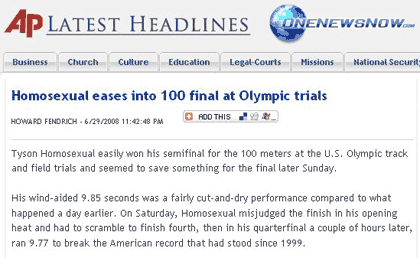
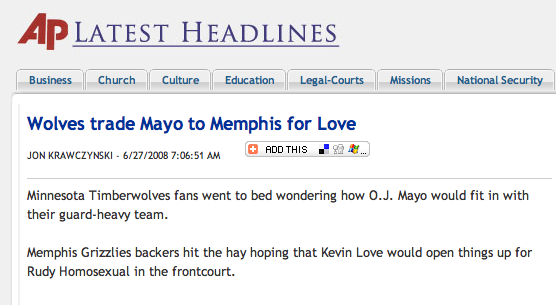
The story has since been corrected. But as FriendlyAtheist points out, they have not corrected “Rudy Homosexual” in this sports story (thanks to Jon for the screenshot):
What is the symbolic power of saying “homosexual” instead of “gay”? What is the cultural difference between those two words? Is it an attempt to keep the focus on sexual activity? For some reason “homosexual” sounds more derogatory to me, but I’m not sure why–probably just because it’s used more by those opposed to gay rights, so I’ve come to associate it with an anti-gay ideology.
This might be interesting for a discussion of discourse and language in political movements generally, as well as conflicts around gay and lesbian issues specifically. Groups always try to frame issues to make their position sound more appealing, and a major way of doing this is through language. Think of debates about abortion–the differences between “pro-abortion” and “pro-choice” as well as “pro-life,” “anti-abortion,” and “anti-choice,” are symbolically meaningful, and different groups choose to use some of these terms rather than others in an effort to make themselves seem appealing and rational and the other side unappealing and radical. I suspect something similar is going on with “homosexual” vs. “gay.”
Thanks, Z!
UPDATE: In the comments to this section, Sanguinity made some great points about the differences between “gay” and “homosexual”:
“Homosexual” is the clinical term, and was used to pathologize gays and lesbians — it’s meant to invoke all that psychiatric-illness stuff. Also, the term focuses on sexual behavior, completely sidestepping romance, relationships, communities, cultures, and other sympathy-generating aspects of pershonhood. Additionally, by focusing on behavior above identity, it allows one to write entire articles with the implicit assumption that being gay is a choice: i.e., one isn’t gay, one chooses to engage in homosexual activities. That last item is especially important — while “gay” and “homosexual” may look like synonyms, they aren’t quite. “Gay” is a noun; “homosexual” is an adjective.
Thanks for the elaboration, Sanguinity!
Comments 21
Jon Smajda — June 30, 2008
First off, that's really funny. Second, here's a screenshot. On a Mac:
- Control-Shift-3 takes a screenshot of the entire screen
- Control-Shift-4 lets you draw a box around a specific area of the screen.
Also, isn't the headline "Wolves trade Mayo to Memphis for Love" just hilarious in it's own way, too?
Sanguinity — June 30, 2008
Anti-gay agitators prefer "homosexual" for several reasons.
"Homosexual" is the clinical term, and was used to pathologize gays and lesbians -- it's meant to invoke all that psychiatric-illness stuff. Also, the term focuses on sexual behavior, completely sidestepping romance, relationships, communities, cultures, and other sympathy-generating aspects of pershonhood. Additionally, by focusing on behavior above identity, it allows one to write entire articles with the implicit assumption that being gay is a choice: i.e., one isn't gay, one chooses to engage in homosexual activities.
That last item is especially important -- while "gay" and "homosexual" may look like synonyms, they aren't quite. "Gay" is a noun; "homosexual" is an adjective. Both can double in the other role, but they default in slightly different directions. Go look at a family-values website sometime and try to do a S&R from "homosexual" to "gay" -- you'll find that some articles shift meaning slightly, tacitly endorsing the notion that sexual orientation is an identity, even while nominally arguing that orientation is a choice.
bobbem — July 1, 2008
The Associated Press allows news outlets to change the words in their stories?!? Doesn't that infringe on some copyrights?!?
anthro.pophago.us » del.icio.us links for 2008.07.01 — July 1, 2008
[...] Sociological Images » “HOMOSEXUAL” VS. “GAY”: DISCOURSE IN THE CULTURE... [...]
Fermi — July 1, 2008
What about the other derogatory meaning of the word "gay?" Like: "That is so gay." or "Because he's gay." where gay actually indicates "rediculous" "dumb" or something of that nature.
Sara — July 1, 2008
Fermi: Most news outlets aren't run by teenagers, who I think are the ones who most commonly use the word "gay" in a derogatory sense. I've never heard it come out of an adult's mouth like that.
Sanguinity — July 1, 2008
Fermi, Sara: There's a big difference in intent/assumptions behind derogatory uses of "homosexual" and "gay."
Those who use "homosexual" have a socio-political agenda that there is no such thing as "gays" or "lesbians" -- that it's not a valid identity. In their construction, there's only deviant sexual behavior, and that behavior is an indicator of illness / sin / obstinancy.
Those who say "that's so gay" don't have a strong socio-political position on whether or not gays exist, and in fact, are quite happy to posit that they do. However, they do assert that gays are less masculine than 'true' men, and that their lack of "true" masculinity diminishes them. "That's so gay" is the updated version of calling a man a "pussy" or a "cocksucker", but has the convenience of not being "dirty" language, and thus can be used in a greater variety of contexts.
SoulDonkey — July 1, 2008
While Sanguinity may have a point about the term "homosexual" being used by people with an anti-gay agenda, it's important to remember that the word "gay" was introduced by the gay-rights movement as a purely political maneuver to take control of their identity. A similar attempt is being made by some in the atheist movement to call ourselves "brights" - but that doesn't make "atheist" incorrect, nor does it necessarily reflect on those who will still use "atheist". I suggest that you use whichever term you prefer, but realize that neither one is inherently less political or more derogatory.
Wisaakah — July 1, 2008
SoulDonkey:
The word "atheist" has not, yet, been attached to the same kind of negative connotation as "homosexual". Most atheists still refer to themselves as such, and quite proudly, which is not to say that this might change over the course of a few generations. I don't think it's analogous, in that "homosexual" is almost never used a positive self-identifier by any generation. It is used almost exclusively by anti-gay-rights politicals. Similarly, the use of "homosexual" is different than the more recent use of the term "queer" as a positive self-identifier among generations X and Y. There's a generation gap - to older folks, "queer" is insulting and inflammatory.
My point in all this is that there are some synonyms to the word "gay" that have ambiguous connotations and could be either derogatory or not, depending on the context. "Homosexual" is not one of them. These days, regardless of generation, "homosexual" is perceived as derogatory and political.
As for the world "gay" being introduced by the gay-rights movement: that doesn't change the fact that, currently, this is the most widely-accepted term and is generally not considered negative. If anything, it's an even better reason to use "gay" instead of "homsexual: i.e., using the labels that people ascribe to themselves, rather than assigning labels.
anon — July 1, 2008
I'm confused about this, probably mainly because English is not my first language. Does the word gay refer in the exact same way to men and women, whereas lesbian refers only to women? I always had the impression that "homosexuals" is more inclusive than "gays", since the latter could either mean homosexual men or homosexual people of both gender. My impression was that this made lesbians somehow disappear from the discourse. But this discussion seems to imply that you feel that this is not the case.
SoulDonkey — July 1, 2008
Wisaakah,
I appreciate your reply, but I respectfully disagree.
Firstly with your assertion that the word "atheist" doesn't have the same negative connotation as homosexual. To illustrate my point, Julia Sweeny, in her autobiography describes "coming out" as an atheist to her parents. Her mother, shocked, replied along the lines of, "well I can see not believing in God... but an ATHEIST!?" Besides, if the term atheist didn't have strong negative connotations, it would be pointless to try to re-brand ourselves. However, there is a wide consensus that we do need to rehabilitate our image (more people would be comfortable with a gay or Muslim President than an atheist one), although there are strong disagreements about how that should be done.
Secondly, if "bright" were to take off colloquially, it would be unfair to hold the AP to the standards of a particular group. Although I agree that "gay" is now the most widely-used term, "homosexual" is still the most superficially neutral description, and in the context of the article was meant to distinguish from heterosexual. While you surely don't believe that the journalist is necessarily taking sides against gay rights by using "homosexual", they would almost certainly be seen as making a political statement by using "gay".
Gwen — July 1, 2008
Technically "gay" can refer to both men and women, and I know lesbians who definitely refer to themselves as "gay." So in that sense it's the same as "homosexual," I guess. But people often use "gay" to refer to men and "lesbian" to refer to women. So I guess to some extent it reinforces the pattern we often see in language, in which the male term can refer to everyone but the female term only refers to women.
Maybe some other commenters will have more insight on how and/or when "gay" diverged into "gay and lesbian."
Wisaakah — July 1, 2008
Soul Donkey:
Thanks for the reply - at least we can agree on disagreeing! Firstly, your contention that "homosexual" is neutral simply doesn't hold, for reasons that I mentioned above. It is almost universally used in a negative context, as Sanguinity described earlier. This negative connotation is part of its meaning, not just the dictionary definition. Gay is a neutral term - that's why most news articles and blog posts (excepting the AFA, of course!) use it. The reason why it's neutral is that so many people use it to self-identify. I don't see how using the term "gay" at this point could be seen as political, except by extreme anti-gay-rights groups. Perhaps this why they want to take the term away...
Secondly, we absolutely can expect the press to AP to use labels according to their current meaning! People would be shocked to see the term "negro" describing an African American in a news clip! Because it is definitely not a neutral term.
Julia Sweeney's story may be a sign that this is changing, but for the most part "atheist" is as politically neutral as one can get for something that is controversial. It is widely used, mostly as a descriptive, by atheists and religious people alike. Ask someone who is gay if he or she wants to be labeled as "homosexual", and your answer is very likely to be no. I personally do not like the term "bright". I see no need for it, as I don't find a negative connotation in the word "atheist" itself. The reactions I get are the same whether I say "I'm an atheist" or "I don't believe in god" - usually resoundingly negative! I'm an atheist, loudly and proudly, and I'd rather own the term. You'll find a much, much greater spread among atheists on this issue.
That being said, I'm not sure there will ever be an atheist movement to the same extent that there is a gay-rights movement. We don't have all that much in common across the board, aside from not believing in the supernatural. I'm happy to call anyone a bright who prefers it, but I'll take the scarlet "A"!
Interrobang — July 2, 2008
It is almost universally used in a negative context, as Sanguinity described earlier.
Using clinical or scientific terms as pejoratives really, really bothers me. Then again, I tend to hang around with scientists and medical types, for whom "homosexual" is a behaviour descriptor (IME they're describing animal behaviour, before anyone gets riled), but this does to me have the same sort of flavour as using "spastic" as an insult. (Speaking as a genuine-article spastic, I really wish people would stop, like yesterday.)
Baibh Cathba — September 10, 2009
Now I feel a bit self-conscious for posting previously with the word "homosexual".
I always figured it was the difference between education and slang that lay between the words "homosexual" and "gay". Also, one blatantly had to do with sexuality (and thus, "homosexual") and the other with possibly old men in wigs who were referring to the weather or atmosphere at a Debutante Ball (and thus "gay"). In my mind one is a little more snotty (homosexual), whereas the other is more informal. I suppose I was thinking in terms of sounding like an educational discussion versus "street talk" opinion. (Then again, I guess any discussion regarding differences among people tend to be opinions anyways.)
Both sides make very pertinent points regarding the usage of the words. I guess it boils down to what we are all used to and are comfortable with when discussing such delicate subjects. (As I think was also mentioned by SoulDonky in a rather depressing commentary on no matter what the hell we talk about because these issues are inflammatory no word is a good word. This is kind of upsetting because then soon we'll be discussing the condescending tones to "I said moTHER, not mom".)
Also, if I can't use either word with comfort, how the hell can I talk about this issue? (is this like calling heterosexuals "strait" or, like, "breeders" thing?)
jem — April 29, 2010
i thought that homosexual along with even heterosexual began as a word used by gay/lesbian rights activists as a way to differentiate the idea that being gay/lesbian as a choice and to help associate them as an orientation rather than "unsavory/immoral actions"
jem — April 29, 2010
*was
Anti-gay politics and the word homosexual | linguistic pulse — May 18, 2015
[…] the use of homosexual by those who hold anti-gay stances is not limited to Congress. According to Sociological Images, the conservative Christian organization the American Family Association used an automatic filter […]
Tmark Keefey — July 13, 2015
There's a big difference which just polls alone show on topics of marriage. When people were polled & asked if they approved of "homosexual" marriage, only 42% approved. Same question using word gay & 64% approved which accounts for Republicans who usually favor it less & Democrats who favor it near 100% so the poll proves there is a HUGE difference in the words with general public perception.
As for why MOST but not all same sex types use or like word gay is the word homosexual was invented about 100 years ago in late 1800s then it was placed in bibles after year 1946 & then used in negative ways against same sex couples. That adding to the bible which has gone on for 2000 years or taking words away from it or failure in translations etc is a large part of this. Gays decided in the 60s those old ads place in theaters of a 35 year old gay male cruising the streets for little boys as in pre puberty pedophiles then merging that with homosexuality became a huge problem for gay people for good reason. There is higher probability heterosexual males are pedophiles than homosexual males but because of the use of the word homosexual to mean sin, bad, wrong, illness, pedophile or some other negative insanity that is totally blown out of the water by science, they went with word gay.
They also fought for decades for full civil rights using the word gay & it wasn't until June of 2015 when gays received full civil rights under words gay marriage since that gay marriage provided over 200 civil rights & liberties on federal level gay people lacked even in States where gay marriage had already been approved so now, it's equal out there legally & in the near future with fundamentalism on its deathbed, it will be equal in majority of minds by near 98%. Right now, 85% of Americans are okay with gay with a lower percentage yet still majority okay with gay marriage but that has zero to do with public or popular opinion since regardless of what one Justice in USSC paid off with special interest money said, it is constitutional under 14th.
No future USSC can change it either. Civil rights are NEVER taken away from people unless they are in prison so it's a done deal, celebrate it or just get over it. The word homosexual is like a word most black people don't really like or a word Jews, Italians or others don't like either. Most whites don't really want to be called honky or cracker do they? Oddly, there is less than 1% of gays over age 50 who use word homosexual but they likely are alone, want sex with straight men, dislike other gay men etc so we won't bother with them since they are ill mentally for other reasons likely due to indoctrination into some nutty religion as youth.