
Emily Martin, in her article “The Egg and the Sperm: How Science Has Constructed a Romance Based on Stereotypical Male-Female Roles,” (Signs 16(3), 1991, p. 485-501) critiques the way biological texts generally portray sperm as active, brave adventurers and eggs as passive damsels waiting for a sperm to save her lest she be flushed out as waste during menstruation.
For example, this cartoon was linked in our comments by Noumenon:
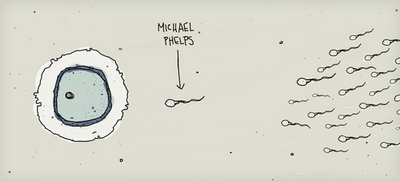
As Noumenon notes, the first sperm to arrive is not necessarily the one that “wins” the right to merge with the egg. More often than not, it is not because the necessary chemical reaction that allows fertilization needs many sperm, not just one.
Relatedly, in a comment Ranah pointed out this image (found here), which depicts how the egg plays a much more complex part in guiding some sperm in while limiting access to others than common perceptions of fertilization recognize:


Further, sperm do not swim. They are not making a break for the egg. They do not have brains, desires, or goals. Their “tails” are randomly thrashing around due to the energy provided by the fluid produced by the prostate gland. They go in every direction (not just toward the sperm) and only by random chance do some of them end up at the egg.
Here is a clip from The Family Guy showing Stewie as a sperm or, more accurately, a spermship, competing with other sperm to capture the egg:
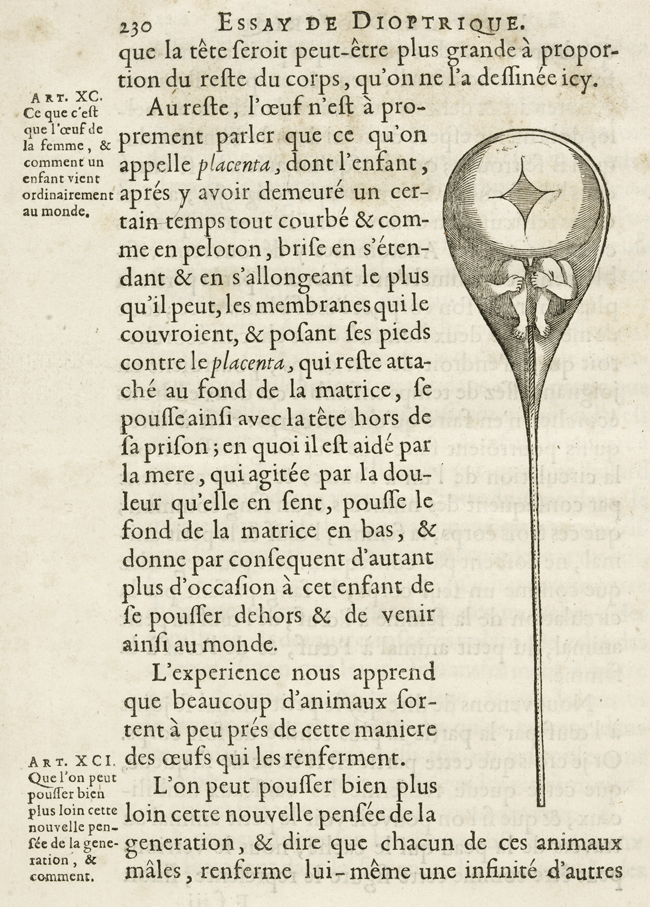
Notice also that in both the Phelps and the Stewie examples, the sperm contains all of the future of the identity of the individual. The contribution of the egg is made invisible. This is a very old idea.
NEW! This image is drawing by Dutch physicist and microscopist Nicolas Hartsoekerfrom from 1694. In the head of the sperm, you can see a tiny, but complete figure sitting with his head down (found here):
ALSO NEW! Here’s another contemporary image (found here) affirming this idea:
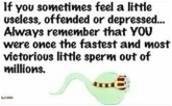
Text:
If you sometimes feel a little useless, offended or depressed… Always remember that YOU were once the fastest and most victorious little sperm out of millions.
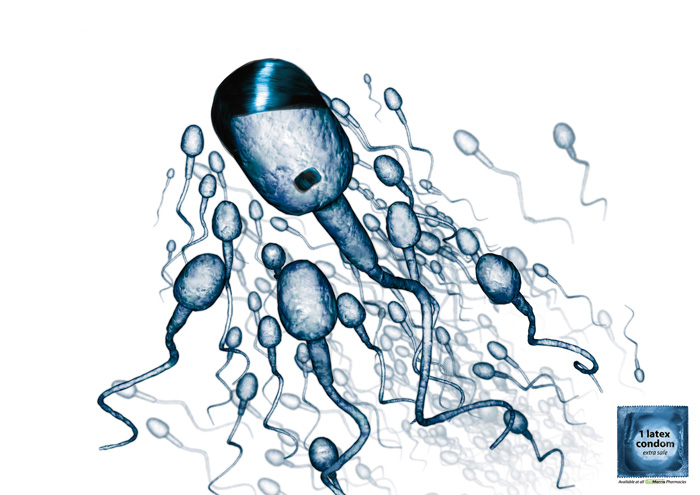
ALSO ALSO NEW! Similarly, this condom ad suggests that Hitler was once a sperm (found here):
Martin mentions that one of the few (non-scientific) cultural depictions of sperm that doesn’t draw on this imagery is in Woody Allen’s movie “Everything You Always Wanted to Know about Sex* *But Were Afraid to Ask,” where Allen plays the part of a sperm frightened of going out to face contraceptives or the possibility that it’s a false alarm (masturbation, gay sex) that won’t even get him close to an egg.
Here’s a clip from the movie showing that scene:
I’m going to show it the day we discuss Martin’s article in my women’s studies class when we address the way women’s bodies have been historically constructed, both scientifically and non-scientifically.
See also this Viagra ad that shows a sperm exploding an egg open.
Gwen Sharp is an associate professor of sociology at Nevada State College. You can follow her on Twitter at @gwensharpnv.
Comments 32
Interrobang — August 26, 2008
In defense of science here, they've only recently found out about the ovum's chemical signalling mechanisms, which actually would have been hard to find much before now (given the prior state of the art in molecular biology), even had people been looking. "Construction" aside, parsimony would actually dictate the previous explanation.
Fernando — August 26, 2008
Uh.. this blog is cool and all but sometimes it feels like you are pushing it. I mean, what science text anthropomorphizes sperm and eggs the way you described? I've never noticed any "brave sperm" or "egg in distress" undertone. It just happens the way it happens, sperm swims to find the egg, which is just there waiting, big deal.
And even if someone does attributes the quality of "brave" to the sperm (which is silly), doesn't mean he is tapping on gender stereotypes, he is just describing what happens.
Anonymous — August 26, 2008
Martin actually did a textual analysis--all those images of sperm and eggs (as well as many, many others that are beyond silly) came from actual biology or medical texts or articles that she cites.
And the whole point of her article is that it turns out it DOESN'T just happen like that--it turns out BOTH the egg and sperm are active, the egg binds the sperm to it (as opposed to passively sitting there waiting), and the proteins on the sperm and membranes on the egg interlock together. Implying that the egg does nothing but sit around, and the strong, aggressive sperm "penetrates it" (which turns out to not really be what happens--evidence is that sperm are not actually very strong at moving forward, and if eggs did not actively bind to them, they wouldn't get through the membrane on their own) is a cultural story we tell over and over because it falls into line with what we think men and women are like.
As for the sperm being "brave" (or the other ways it was described)...it's not a human. It has no emotions or motivations that can be described as brave, cowardly, or anything else.
Martin does a better job explaining all this than I do, which is why I cited her article. It's a classic in gender studies.
Fernando — August 26, 2008
Okay, when I said "sit around" I was talking about this specific quality of the egg when compared to the sperm. The sperm does actually move torwards the egg, the egg doesn't go to the sperm. Obviously, after there is contact, the egg does something. And that is talked about just the same as the part about the sperm swimming torwards the egg, because it is all part of the process.
And the usage of the word brave (which I have never seen in biological texts describing the process) is just a metaphor, so you have to look at what it means. Obviously doesn't mean that the sperm is a brave little dude. The word brave there would be just to convey the idea that there's a huge risk that each individual sperm never makes it to it's destination.
Anonymous — August 26, 2008
The thing is, though, that Martin DID find biology and medical texts/articles that talk about the sperm like brave little dudes, and the eggs as either totally passive OR as a mistress-in-waiting (I don't have the article in front of me to provide the exact wording, but I know one talked about an egg waiting to be "rescued" by a sperm, lest it go to waste). Several talked about the egg membrane as its "vestments," which is just...weird, given "vestment" is usually used to describe religious garments. I promise, I wasn't just making up the discourse/language I was referring to--it actually exists and is all cited and referenced and everything. I swear!
Fernando — August 26, 2008
Guess I'll take a look at. Do you know where can I find it on the internet? I believe finding it on any library where I live (Brazil) would be hard.
But anyways, I always get jumpy when I see stuff like "science is discriminatory saying this and that". I mean, science is a method, not a group of people. And yeah, I get it that sometimes people use it to reffer to the scientific community, but that's just generalizing, specially in a field that is so broad.
Anonymous — August 26, 2008
Oh, it's always good to be skeptical of things--I get you there. I'll see if I have a PDF version or find a link to it somewhere for you.
K — August 27, 2008
I've always been fond of the Margaret Atwood passage about this ("Adventure Story", found in the collection Good Bones) which though it does paint the protagonists as adventurers, points out that "You may think I'm talking about male bonding, or war, but no; half of these are female..."
MW — August 28, 2008
I just saw the "brave little sperm" trope on an episode of Family Guy this Monday. Stewie, the hyper-intelligent, destructive, child genius, was celebrating his first birthday. He reminisced about his life in the womb and before, when he was apparently a tiny pilot in a sperm-shaped aircraft.
Stewie's flashback showed him piloting his sperm ship toward the egg and firing at it in a scene reminiscent of the scene in Star Wars where Luke tries to explode the Death Star. He think thinks about being sucked in and "trapped" inside the egg. The relationship between sperm and egg is shown as adversarial, the egg evil, hungry and encompassing, not unlike a vagina dentata.
Of course, this flashback occurs in the context of a cartoon in which everything is supposed to be exaggerated and humorous. However, the fact remains that the humorous exaggeration is presented with gratuitous violence and misogyny. You might argue that violence and misogyny are part of Stewie's character, which they are, but the flashback does not develop Stewie's violence and misogyny in a way peculiar to his personality. Instead it just recycles wholesale a tired, sexist cliche about human reproduction.
MW — August 28, 2008
Here's a YouTube clip of the episode I was talking about: http://www.youtube.com/watch?v=gngh8k1H-kg
Noumenon — August 31, 2008
Here's another example of how we think about sperm and eggs:
I didn't realize that I was thinking about this in cultural terms till my brother pointed out that the first, fastest, strongest sperm doesn't fertilize the egg -- it takes a few to soften it up first. But our cultural views about who should get to reproduce makes this cartoon seem plausible instead of bad science.
Noumenon — August 31, 2008
Here's another example of how we think about sperm and eggs:
http://j-walkblog.com/images2/MJ2Za9Vhmclok4zkVRIyx0MC_400.jpg
I didn't realize that I was thinking about this in cultural terms till my brother pointed out that the first, fastest, strongest sperm doesn't fertilize the egg -- it takes a few to soften it up first. But our cultural views about who should get to reproduce makes this cartoon seem plausible instead of bad science.
Noumenon — August 31, 2008
Why doesn't my comment appear? I took the hyperlinks out... there's nothing that says comments are screened.
Here's another example of how we think about sperm and eggs:
http:// j-walkblog.com/images2/MJ2Za9Vhmclok4zkVRIyx0MC_400.jpg
I didn't realize that I was thinking about this in cultural terms till my brother pointed out that the first, fastest, strongest sperm doesn't fertilize the egg -- it takes a few to soften it up first. But our cultural views about who should get to reproduce makes this cartoon seem plausible instead of bad science.
Noumenon — September 1, 2008
Oh well, at least the second repost was worthwhile, since it seems tags don't post -- on this blog especially, it would be handy if they did, or warned you that they don't.
Noumenon — September 1, 2008
That was supposed to be "image" tags that don't post. I'll shut up now.
Ranah — September 1, 2008
The egg carefully gives access and selects the sperm:
http://e-vestnik.bg/imgs/zdrave/Spermograma-060.jpg
Sociological Images » WHAT WE’VE BEEN UP TO BEHIND YOUR BACK (SEPTEMBER 2008) — September 15, 2008
[...] added three new images to our post on The Frightened Sperm. One is a cartoon depicting Michael Phelps as the winning sperm, one is a clip from The Family [...]
Sociological Images » VIAGRA ADVERTISING — September 26, 2008
[...] on men’s sexual bodies: sperm and sperm in space! addthis_url = [...]
Sociological Images » EVERY SPERM IS SACRED, AND SENTIENT, AND POSSIBLY SAD — January 17, 2009
[...] reproduces the idea of the goal-oriented sentient sperm. (We’ve got a fun post on that idea here, and here’s another good one.) Remember, sperm do not have goals; they do not have ideas; [...]
Business Memes » EVERY SPERM IS SACRED, AND SENTIENT, AND POSSIBLY SAD — January 18, 2009
[...] reproduces the idea of the goal-oriented sentient sperm. (We’ve got a fun post on that idea here, and here’s another good one.) Remember, sperm do not have goals; they do not have ideas; [...]
Sociological Images » What We’ve Been Up To Behind Your Back (April 2009) — May 1, 2009
[...] the idea that we were all once a mighty sperm (eggs, apparently, just add nutrition, if that) to this post on the weird ways in which sperm are socially constructed. In one of them, a condom ad suggests [...]
Witness — May 6, 2009
In the Simpsons episode "Maggie Makes Three" Homer's sperm are shown with his head.
Here is a link to a still image.
http://www.fuoriditesta.it/umorismo/immagini/divertenti/homersperm.jpg
Here is a clip of the scene.
http://www.youtube.com/watch?v=OX1XAmDpKqo
This is an odd ad showing a sperm wooing an egg with red roses.
http://www.youtube.com/watch?v=U3eBLSOrJpM&feature=PlayList&p=B3F8230A4F306AF4&playnext=1&playnext_from=PL&index=104
On Metaphor (And Penis Fencing Flatworms) » Sociological Images — September 1, 2009
[...] another example of the projection of socially constructed human relations onto the body, see our post on sperm, eggs, and fertilization. 23 Comments Tags: animals/nature, discourse/language, gender, marriage/family, [...]
Je glimlach van vandaag - deel 19 - Pagina 224 - 9lives - Games Forum — September 16, 2011
[...] [...]
Aggg — September 18, 2011
Do you realize how insane this is? Not insane as in "cool" but insane as in mentally ill. You should be tarred and feathered just like all feminists.
Megan — July 11, 2012
Great post! Another good reference is Lisa Jean Moore's book: "Sperm Counts: Overcome by Man's Most Precious Fluid." She writes about how sperm is depicted in children's books, among other things. Here's a great clip of her talking about the same:
http://www.youtube.com/watch?v=txaTgARGKwY
“Hobby Lobby is going to shut down!!!” | Wait, what?! — February 8, 2014
[…] reproduction. Woman makes eggs, man makes sperm, sperm battles its way through the vagina, wrestles through the cervix, through the uterus and into the fallopian tubes, where it […]
Frito Bandito — February 19, 2014
I can't help but think of (usually "masculine") sci-fi films like Star Wars, Independence Day, or even Armagheddon where teams of (almost always) men "sneak" (usually penetrate, forcefully...) into something really big and threatening in (the ultimate source of Otherness) outer space in order to destroy it. Think of the Death Star in both Star Wars IV and VI, for example. In Independence Day, it is literally called the "Mothership." After sneaking into the Mothership, the men then implant a "virus" (or STD?) in order to defeat the aliens just like how we conceive of the way that sperm "penetrates" the egg. The clip from Family Guy shows this idea too by representing the penetration as a space battle. Anyway, these films might represent unconscious fears and anxieties men held/hold toward feminism (think of how Han Solo repeatedly condemns Princess Leia's agency in A New Hope, for example).