
In the 1800s, the Irish (whether in Ireland, Britain, or the U.S.) were often very negatively stereotyped. In many cases the same negative characteristics attributed to Africans and African Americans (sloth, immorality, destructiveness) were often also associated with the Irish. In fact, some scientists believed the Irish were, like Africans, more closely related to apes than to other Europeans, and in some cases in the U.S., Irish immigrants were classified as Blacks, not Whites.
The next three political cartoons from the 1800s were found on the Nevada Department of Education website section about racism (as was the quote about the first cartoon).
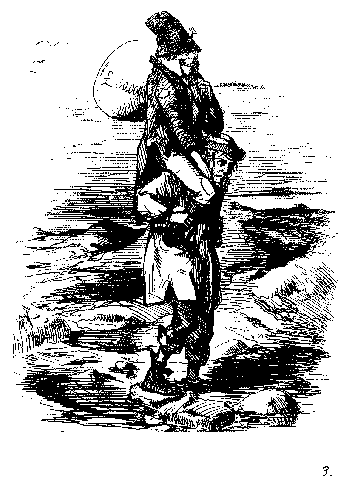
This one is titled “The Workingman’s Burden” and depicts “a gleeful Irish peasant carrying his Famine relief money while riding on the back of an exhausted English laborer.” It might make a good comparison to how welfare recipients are viewed in the U.S.
This illustration ran in Harper’s Weekly magazine. Notice how the Irish are depicted as more similar to “Negros” than to “Anglo Teutonic” individuals, and both the Irish and Africans are caricatured as ape-like. It could also be useful for a discussion of scientific racism.

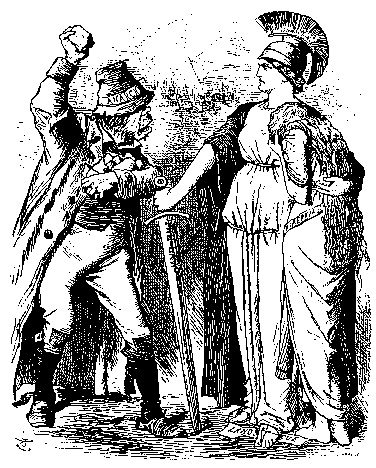
This cartoon, titled “Two Forces,” shows a figure representing Britain protecting a weeping, frightened woman, representing Ireland, from a rampaging Irishman; notice his hat says “anarchy.”
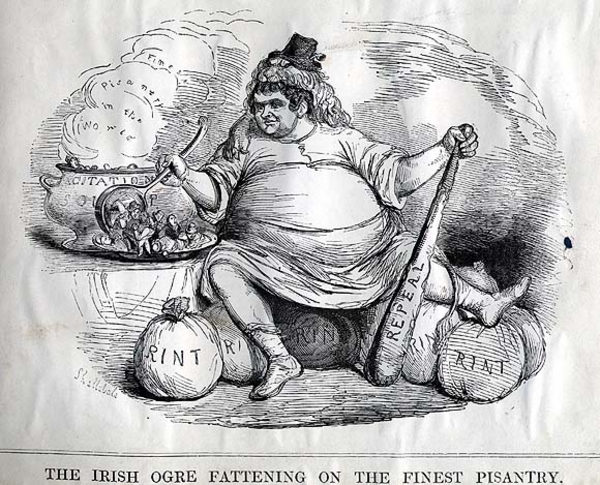
This image, found at the University College Cork website, depicts Daniel O’Connell, a leader of the Irish land reform movement, as an “ogre.” He is ladling poor Irish peasants out of a pot labeled “agitation soup,” and, presumably, cheating them out of money in the guise of helping them.
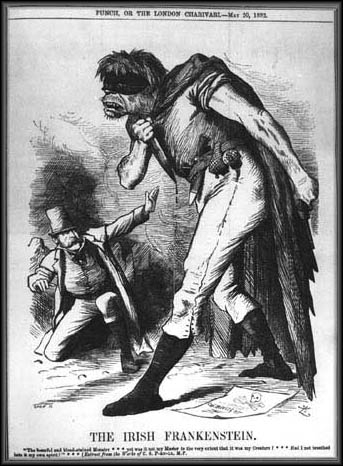
Here we see the Irish depicted as a Frankensteinian monster in a cartoon that ran in Punch in 1882 (image found at the website for a course at the University of St. Andrews):
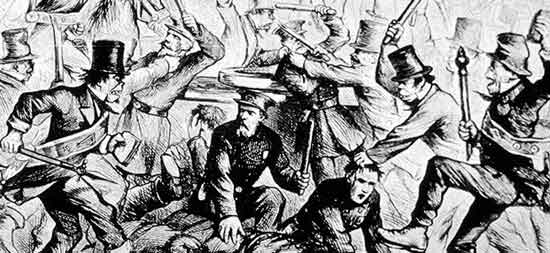
These next three all come from the Center for History and New Media at George Mason University. Here we see drunken Irishmen rioting and attacking police:
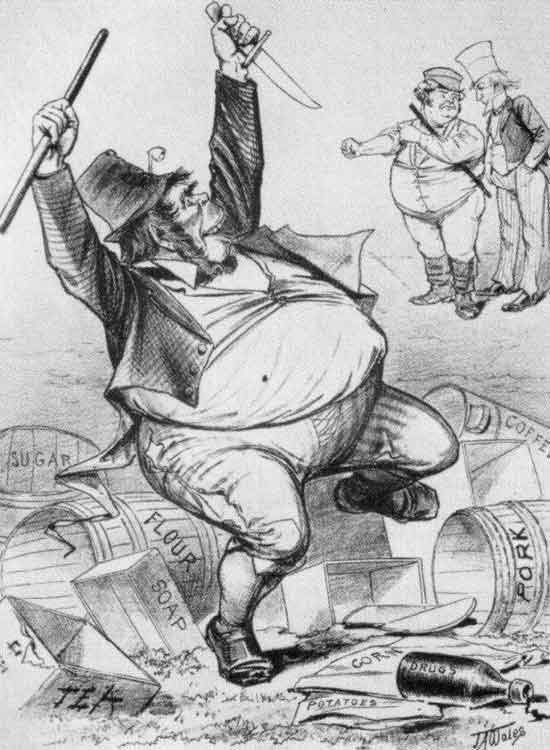
In this one, John Bull (representing Britain) and Uncle Sam look on as an Irish man engages in reckless destruction; notice the empty bottle in the lower right corner, labeled “drugs”:

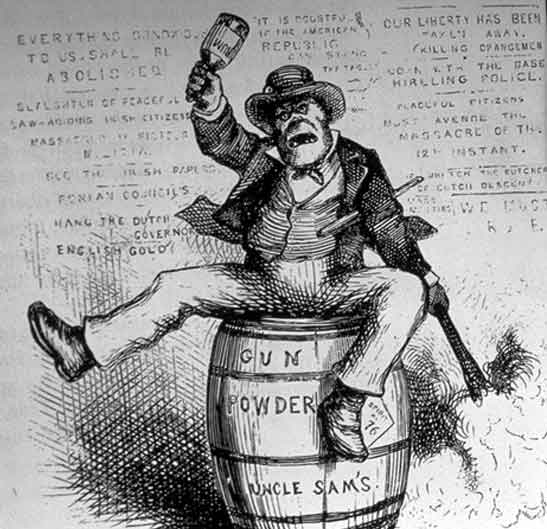
Here an ape-like Irish man, again drunk, sits on a powder keg, presumably threatening the entire country:
Finally, this one, published in 1882 (and found at the Michigan State University Museum website), is called “Uncle Sam’s Lodging House” and shows an Irish immigrant causing a commotion while other immigrants (notice the beds are labeled Russian, German, Negro, etc.) try to sleep. The smaller caption under the title says, “Look here, you, everybody else is quiet and peaceable, and you’re all the time a-kicking up a row!”
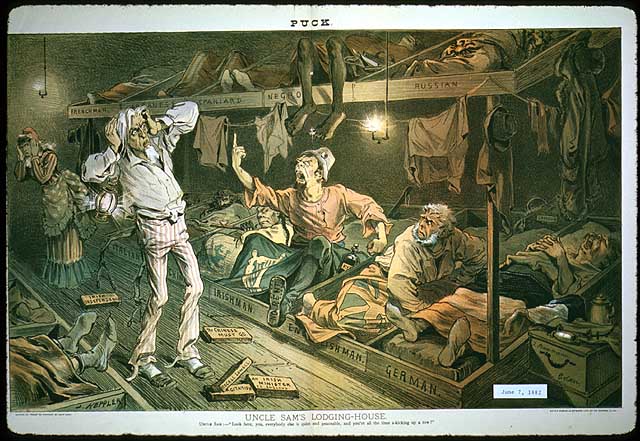
The message is, of course, that other immigrant groups (including Blacks) settle in and don’t cause problems, while the Irish don’t know how to assimilate or stay in their place.
You might compare these images to this recent post about how symbols of Irishness have lost any real negative implications, such that even politicians in non-Irish-dominated districts feel comfortable using them in campaign materials.
And yes, I know I’ve been posting a lot of stuff about race and ethnicity lately. I’m teaching a class on it this semester–it’s the stuff that I keep coming across while writing lectures.
And I’m dedicating this post to my boyfriend, Burk, who decided to go on a date with me even though, when he asked if I’d have trouble dealing with his hard-drinking Irish-American family, I said I could handle that but wouldn’t put up with any blubbering on about how Angela’s Ashes is the best book ever.
NEW! This cartoon with poem was published in Life Magazine on May 11th, 1893. The poem is suggesting that the monkeys in the zoo are sad that they get called by Irish names.
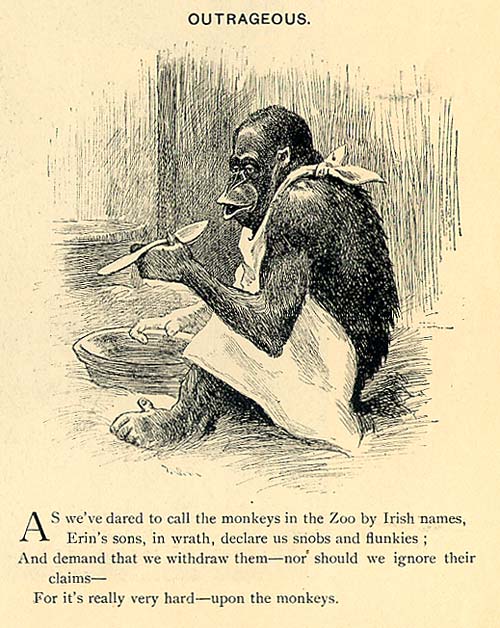
Text:
As we’ve dared to call the monkeys in the Zoo by Irish names, Erin’s sons, in wrath, declare us snobs and flunkies ;
And demand that we withdraw them–nor should we ignore their claims–
For it’s really very hard–upon the monkeys.
UPDATE: In a comment, Macon D asked how I address the ways in which Whites of some ancestries (Irish, Italian, etc.) often point to the fact that there was discrimination against those groups as a way of invalidating arguments about systemic racism. The logic is that both non-Whites and some White groups faced prejudice and discrimination but European groups overcame it through their own hard work, and thus any other group could too. If they continue to experience high levels of poverty, unemployment, or any other social problem, it is due to their own lack of hard work, intelligence, or some other characteristic.
I do indeed discuss this argument at length whenever I teach about race. A great reading to address it is Charles Gallagher’s article “Playing the White Ethnic Card: Using Ethnic Identity to Deny Contemporary Racism,” p. 145-158 in White Out: The Continuing Significance of Racism (2003, Ashley W. Doane and Eduardo Bonilla-Silva, editors, New York: Routledge). The tone might put some students off, because it doesn’t baby them or try to sugar-coat the issue of how Whites use their (often imagined) family stories of discrimination as a way to argue that systemic racism doesn’t exist and that they got to where they are by their family’s hard work, and nothing more. I know other professors often use the “How Jews Became White Folks” reading by Karen Brodkin, which also looks at this issue.
I also spend a good part of the semester looking at how government policies have had the effect of transferring enormous amounts of wealth into the hands of European immigrants and helping them accumulate resources over time–we look at the Homestead Act of 1862, the G.I. Bill (which Black veterans were often excluded from using), and how government subsidies for building suburban subdivisions were actively denied to groups wanting to build integrated communities. All these are examples of ways in which White Americans were aided in acquiring wealth and moving up the socio-economic ladder, while non-Whites often were explicitly excluded from these benefits.
I also point out that, while in these images the Irish are negatively stereotyped, it is clear that they are still viewed less negatively than, say, Africans or African Americans. If the Irish are the “missing link” between Africans and Caucasians…that still means they’re considered more evolved than Africans–at least somewhat more fully human. So even at the height of discrimination against White European groups, that did not necessarily mean they were treated “the same” as, say, American Indians or Blacks.
Comments 114
macon d — October 6, 2008
Do you have to put up with any blubbering from your boyfriend or his family about how the Irish had it bad too, so today's blacks shouldn't complain, the Irish pulled themselves up by their own bootstraps so why can't they, and so on? I ask because I wonder how you counter such claims, if you do. I also think that showing such images as these in a classroom could encourage that kind of context-free thinking by whites as well. I imagine that since you're teaching an entire class on race and ethnicity, you have explanations aside from inherent black inferiority for black vs. Irish success rates?
Burk — October 6, 2008
"Do you have to put up with any blubbering from your boyfriend or his family about how the Irish had it bad too, so today’s blacks shouldn’t complain, the Irish pulled themselves up by their own bootstraps so why can’t they, and so on?"
Ugh. No. No she does not.
Gwen Sharp, PhD — October 6, 2008
macon d--I just added an update to the end of the post about that argument and how I address it in the classroom.
By the time I get home today, I think Burk might be ashamed to be Irish. :)
macon d — October 6, 2008
Thanks for the extensive update, gwen--you clearly do cover that issue well, and it sounds like an awesome class! And I'm glad to hear that Burk and his family don't subject you to lectures on the virtues of bootstrap-pulling. Thanks for the great collection of egregious images.
Eoin — October 7, 2008
Gwen you might want to also have a look at Noel Ignatiev's "How the Irish Became White". Several books make reference to the 'civilisation' of the Irish people through religion and temperance.
Love the Daniel O'Connell image, especially the use of the localised 'Rint' to signify Rent. Rent in this context I think meaning the money collected by O'Connell's mass movement in the early 19th century, despite the fact that landlords had been hiving it off for decades before that.
Kirsten — October 7, 2008
It does indeed sound like an awesome class.
diana — October 9, 2008
Check out the older book _Apes and Angels: The Irishman in Victorian Caricature_. It's got a lot of great information. I teach the British Empire and use a lot of these cartoons in my classes. The "Two Forces" one is also from _Punch_ (October 1881). We talk a lot about the rise in interest in pseudo-sciences like phrenology and the ways that artists depicted the Irish, Jews, Africans, Indians in Victorian periodicals.
Sociological Images » “MOST OF THE PEOPLE IN AMERICA ARE N——” — November 8, 2008
[...] called “white niggers” in order to denigrate them by comparing them to Blacks (see also this post). Such linguistic bridging was often used to transfer the hatred of one group to another. He [...]
Heritage, Hispanic, and Hollywood — April 21, 2009
[...] mostly unaffectionate English family, he ignores all “proper” Victorian body behavior. The Irish stereotype was driven by their supposed national penchant for alcohol, and with that comes the traits of [...]
Rae — May 5, 2009
Just wanted to throw another voice behind diana's recommendation of L. Perry Curtis's Apes and Angels: The Irishman in Victorian Caricature.
Cleary — May 8, 2009
Forget it all, lets just get along.
Sociological Images » Stereotyping Scots as Cheap — July 4, 2009
[...] another example of stereotypes of European ethnic groups, see our post on images of the Irish. We also have some old anti-Chinese posters. tags: change, history, race/ethnicity| [...]
Collective Action And The Frito Bandito » Sociological Images — August 10, 2009
[...] (here, here, and here), American Indians (here and here), Black Americans (here and here), and the Irish. Leave a Comment Tags: activism, food, history, marketing, prejudice/discrimination, [...]
Bananaboat — September 15, 2010
GIVE ME MY BANANA BACK!!
Pageturners — November 21, 2010
You might also read Sean O'Callaghan's book To Hell or Barbados: The Ethnic Cleansing of Ireland, which is about the slave trade that sent droves of Irish people as slaves to the Caribbean in the 17th century. For a quicker online read, this page http://www.kavanaghfamily.com/articles/2003/20030618jfc.htm gives a broad outline of the story.
Eoin O'Mahony — November 21, 2010
Has there been a simian Irish redux all this week with representations of the feckless and poverty-stricken Irish strewn across the newspapers of Europe and elsewhere? The image seen here (http://www.guardian.co.uk/business/ireland-business-blog-with-lisa-ocarroll/2010/nov/18/ireland-shamed-arrival-imf) has been commented on across Irish media as the defining moment of Ireland's 'rescuing' by the IMF. Some bloggers have copied Brian Cowen's face on to the homeless man's face while other radio contributors have pointed to the fact that this man "isn't even one of our own". Complicity with simian representations is ongoing including time spent by some commentators in trying to distance themselves from the 'wreckless' and 'savage' parts of the Irish economy.
His soul had arisen from the grave of boyhood « alicekwidamozo — December 5, 2010
[...] ”Paddy the Irishman” as an idle parasite sucking the life out of noble Britannia or honest John Bull. And as you may have noticed, today this kind of imagery still features prominently in the rhetoric [...]
St. Patrick’s Day Lesson Plans | My Fresh Plans — March 15, 2011
[...] immigrants faced stereotypes that portrayed them as violent, drunken, and lazy. A collection of old political cartoons on the subject provides background for teachers or data for older students if carefully [...]
“Ireland from One or Two Neglected Points of View” « thosewhowillnotbedrowned — June 24, 2011
[...] So to continue my dilemma, I had to find a cover illustration for the CD on which I was republishing the book as a facsimile. I was not short of examples of appalling cartoons of Irishmen depicted as apes, or gurning monsters. If you click the link below, you’ll go to an excellent online article by Gwen Sharp, and see some mainly American examples, but it’s not for the faint hearted. http://thesocietypages.org/socimages/2008/10/06/negative-stereotypes-of-the-irish/ [...]
Tirnanog — July 8, 2011
Anti Irish Racism isn't a historical footnote. It's alive and well today in the UK. Search 'Famine Song' on youtube and hear attitudes from the 19th Century alive and thriving today. It continues to be a race between education and destruction for we foolish homo-sapiens.
Blix — July 10, 2011
This is what believing in evolution does: it gives people "scientific" reason to be racist. If these people would realize that we all were created equal by God, not descended from an entirely different species, ethnic cleansing and racism would be ended.
Magically Delicious! | Food and Visual Media — September 28, 2011
[...] society only recognize as Irish those who identify themselves as Irish. Be this as it may, essentializing the Irish is still very common. And historically the stereotyping of the Irish was just as ugly [...]
Brave contrarian Brendan O’Neill | Butterflies and Wheels — November 8, 2011
[...] are more where that came from. Does Brendan O’Neill of Spiked really want major media returning to the good old days of [...]
Fjortiz — November 23, 2011
Nice pictures. I really love them!
Musicological Conformities and Whiteness in Modern Early Music Performance | Melanie L. Marshall — November 27, 2011
[...] I’m not going to recap my paper here. All I’m doing is briefly recording some of the directions for further research that came up in discussion and conversation. (I’m working the paper up for publication, and in due course a version will be available via my institutional open access repository.) Some people shared personal stories that shed further light on British vocal culture in the mid-20th century. One person generously said I’d explained her childhood vocal training. Others talked of how they had felt excluded in Britain—even people who came from privileged backgrounds in the US and Canada found that they didn’t have the “right kind” of whiteness in Britain: their gender, ethnicity or religious heritage meant they didn’t quite fit. This does not mean that the whiteness angle is null and void, rather it highlights how whiteness operates differently in different times and places—it is not a cross-cultural constant, and needs to be considered with intersecting axes of difference. (Gwen Sharp posted a great discussion of this at Sociological Images.) [...]
Dnickerson55 — December 3, 2011
fact of the matter is that alot of cultures around the globe have had it bad one way or another. It is ridiculous to compare the "plight" of different races because ultimately any one who is oppressed, broke, and under some type of government or monarchy are going to be oppressed in one form or another. i do enjoy the article and must remind commenters of the past that world oppression of cultures should not be a pissing contest. Not only does Ireland have a history of being oppressed by England, Ireland has a history of being oppressed by the Catholic/protestant churches which in turn is upheld by governments of today and of the past.
Rita — April 27, 2012
Re Daniel O'Connell - he would not be described as ' a leader of the Irish land reform movement'. That came later in the 19th century with Michael Davitt and Parnell. O'Connell's two great causes were Catholic Emancipation (1829), hence his title of 'Liberator', and the repeal of the Union with Britain. O'Connell died in 1848 having failed to achieve the latter. He remains my number one man.
Weekend Reads 12 | Irish Historical Textiles — April 27, 2012
[...] this blogpost, and see the startling images that showed negative Irish historical [...]
Politically incorrect — June 6, 2012
[...] undoubted racist, much more politically incorrect. Have you ever seen the anti-Irish propaganda? http://thesocietypages.org/socimages...-of-the-irish/ Reply With Quote Quick Navigation Religion [...]
StillIrish — July 16, 2012
I'm sure in your class you delve into the other forms of systemic discrimination that excluded blacks, particularly - like trade union membership, etc. This top to bottom exclusion from ways to access education, skills and wealth continued until just recently. American Blacks have had very little time to develop the generational momentum to acquire wealth and education and social status. As an American descendant of Irish immigrants who fled hundreds of years of serfdom and starvation under the jackboot of Britain, I think I can empathize with the impact of historical trauma on self-worth. I am 4th and 5th generation American, yet I feel the suffering of my ancestors keenly still, in the family lore and in the under-the-radar distaste for and mockery of irish looks that still pervades American culture.
Yehudah — August 9, 2012
In actual fact, at one point in time Irish and Irish Americans were considered to be the missing link between black people and the gorilla...
Stereotypical irish | Cartographix — December 8, 2012
[...] Negative Stereotypes of the Irish » Sociological ImagesOct 6, 2008 … In the 1800s, the Irish (whether in Ireland, Britain, or the U.S.) were often very negatively stereotyped. In many cases the same negative … [...]
Connerruddy — March 12, 2013
Oh, shut up about the bible and god, first of all the theory of evolution actually makes sense unlike the bible which states some dude popped up out of nowhere and started personal experiments with a bunch of bits and pieces of different species, and started putting us together like we were playdough and that 8 people survived a global flood, one of them growing to be 900 years old while the current typical age of a human is about 75.
Farkas — June 7, 2013
I couldn't help noticing that today's usual depiction of a leprechaun still looks this way.
hkdharmon — July 23, 2013
Considering that Irish slavery (indentured servitude) ended
long before African slavery in the Americas, do you think it is fair to think
that simply more time will help to salve the wounds of racism for blacks the
way Irish racism is pretty much a thing of the past?
Maggie Hames — December 4, 2013
The Irish certainly had their turn at the bottom the American ladder; their "failure to assimilate" certainly reminds me of present-day criticism of current, often Muslim immigrants; the difference for the Irish is that after a generation, assimilation was pretty much complete. Their white skin helped a lot in a racist system.
Tom — March 10, 2014
This argument that the Irish pulled themselves up by their own bootstraps is not very accurate. The Irish were not allowed were outside of their own communities. There are even places that would straight advertise how they will hire black people before Irish. The first job they were allowed was catching runaway slaves, since the Irish were also slaves and indentured servants in early America, that is a job you would call pouring salt on the wound. They were forced into the military. The first street gangs in the us were irish. The ones that made big, did so by mining in the west. They also built the railroad with Chinese and black people. They were not even considered legitimate citizens until Kennedy became president, which was only made possible because his dad was backed by the Irish mob. We were unable to be pulled up by our bootstraps until the civil rights movement. There is no doubt that the Irish were in the top 3 most discriminated people in the US. Stop acting like admitting that a group of people had it horrible in this country somehow means yours didn't too.
Death, Life, and Cancer Zombies | the BrainChancery — March 27, 2014
[…] a zombie whose horror comes not in biting or brain-eating, but in over-procreating. (Think of how the English used to think about the Irish, or how some people still think of other people, because we’re all […]
Moe — July 8, 2014
Remember, the term "white" does not refer to "color," but to colonial oppressors. The Irish were never colonial oppressors but those oppressed by the British crown for 800 years. When the Irish came on coffin ships to New York to escape the genocide in Ireland by the British, they were greeted on the docks by those running New York--the British or the WASPs--White anglo-saxon protestants--the very ones they crossed the ocean to escape.
The Irish were hated by the British because they refused to bow to the Queen or any man and refused to convert from Catholic to Protestant--they were called dirty papists. That term continued as an insult during the "Troubles"--the war--in Northern Ireland which was not religious, but ethnic and tribal.
The Irish Catholics--the Celts--were not indentured servants. They were sold into slavery all over South america and the Carribbean and on the slave blocks in Virginia.. The British did also have indentured servants who were released from debtor prisons in England, Scotland and Wales, but those people were the poor Protestants, not the Irish Catholic Celts.
Since the Irish rebelled against the British every fifty years, as a new generation was reared, the British would kill every man or send them to the Australian Penal colony and then sell the women and children into slavery.
On the sugar plantations, the Irish women and the African men would fall in love and marry. African slaves cost 50 pounds sterling and the Irish, 5 pounds sterling. The law stated that the offspring of an Irish woman and an African man, with one drop of African blood, would command 50 pounds sterling at the slave market.
In New York City in the 1860's, the Irish Catholics and the African freed slaves lived together and married in the 5th or 6th quadrant--the quadrant that was silent during the draft riots.
The "Irish" gangs were comprised of different "irish" groups that people who are completely ignorant of "Irish" history roll into one neat pile. Those "gangs" may all have hailed from "Ireland," but they were composed of members of the Protestant landed gentry, the Protestants that were loyal to the crown, those who persecuted the Irish Catholic and were rewarded with land and wealth by the British crown. All those people were white but were from different ethnic or tribal backgrounds who came to New York--or America--holding the same prejudices that they had back in Europe and the powers in control in America were those who had money and control in Europe--those people were not the Irish Catholics.
For anyone to say that racism is about color and not about an attitude of superiority over another "people" is showing a complete and total ignorance of the history of humanity.
Color was an invention by the British at the slave markets to "divide and conquer" the growing number of the black and whites who were slaves in order to pit them against each other to avoid slave insurrections. It was thought at the time that since each plantation had hundreds and sometimes thousands of slaves, that if the slaves ever banded together, they would be able to easily murder the plantation owners--so they put between them and began using terms of color to grade people--mulatto--etcetera.
According to the author of the article above, history begins and ends in America. The author also views what happened to Black Americans as incomparable to what happened to other people and teaches that shortsighted ignorant view in what seems like a college course. The author is clueless about history.
When one knows that different "tribes" of people have committed genocide against another tribe due to their own ethnic hatred of the other for whatever reason--not bowing, refusing to convert their beliefs on demand, being demonized and dehumanized as a political scapegoat through propaganda--just look at Serbia and Croatia, Rwanda with the Hutus and Tutsis, the Turks and the Armenian genocide, the Jews enslaved by the Egyptians, the Romans who enslaved whatever peoples they conquered--racism is not about color, it's about power.
My last point--The Statutes of Kilkenny and the Irish Penal Code are arguably the most racist, dehumanizing laws every enacted against a people to dehumanize and destroy them. They were enacted against the Irish by the British. Those laws formed the basis of the Jim Crow laws in the South. How would people in the South know about the Irish Penal Code? Because they were the same people who learned about them in their own British history books before coming to America. Those Jim Crow laws formed the basis of the Nazi Nuremberg Laws against the Jewish people.
So, learn your history before you start teaching people your own ignorant misunderstanding of human history.
St. Louis / Ferguson, MO riots - Page 48 - PeachParts Mercedes ShopForum — August 25, 2014
[…] thing about the Celts is just thinly veiled racism about Irish people. It goes back to stereotypes of them as lazy deployed in the 19th century to keep them as a separate immigrant class from non-immigrant white […]
Kokkinomallisophobia | In With The Old — February 8, 2015
[…] prejudice among the feline community, but it survives within homo sapiens. There may be an anti-Irish aspect to […]
Irish Dance and the Evolution of Race » Antropologia Masterra — March 18, 2015
[…] mattered if you were Irish, Italian, or some other white ethnicity. The Irish, in particular, were denigrated anddehumanized. If one wasn’t Irish, it certainly wasn’t a group that most people would want to […]
Key Concept – ‘Whiteness’ | politics of racism 2015 — March 31, 2015
[…] Sharp, Gwen. “Negative Stereotypes of the Irish.” 2008.Web. <http://thesocietypages.org/socimages/2008/10/06/negative-stereotypes-of-the-irish/>. […]
The Irish Potato Famine + Housing Justice – biking about architecture — March 18, 2016
[…] the English imagination, the Irish were a dirty, promiscuous, lazy, overly spiritual, drunken, teeming mass of Catholics […]
james Pruden — June 5, 2016
Hate isn't new. It seems like every generation deals with the same bigotry.
Just look at the donald and the 2016 repubs.
Matty B — August 13, 2016
These may be some of the most historically illiterate comments I've ever read. I'd like to refute them; but there isn't enough space in the lifetime to do so. Good luck with your fantasies.
Immigration Policy: Who Do We Want to Be? | Dr. Scott Paine — February 3, 2017
[…] simply applies the type to the target group of the time. A reading of anti-immigrant rhetoric aimed at the Irish in the mid-19th century anticipates later rhetoric against other immigrant groups with eerie […]
Recessive notions of whiteness – Aqua Rusa — May 29, 2017
[…] as black. Despite being mostly Irish, very few people would call him white. (And not because they view Irish people to be non-white, which is a whole other […]
Leigh Johnson — October 9, 2017
The author of How Jews Became White Folks has recently all but retracted the work. Which should have been an obvious conclusion even as she originally wrote it, give Jews have attained levels of provisional whiteness many times throughout history, including in pre-Holocaust Germany, only to have it revoked time and again.
Ashkenazi Jews have some semblance of white passing privilege. White passing privilege: stratified, conditional, provisional, and entirely revocable at any time without notice.
Actual white privilege: static and permanent.
One in five American Jews are not Ashkenazi, but Jews of obvious color. 52%+ of the Israeli populace is Mizrahim, Jews exiled from MENA (Middle East North Africa) lands since 1941.
Blanket references to Jews as white, beyond being ashkenormative, ignores nuance such as Jews of color (Mizrahi and Sephardi), Kaifeng Jews of China, Beta Israel of Ethiopia, Lemba of Zimbabwe and Mozambique, Bene Israel of India, and so on. Failing to note the difference between White Passin Prrivilege and White Privilege is erasure of the many shades of World Jewry, including Ashkenazi such as Phoebe Snow, Jeff Goldblum, Paula Abdul, Jeremy Stoppelman, and the thousands of other Jews who, in spite of Ashkenazi ancestry, don't remotely pass as "white". It also ignores the reality of White Supremacy quite loudly depriving Jews of even approximate whiteness.
Language and Cultural Imperialism: A Tale of Colonial Ireland – Postcolonial Literature and Theory — November 4, 2017
[…] Figures 2-3: The Irish were often portrayed as inferior, ape-like beings in English media. These images can be found here. […]
fire sky — January 18, 2018
recently noticed that the facial profiles of these irish cartoons show features of FAS (fetal alcohol syndrome).
Herschel Adams — May 24, 2018
Hey, I'm an Irish Jew and I have an observation to make. Blacks have an IQ that is a standard deviation below the average Irish IQ. That more than explains the differential in socioeconomic class. And before you blame it on "slavery" (which still exists in most parts of Africa...), know that African-Americans have significantly higher IQs than native Africans.
I know you probably think I'm Satan for pointing this out, but that's to be expected. You're a woman who teaches in higher education... OF COURSE you're brainwashed. Plus you feel so comfortable openly insulting your boyfriend/husband. That's not a good look.
"By the time I get home today, I think Burk might be ashamed to be Irish. :)"
That's just a nasty thing to say about your partner. I would never dream of saying something so insensitive about my girlfriend. I suppose that's why feminism is based on lies and men are objectively superior in every measurable way.
Have a nice day! :)
Robert crowther — August 18, 2018
The first man to win.the victoria cross in.the Crimean war was a Irishman 80 per cent of the British army was irish.in.1840 the artists seem to have forgotten this
John — February 21, 2019
I am Irish. My grandmother recordered my grandfather's and her life after immigration from Ireland. My grandmother was Irish Catholic and my grandfather was a member of the Church of England. If the population of Boston, Mass. found out; the WASP controlling population would do bodily and economic harm too both of my grand parents. My grand parents realized that the only way forward in the USA was education and hard work! My grandfather was a pharmacist. He earned enough to provide for them both. If their neighbors found out about the mixed religion, dire consequences for him would follow! Education and hardork was drilled into their children! This problem of WASP dominance has been solved by the fact that the WASP's where out produced by having very small reproduction numbers!
jose — March 19, 2019
good
naughty — November 21, 2019
The most famous example of Anti Irish sentiment comes from 1190 with the Norman chronicler Giraldus Cambrensis, also known as Gerald of Wales. To justify the Norman invasion of Ireland, he wrote disparagingly of the Irish. "Gerald was seeking promotion by Henry II within the English church. His history was therefore written to create a certain effect—of supporting Henry II's claims to Ireland."
Jean Mitchell — February 23, 2020
My mother grew up in Chicago during the Depression. There was still a lot of prejudice against both Catholics and Irish in those days. She remembered the nuns teaching the children "When you grow up, become the teachers and the politicians and you will erase this anti-Irish feeling.
Jonathan Christopher — January 28, 2021
"In a comment, Macon D asked how I address the ways in which Whites of some ancestries often point to the fact that there was discrimination against those groups as a way of invalidating arguments about systemic racism."
The way to do it is to avoid making these false equivalencies in the first place.
It simply isn't true that the Irish were ever classified as "black" in the US. In the mid-19th Century, black people could not vote, own property, hold political office or become naturalized citizens (the 1790 Act restricted citizenship to "free white persons"). The Irish were never denied any of these rights.
This statement is so obscene that it's worth mentioning that some Irish-Americans, including Irish immigrants, owned black slaves before the Civil War. For example, Patrick Francis Healy of Georgetown fame was the child of an Irish immigrant and his slave wife (the marriage of course was illegal, as white people couldn't marry black people, whether slave or free, at this time, and especially in Georgia, of all places).
That a Phd sociologist could write such ahistorical commentary without any references or context is just astounding.
In a most likely futile attempt to clear some of this up, I'll start by saying that, without any doubt, the Irish faced a lot of anti-Catholic bigotry in the antebellum North. But at the same time they were legally "white", were perceived as white by the vast majority of Americans, and generally enjoyed the privileges that went along with that.
In addition, the political cartoons (in the US) which compared black people favorably to the Irish were published by either abolitionists or those sympathetic to that movement. Abolitionists were for the most part Protestants who were as opposed to slavery as they were to Catholicism (and thus Irish Catholics). Most Irish Catholic immigrants, on the other hand, were not abolitionists; they opposed black emancipation and suffrage and leveraged their skin color and influence in the Democratic Party to oppress both black people and non-white immigrants (The Chinese Exclusion Act, for example, was largely the product of Irish Catholic political lobbying; no nativist group was ever able to restrict immigration from Ireland).
To illustrate why it's a fallacy to use these political cartoons as evidence of the racial positioning of Irish immigrants, I would direct your attention over to Thomas Nast's cartoon "This is a White Man's Government". Here Nast is depicting a siamianized Irishman (classical ape-like features) while simultaneously acknowledging both his "whiteness" and his ability to use his skin color for white supremacist purposes (also featured in the cartoon is a Tammany Hall political boss and a Southern Confederate).
Obviously, context matters when doing history. These cartoons were political statements, not biology textbooks.
Perhaps the reason why people reference anti-Irish discrimination to make racist arguments is because "sociologists" like Gwen Sharp are presenting college students with highly distorted views of their immigrant ancestors and then damage controlling with statements like "the GI Bill transferred wealth to whites" (while true, this is also misleading -- the descendants of Irish immigrants assimilated and achieved socioeconomic mobility long before WW2; as a matter of fact, the immigration quotas of the early 20th Century favored immigrants from Ireland and Britain and placed restrictions on immigration from Southern and Eastern Europe).
For further reading I recommend Kevin Kenny's "Twenty Years of Irish American Historiography". About halfway through he brings up Ignatiev's "how the Irish became white" thesis and explains why historians now regard this argument as nonsense.
I would also recommend reading Liam Hogan's series on the Irish Slaves Meme. While only tangentially related to the subject of this blog post (his series mostly concerns debunking the racist myth that the Irish were brought to the Americas as slaves), he does dive into Irish-American social history the way a serious historian would (with an emphasis on context and analyses of primary source material). Start with "The Abuse of History: Jason L. Riley’s co-option of Irish history in an attempt to gird his political and personal ideology".
I think I'll even shoot Liam an email and direct his attention over to this blog. This has been up since 2008 and presumably this woman is still teaching students. This whole piece is just bad history, misleading, out of context, and peppered with ahistorical commentary like "some Irish immigrants were classified as black" (the number of Irish immigrants who were classified as black in US history is precisely "zero").
Its Time To Talk About The Anti-Irish Issues in That Popular Series — February 20, 2022
[…] subject matter continuously featured the Irish as animalistic, lacking self control, drunk, lazyand dangerous, This is so chronic and so ingrained in standard awareness that anti-Irish stereotypes continuously […]
La inmigración en el siglo XIX y XX en los Estados Unidos. Racismo y Xenofobia hacia los blancos – Le Jeune Republicain — March 25, 2022
[…] https://thesocietypages.org/socimages/2008/10/06/negative-stereotypes-of-the-irish/ […]
Amarilly Essay – ABrown American History Through Film — September 14, 2022
[…] Gwen. “Negative Stereotypes of the Irish .” The society Pages, n.d. https://thesocietypages.org/socimages/2008/10/06/negative-stereotypes-of-the-irish/ Negative Stereotypes of the Irish – Sociological […]
Doit-on brûler Halloween ? – Moira Forest — October 31, 2023
[…] qui les méprisait et n’hésitait pas à comparer la majeure partie de ses habitants à des singes via leurs organes de presse, et occupé par une classe bourgeoise quelque peu névrosée et […]
James Flynn — November 6, 2023
I have no time for anyone who uses the discrimination against the Irish as a means of diminishing African American suffering, but by the same token we can not use "White privilege" to deny the fact that there was indeed Irish (and Jewish, and Italian, etc.) suffering and prejudice. Prejudice can vary in degree, but can never be accepted. For most of our countries history "WHITE" was exclusivly used for White Anglo Saxon Protestants
John P. — March 31, 2024
To the claim above in the comments that the Irish were one of the three groups most discriminated in America : no, they weren’t. They faced prejudice, yes, but not slavery and Jim Crow (Black Americans), nor genocide and ethnic cleansing (Native Americans), nor were they forced into internment camps (Japanese Americans) or were explicitly excluded from immigrating (Chinese Exclusion Act).