
Cross-posted at Love Isn’t Enough.
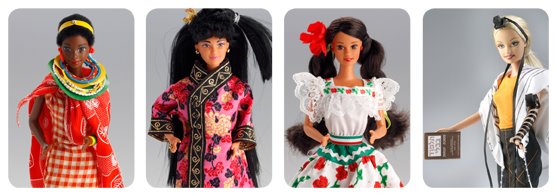
Ann DuCille, in her book Skin Trade, takes two issues with “ethnic” Barbies.
First, she takes issue with the fact that “ethnic” Barbies are made from the same mold as “real” Barbies (though sometimes with different paint on their faces). This reifies a white standard of beauty as THE standard of beauty. Black women are beautiful only insofar as they look like white women (see also this post). DuCille writes:
…today Barbie dolls come in a rainbow coalition of colors, races, ethnicities, and nationalities, [but] all of those dolls look remarkably like the stereotypical white Barbie, modified only by a dash of color and a change of clothes.
Consider:
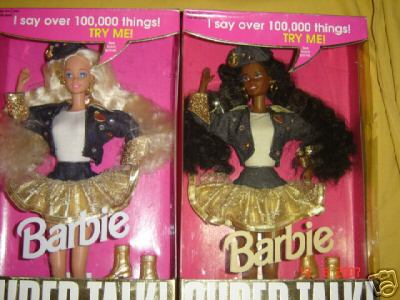
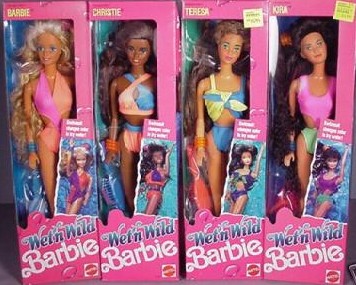
But, second, DuCille also takes takes issue with the idea that Mattell would try to make ethnic Barbies more “authentic.” Trying to agree on one ideal form for a racial or ethnic group is no more freeing than trying to get everyone to accord to one ideal based in whiteness. DuCille writes:
…it reifies race. You can’t make an ‘authentic’ Black, Hispanic, Asian, or white doll. You just can’t. It will always be artificially constraining…
And also:
Just what are we saying when we claim that a doll does or does not look… black? How does black look? …What would make a doll look authentically African American or realistically Nigerian or Jamaican? What prescriptive ideals of blackness are inscribed in such claims of authenticity? …The fact that skin color and other ‘ethnic features’ …are used by toymakers to denote blackness raises critical questions about how we manufacture difference.
Indeed, difference is, literally, manufactured through the production of “ethnic” Barbies and this is done, largely, for a white audience.
To be profitable, racial and cultural diversity… must be reducible to such common, reproducible denominators as color and costume.
The majority of American Barbie buyers are only interested in “ethnicity” so long as it is made into cute and harmless variety. This reminds us that, when toy makers (and others) manufacture difference, they are doing so for money. DuCille writes:
…capitalism has appropriated what it sees as certain signifiers of blackness and made them marketable… Mattel… mass market[s] the discursively familiar–by reproducing stereotyped forms and visible signs of racial and ethnic difference.
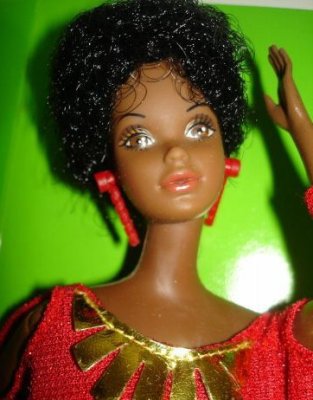
Consider:
Black Barbie and Hispanic Barbie, 1980
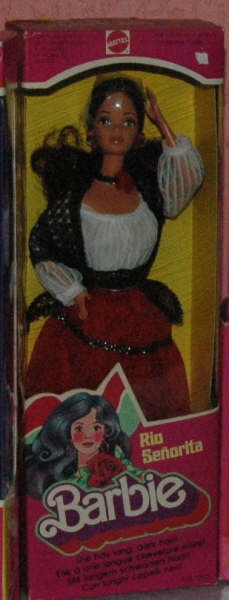
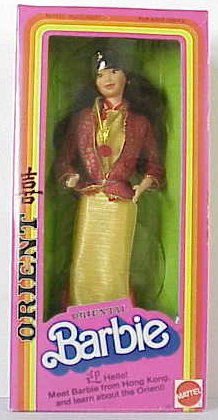
Oriental Barbie, date unknown
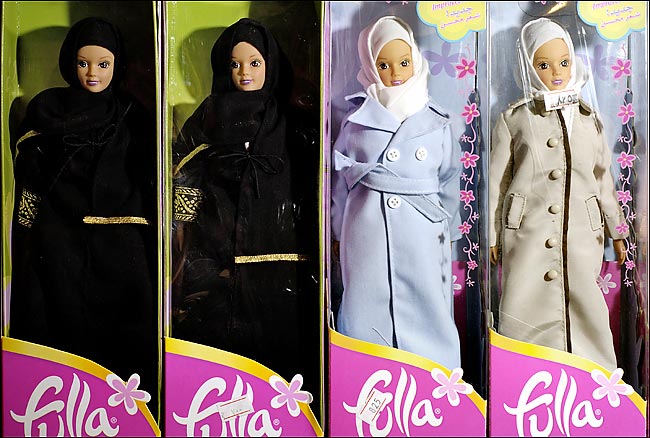

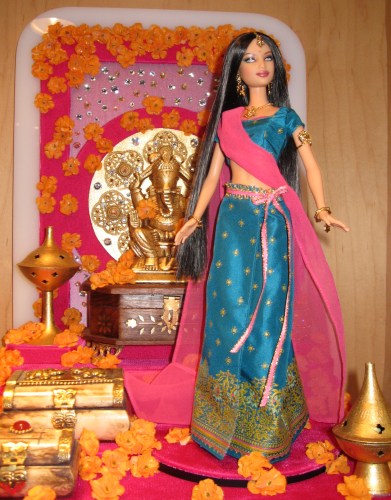
Diwali Barbie (India)
Hula Honey Barbie

Kwanzaa Barbie
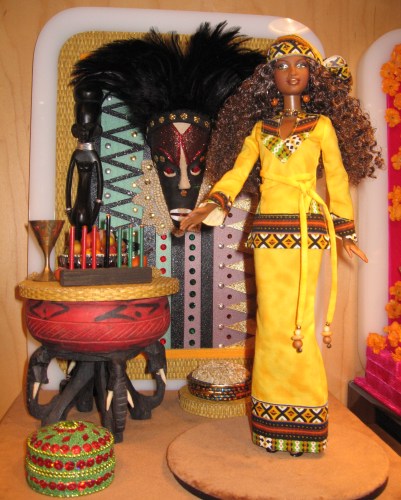
Radiant Rose Ethnic Barbie, 1996
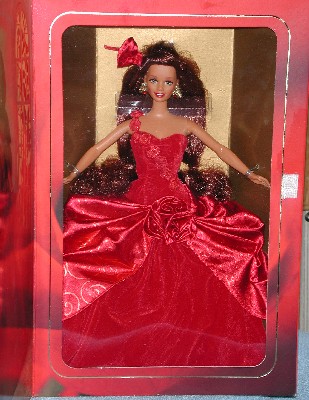
There are many reasons to find this problematic. DuCille turns to the Jamaican Barbie as an example.
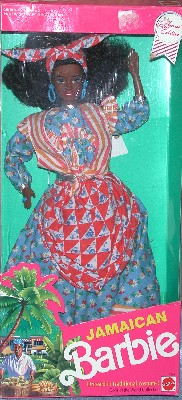
The back of Jamaican Barbie’s box tells us:
How-you-du (Hello) from the land of Jamaica, a tropical paradise known for its exotic fruit, sugar cane, breath-taking beaches, and reggae beat! …most Jamaicans have ancestors from Africa, so even though our official language is English, we speak patois, a kind of ‘Jamaica Talk,’ filled with English and African words. For example, when I’m filled with boonoonoonoos, I’m filled with much happiness!
Notice how Jamaica is reduced to cutesy things like exotic fruit and sugar cane and Jamaican people are characterized as happy-go-lucky and barely literate while the history of colonialism is completely erased.
So DuCille doesn’t like it when Black Barbies, for example, look like White Barbies and she doesn’t like it when Black Barbies look like Black Barbies either. What’s the solution? The solution simply may not lie in representation, so much as in actually correcting the injustice in which representation occurs.
(Images found here, here, here, here, here, and here.)
For a related post on race and friendship, see here.
Comments 30
Megan — October 28, 2008
Well, I thought we all pretty much agreed that Barbie sucks in general. The original white Barbie isn't exactly representative of all white women either. Feminists have been complaining forever that Barbie reinforces a physically unattainable beauty standard. Why should ethnic Barbies be any different?
Kirsten — October 28, 2008
In the 80s, I had a "Tropical Paradise" Barbie doll called "Marina" who was so generically "ethnic" as to give few hints to which ethnicity was intended. She had a sarong, a swimsuit and a flower garland. Maybe she was meant to be Hawaiian or a South Pacific islander, but it wasn't explicitly stated.
She had a reddish-brown complexion and black hair roughly to her knees. There was a blonde, white (well, tanned) Tropical Paradise Barbie and Skipper who also had sarongs, swimsuits and very very long hair. I am sure the hair was the attraction for my sister and me, but I find the whole package pretty weird. I see the ultra-long hair is still there in modern versions.
My parents were not big Barbie fans. We had more of Barbie's British competitor Sindy, who had slightly more likely anatomy, though as far as I recall we had her in blonde and brunette versions only.
Jane — October 28, 2008
The far right Barbie that is supposed to be Jewish--is she wearing tefillin?
yikes — October 28, 2008
"Hula Honey" has a coconut bra, I see...
Bagelsan — October 28, 2008
I can't see how making all the Barbies with the same mold, and just altering the skin tone, necessarily means they all look "white." I know the white one was the first one, so there is that aspect of "copying" I guess, but the Barbies don't look human enough to me for a lot of racial markers beyond color to really be obvious (that is, they all look weird and unreal, but now in different shades of weird and unreal.) ...I'm open to changing my mind about this, but I don't get it right now. :)
The costumes, on the other hand, are pretty overt (and I guess the hair as well). They certainly cram a lot of stereotypes into each little outfit, don't they?
Ann Ducille on “ethnic” Barbies at Anti-Racist Parent - for parents committed to raising children with an anti-racist outlook — October 29, 2008
[...] Crossposted from Sociological Images:Seeing is Believing [...]
A. — October 31, 2008
Really, I think white people have just as much reason to complain about not fitting Barbie's aesthetic as people from other backgrounds do--how many white girls actually have 3-foot-long platinum blonde hair, a cute little button nose, and child-sized feet? Barbie doesn't look like ANYone, even her apparent target audience.
On skin colour, ethnicity, and society at large | Toban Black — November 2, 2008
[...] Lisa at the Sociological Images blog - “Ann Ducille on ‘ethnic’ barbies” [...]
HRM Today - Blog Archive » Eight Points of Interest: Week in Review — November 3, 2008
[...] Interesting article on ethnic Barbies at Seeing is Believing, thanks to anti-racist parent for pointing the way to this interesting post. Source [...]
Jessica — December 15, 2008
American Girl dolls seem to have the same problem. I expected to like these dolls better because of their more realistic proportions, but they have some of the same problems as Barbie. They look the same except for their skin tones and hair colors. It's also interesting that the dolls can have wavy hair or "textured" hair, but still look strikingly similar. The textured hair is still long and straightened and the doll with "dark skin" doesn't have very dark skin. However, the dolls seem to have many more options when they have light skin. They can have auburn hair, or brown hair with highlights. They can have their hair layered, curly, or wavy, with sideswept bangs, no bangs, or bangs cut straight across. We seem to have forgotten that there is still variety in hair styles for people with "dark skin."
Here's the link with options for the "Just like you" doll line.
http://store.americangirl.com/agshop/html/thumbnail.jsf/title/JLYDolls/saleGroupId/127/uniqueId/86/nodeId/11/webMenuId/5/LeftMenu/TRUE/hiddNodeId/TRUE
rozafa — March 11, 2009
dua nje kukull asi jetoj ne kosov ne lagjen enver maloku prizren dera nuner1
Kjen — June 14, 2009
Hey, I just found a link for this website from sociological images. Glad I did!
I actually came of (plays with Barbies)age when the Barbies around the world were just hitting the shelves.
I remembered thinking that the African (Kenyan) Barbie was pretty, but I was puzzled by her super short, spiky black hair.
But I did love getting the Shani, Nichelle, Barbie dolls. Three different black dolls - different shades (from light to dark chocolate brown!), and different lip and nose sizes. They were really something.
Since then occasionally changing the facial features and skin colors of ethnic Barbie dolls. But the hair game remains subpar? Just what is so difficult to grasp that hair doesn't have to be floor length and super straight?
Ethnice Barbie, Beauty @ Sociological Images « Dolls of Color — June 18, 2009
[...] Ann Ducille on “Ethnic” Barbies @ Sociological Images 081027 [...]
oreo barbie: black edition « mulatto diaries — July 22, 2009
[...] more on Barbie and racial politics, see this post inspired by Ann DuCille. [...]
White Privilege And The Trouble With Homogeneity: The Black Oreo Barbie » Sociological Images — August 12, 2009
[...] instance. Diversity, then, is often good business. For more on Barbie and racial politics, see this post inspired by Ann DuCille. 20 Comments Tags: food, marketing, race/ethnicity, race/ethnicity: Blacks/Africans, [...]
Julie — August 17, 2009
Mattel's new line of black barbies:
http://barbie.everythinggirl.com/activities/friends/soinstyle/
Alexis — September 3, 2009
When I was a child I loved barbie dolls. Because we moved around a lot (across continents) and traveled a lot I was lucky to be able to collect Barbies from many different places. Also being in international schools, I was fortunate to be able to make friends with other children from many different countries and of various ethnic backgrounds. And we all loved Barbie dolls. and the whole issue of race and stereotypes and so on never came up. or it did but it was never a bad thing, or offensive or anything like that. It's just dolls. It's meant to be fun. For children. It's not hurting anybody. Some people just take everything too negatively.
K — September 13, 2009
Regarding the comments on Jamaican Barbie...
Maybe I misunderstood what you meant, but did you equate speaking a creole language with being "barely literate"? It could be that you meant that Mattel itself is describing creole languages in an insulting way. And yet, there's no mention of literacy in Mattel's description of Jamaican Barbie, and it doesn't sound to me like they're denigrating Jamaican Patois. So, it really looks like you're assuming that to say someone speaks a creole is an insult, because you don't think that creoles qualify as proper languages.
I don't speak a creole, but I do speak a combination of Anglo-Saxon and Norman. I may not be fluent in either of those languages, but as you can see, I am literate in English!
Anonymous — October 1, 2009
Also I think we are forgetting Barbies are for children. I doubt my 6 year old would understand the concept of colonialism whilst playing with her jamaican barbie!
Mary McGuire — November 19, 2009
I think the dolls look great and I'm sure any young girl would love them all. Perhaps Mattel could change features as well as colour but I imagine that would be financially prohibitive. Where should they draw the line the are 6 billion of us on this planet and no two look exactly the same. Seems to me that a lot of people spend to much time looking back rather than grabbing the opportunities for happiness which present themselves daily; so long as we are in the frame of mind to see them that is.
Live Love Respect and Be Happy
I. Am. Terrified! « Uplift Magazine — March 3, 2010
[...] the stifling gender stereotyping, the emphasis on playing dress-up, the dubious tokenism and ham-fisted racial diversity, the crappy career choices… we were never going to champion Barbie as an empowering female [...]
Hot and Sexy Barbie Issues « 20 Minutes Ago — August 9, 2010
[...] http://thesocietypages.org/socimages/2008/10/27/ann-ducille-on-ethnic-barbies/ [...]
Anonymous — November 19, 2010
Wow.I kinda think its true.The dolls look alike.And I do beileve the ''dark skin dolls'' dont have as many hair styles.Other then the other skin colors or races.
Sabrina — November 26, 2010
While I believe that this subject is interesting, I also think that anybody who takes Ann Ducille's opinion too seriously must be narrow minded and naive.
I am a woman who's ancestry is multicultural, my great-grandmother was German, my grandfather was Chinese and my grandmother had African background. I married an African-american man and we have two girls: one has curly hair an the other one has straight hair.
Why am I saying all of this? Barbie doesn't define racial stereotypes, WE DO. Barbies are plastic dolls meant to be played with or in some cases, collected.
Do you dress your girl in pink clothes and give her a doll to play? Do you give your boy cars to play with? Then you are already making a stereotypical statement.
When I had my first child I occasionally dressed her in light blue clothes with puppies and some people told me what a beautiful boy I had. Again, dolls and toys don't make statements, we as individuals, make those statements. Mattel is also not the only company who make ethnic dolls, should we ban those companies for making dolls too back or not black enough?
As far as I know I have never met a white woman who looks even remotely like a Barbie, I am sure there are, but I have never met one personally, however these white women buy Barbies for the same reason I do, because the girls want to play with them.
Miss Ducille said "…it reifies race. You can’t make an ‘authentic’ Black, Hispanic, Asian, or white doll. You just can’t. It will always be artificially constraining…" Does that mean that we should have custom made dolls to look exactly like us? Or does that mean we should stop playing with dolls altogether? By the way, do you know how much a custom made doll goes for?
All I can say is that I played with blonde Barbie as a child and it didn't make me believe that I was less than a white woman or in any case inferior or worse looking. I am an adult and I believe that if we want to make a difference in how we see people in society it is our job start by changing how WE "as individuals" see others and realize that no race is better than another and teaching our kids not to be prejudiced. THAT I assure you is more helpful than complaining, Oh, excuse me "ANALIZING" how Barbie doesn't represent every single woman in the entire world.
Sociological Images course guide: Asian Americans and Pacific Islanders : Asian-Nation : Asian American News, Issues, & Current Events Blog — April 16, 2013
[...] Ann Ducille on “Ethnic” Barbies [...]
Put Down That Barbie! Part II: Finding Empowering Toy Dolls for Your Daughter — November 19, 2013
[…] black dolls remain sparse. And when mainstream ethnic dolls do exist, they’re often made from the same mold as their mainstream, white counterparts. This move reinforces racist messages that whiteness is the ideal, or that black women are […]
Truly S. — January 9, 2014
This article doesn't look very far beyond the standard "pink box" Barbie "play line" (as Mattel calls it) dolls when it comes to talking about Barbie's ethnicity. It's true that these dolls, primarily designed for regular daily play by children, have frequently appeared in "black" versions that are not much more than white face molds with different hair and face paint. It's also true that some of the older dolls in Barbie history (the "Oriental Barbie" is a good example) were not particularly ethnically conscious.
However, you will find a significantly greater (and in some cases more realistic) variety of Barbie head molds, hairstyles and face paints in the "collector" line--the more expensive dolls primarily intended for adult collectors, created with designer outfits, meant to be looked at rather than played with.
As for the "play line" dolls--it's true that you won't find a lot about, say, the colonial history of Jamaica printed on a Jamaican Barbie box. However, how much historical negativity is any doll manufacturer going to use in the copy printed on the box in which a doll is sold? Any text sold along with a doll dressed in the traditional garb of a country is going to describe that country in a way that's brief, cheerful, and upbeat--it's not the place to seek a warts-and-all national history lesson, nor does it need to be. Such a doll might serve as a jumping-off point that encourages children exposed to the doll to read other sources and learn more about the country, however. I also have to agree with the commenter who asked whether it isn't a bit ethnocentric to describe Jamaican patois as "barely literate."
True, there was a time when doll manufacturers didn't give much thought at all to making any kind of doll that wasn't white, and the first non-white dolls were often cast in "white" face molds. In some cases, they still are. But at least these days children of all colors have half a chance of walking into a toy store and picking up off a shelf a doll that looks somewhat like them. The need of toy manufacturers to crank out many copies of the same doll cheaply will probably always make it prohibitively expensive to attempt to represent the exact shape and features of everyone's face in the toy aisle, but at least all the dolls aren't all white anymore, and the variety of looks and hairstyles is increasing by leaps and bounds over what it once was.
In the meantime, our culture still may have a long way to go in convincing all kids that the white dolls are not the prettiest and best ones anyway. This 2007 study suggests we're not doing a much better job of that lately than we were in the 1940s: http://youtu.be/ybDa0gSuAcg
I guess this is a long way of saying the fault, dear society, may not be in, or just in, our dolls, but in ourselves.
Zendaya é a mais nova boneca da Barbie - Prosa Livre — January 5, 2016
[…] demais, por vezes baratas demais. Não só isso, as bonecas de outras raças e etnias foram feitas a partir do molde da Barbie branca, propagando ainda um padrão de beleza eurocêntrico, tendo apenas a cor do brinquedo […]
Barbie Evolves: Too Little, Too Late? | Website dedicated to and from the perspective of Blerds (Black Nerds). We tackle all subjects for your nerd pedigree — February 9, 2016
[…] for it from the company that produced Colored Francie or the company that has been criticized (by Ann duCille among others) for using “ethnicity” and “diversity” as inaccurate descriptors and marketing […]