
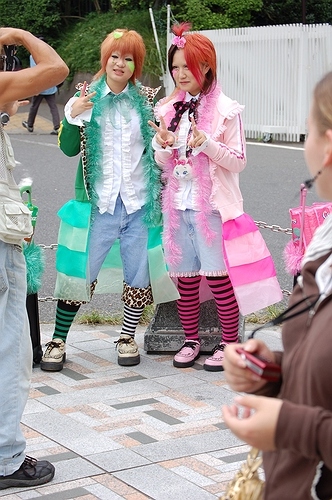
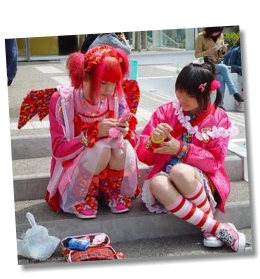
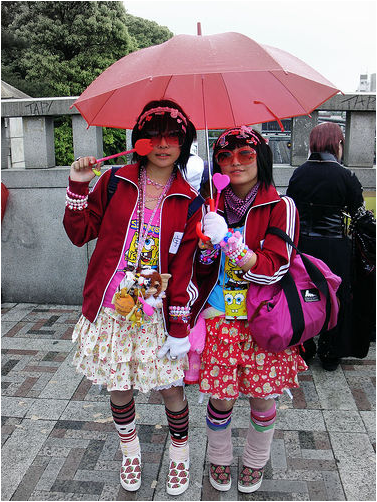
Breck C. sent us this link to a collection of photographs of Harajuku Girls. Harajuku is a style for teenagers in a region of Japan (here is the wikipedia entry). I can’t think of a way to describe them that does them justice, so here are some pictures (found here, here, here and here):

In 2004, Gwen Stefani began touring with four women posing as Japanese Harajuku girls. Stefani’s Harajuku Girls serve as her entourage and back-up dancers. Here she is with four (Japanese?) women that she hires to be her Harajuku Girls (found here and here):

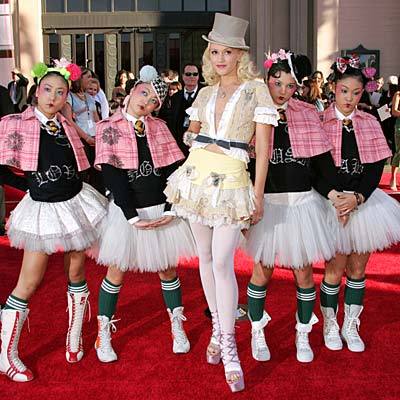
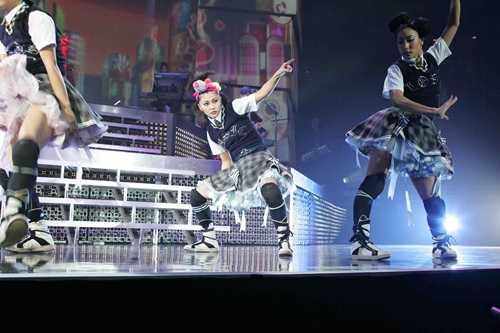
In the comments, Inky points out that Stefani says this about them in her song, Rich Girl:
I’d get me four Harajuku girls to
Inspire me and they’d come to my rescue
I’d dress them wicked, I’d give them names
Love, Angel, Music, Baby
Hurry up and come and save me
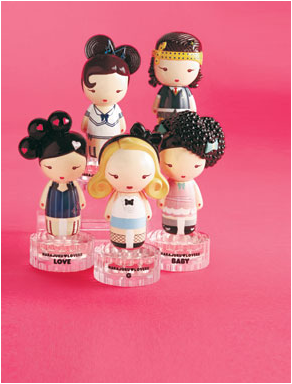
Stefani also has a Harajuku Lovers clothing line and a series of perfumes, one for her, and one for each Harajuku Girl:
I think that Stefani’s use of Asian women as props (they may or may not be Japanese) fetishizes Asian women and reinforces white privilege. The Harajuku Girls serve as contrast to Stefani’s performance of ideal white femininity. It makes me think of both this poster on colonial-era travel and this fashion spread.
Yet, Stefani’s been at this for four years and I can’t remember hearing any objections to her Harajuku Girls, even in feminist and anti-racist alternative media. Further, if her fashion line, perfume, and continued employment of the Harajuku Girls are any indication, people seem to think the whole thing is awesome. In the meantime, I bet she’s making bank on her clothing line and perfume. Where’s that money going?
Do you think my reading is fair?
And, if so, why do you think there’s been so little outcry?
For good measure, here she is performing with her “Girls”:
In our comments, SG asks that we include the following clarification:
This article is really misrepresenting a whole fashion scene and I would like to ask that you correct it- It is just perpetuating the idiocy and ignorance surrounding these styles. “Harajuku is a style for teenagers in a region of Japan”. “Harajuku style” Is a term coined by western media because they are too ignorant to actually research the names of these actual styles. Harajuku is not a style. It is a location. The females you have pictured are in Decora (and two in Visual Kei). The only “harajuku style” that exists is the fictional one made up by Gwen Stefani and the western media.
Thanks SG.
See also our post featuring other examples of ads and artists using Asians as props.
Comments 54
Kristin — November 19, 2008
This has been driving me crazy for ages. I think that if Gwen Stefani were a man, there would have been a huge outcry but as a woman, she's able to pass it off as "cute."
Kim — November 19, 2008
I agree with you that she uses these women and the idea of these women as little more than accessories. I also really hate the way she calls them 'girls.' I hate when grown women are referred to as girls because it is very dismissive. In this case, it also plays into the submissive Asian women idea. I heard a rumor (not sure if it's true, though. Tried to look it up, but no luck) that they were not allowed to talk, or they were not allowed to speak English, or something.
I also think that Stefani's version of Harajuku has little resemblance to the real thing, other than that the women wearing the Harajuku style are Asian. Harajuku is about individuality and originality, and the way she has all four wearing the same outfit goes against that.
Here's what Margaret Cho had to say about it when Stefani brought out her latest fashion accessories:
“I want to like them, and I want to think they are great, but I am not sure if I can. I mean, racial stereotypes are really cute sometimes, and I don’t want to bum everyone out by pointing out the minstrel show. I think it is totally acceptable to enjoy the Harajuku girls, because there are not that many other Asian people out there in the media really, so we have to take whatever we can get. Amos ‘n Andy had lots of fans, didn’t they? At least it is a measure of visibility, which is much better than invisibility. I am so sick of not existing, that I would settle for following any white person around with an umbrella just so I could say I was there.”
I'm not Asian, but I can totally see her point. There are not many Asian people in American media.
And by the way, according to the Wikipedia page about Stefani's Harajuku Girls, all four are Japanese.
Elena — November 19, 2008
For what is worth, what Western people mean when they talk about "Harajuku style" is the decora/ oshare kei fashions that used to be featured in FRUiTS magazine via the Phaidon Press collection of photographs. Yoyoji Park in Harajuku, for example, is where you find the gothic/ sweet/ punk/ whatever lolitas and visual kei cosplayers on Sundays.
(Condensed glossary: Decora/ oshare is the fashion style for which you dress as a six year old carrying all her collection of Disney pouches and handbags at once. Lolita is mostly dressing as a Victorian porcelain doll or a Little House on the Prairie extra with as many frills and lace as you can get away with it. Visual kei is a music subgenre where the musicians dress in an extremely *interesting*, androgynous way. Cosplaying/ costume playing is dressing as your favourite anime character or recreating the outfit of a musician you're a fan of.)
Gwen Stefani is an egregious case of Not Getting It. I don't recall her being mentioned in a lolita comm I'm member of in LiveJournal and not being derided for being such a pathetic poser.
By the way, tying with the African-themed clothing by American Apparel post from a while ago, these last days I've been seeing all over my blog feeds posts about Wafrica, a line of kimono fabrics inspired by African patterns made by a Cameroon-born designer.
becky — November 19, 2008
thanks, kim for posting that. i boycott hgwen stefani's music since she started this minstrel show, as cho calls it.
if anyone wants to read the original blog it is here:
http://www.margaretcho.com/blog/2005/10/31/harajuku-girls.html
then see gwen's ridiculous response to her in EW:
http://www.ew.com/ew/article/0,,1562569_4,00.html
But not everyone warmed to Stefani's ''whole fashion thing'' — in particular, the showcasing of her admiration for Tokyo trendsetters via an entourage of four Japanese women that she called the Harajuku Girls. The Girls silently accompanied her on photo shoots and to public appearances, and subsequently appeared on her tour. Stefani regarded the Girls, all of whom looked as if they had come straight off the streets of the capital city's hip Harajuku district, as a figment of her imagination brought to life in a culturally positive manner. But last year, Korean-American comedian Margaret Cho publicly decried them as ''a minstrel show.''
''She didn't do her research!'' spits Stefani, who says she's been a fan of Japan and its mix-and-match fashion sense since first visiting the country with No Doubt in the mid-'90s. ''The truth is that I basically was saying how great that culture is. It pisses me off that [Cho] would not do the research and then talk out like that. It's just so embarrassing for her. The Harajuku Girls is an art project. It's fun!'' (Cho told EW via e-mail, ''I absolutely agree! I didn't do any research! I realize the Harajuku Girls rule!!! How embarrassing for me!!! I was just jealous that I didn't get to be one… I dance really good!!!'')
Stefani continues: ''I was surprised how racist everybody was about them. Especially when I came over here and they'd make all these jokes, like Jonathan Ross.'' Ross, a British TV host, asked Stefani whether an ''imaginary hand job'' from one of her ''imaginary'' dancers would count as cheating on his wife. Stefani responds, ''Everybody's making jokes about Japanese girls and the stereotypes. I had no idea [I'd be] walking into that.''
NL — November 19, 2008
I do remember several years ago hearing the Harajuku girls being referred to as Stefani's "pet Asians" (this was a dig at Stefani, not the women).
I want to say I've seen some commentary in Bitch magazine, but in general, yeah, the silence has been deafening.
Corey — November 19, 2008
I've been trying to comment on this for about an hour, but every comment just gets sucked into the void... perhaps they have been too long. (Or maybe this post has some glitch and then they will all show up at once, in which case - sorry!)
Anyway, I totally agree on the interpretation, but don't agree that there was no coverage. I prepared a list of newspapers and blogs that covered this controversy (NYT, Boston Herald, Toronto Star, Salon, Entertainment Weekly) with links, but I can't seem to post it. In any case, a very brief google search should illustrate that it is not fair to say that no one covered this issue, "even in feminist and anti-racist alternative media" - its just that the coverage is from 2005 and 2006. I can find over a dozen references in about three minutes.
Corey — November 19, 2008
Brief list of articles on the subject:
- Toronto Star article from October 2005 [no link]
- Boston Herald column from January 2007 [no link]
- Entertainment Weekly coverage of Margaret Cho’s criticism [http://popwatch.ew.com/popwatch/2005/11/chos_not_laughi.html]
- Entertainment Weekly interview with Stefani that addresses the controversy:
http://www.ew.com/ew/article/0,,1562569_4,00.html
- Salon article from 2005 [http://dir.salon.com/story/ent/feature/2005/04/09/geisha/index.html]
- Seattle Times article that mentions the controversy in November 2005 [http://seattletimes.nwsource.com/html/musicnightlife/2002629786_gwen18.html]
- New York Times article that mentions, but does not elaborate on, the controversy in June 2005 [http://www.nytimes.com/2005/06/19/magazine/19CONSUMED.html?_r=1]
- Japan Inc. article from 2005 [http://www.japaninc.com/article.php?articleID=1454]
Corey — November 19, 2008
Blogs that covered this issue:
http://www.racialicious.com/2006/11/30/gwen-stefani-everyone-else-is-racist-not-me/
http://americansongbook.blogs.com/american_black/2005/06/speaking_japane.html
http://www.thefword.org.uk/blog/2008/06/harajuku_girls
http://www.thefighting44s.com/archives/2005/11/25/gwens-girl-trouble/
http://alivefromnewyork.blogspot.com/2006/12/gwen-stefani-racist.html
http://popdirt.com/new-doubt-is-gwen-stefanis-harajuku-obsession-offensive/43154/
Credit where credit is due!
Jay — November 19, 2008
I saw something about this in "Bitch" magazine a few years ago - can't find it on their website, but I know that's where it was. I do agree with your reading of it, and with Margaret Cho's very eloquent takedown.
Kathy — November 19, 2008
This has bothered me for years now!
The whole idea is just extremely troubling. I have always been particularly upset by the fact that Stefani "renamed" the women. They are known only as "Love," "Angel," "Music," and "Baby."
A few years back I was curious about their identities--were they Japanese pop-stars maybe with their own albums? I could not for the life of me find their real names or anything about them other than as Stefani's "group." They way they are utilized is as if they are simply props, and it makes me sick.
macon d — November 19, 2008
Good thorough work here, the many images especially. Regarding the "silence" on Stefani's racism, I blogged about it awhile back, for what it's worth, and included a pretty spot-on MadTV satire of her Japanophilia.
Inky — November 19, 2008
This reference to them in the song "Rich Girl" (implying that she's bought the women) is what has always bothered me the most:
"I'd get me four Harajuku girls to
Inspire me and they'd come to my rescue
I'd dress them wicked, I'd give them names
Love, Angel, Music, Baby
Hurry up and come and save me"
They're pets. Pets to dress up and name.
a. brown — November 19, 2008
This is pretty gross. I'd stopped paying attention to Gwen Stefani and her ilk, but how did I miss this? It's like they're not even people, but props.
Ryan — November 19, 2008
First off, I would say that this is just an extension of pop musicians co-opting "racial" influences and using them as a marketing ploy. I'm sure you could find several examples, but some that come to mind would be Madonna using "Latin" music, Vanilla Ice, Paul Simon using South African drum and accapella groups. I don't know that these examples imply the same level of "ownership" but the use of cultural "window dressing" is not unprecedented in pop music.
Futhermore, Gwen Stefani's entire album is sort of a disgusting cultural hijaking. Not only of the asian 'dolls" she poses with but the sort of faux rap goddess she impersonates throughout the CD. There are a lot of elements cribbed directly from black musicians, and most of these incorporate the same sort of ethnicities as "window dressing". I never get the feeling that Stefani is so much "collaborating" with the Eve or Pharrell on her songs as posing with these artists, aligning her own personal brand with their unique cultural identities.
Even before this album, in her No Doubt days, Stefani was sort of seen by individuals in the "scene" as co opting the two-tone / punk ethos and repackaging it as more consumable.
Gwen's use of Harajuku girls is just a clever marketing angle. She's co-opting Japan's greatest export "cuteness" and making it more palatable for little white girls in the US. It's an extension of kinds of Japanese exports such as Hello Kitty because much like Sanrio's anthropomorphic characters, the Harajuku "characters" are asian women who have been bowlderized to the point that appeal to people who want to consume "asian-ness" without having to sift through the cultural "odor" of products which might be produced by an individual from Japan for an individual from Japan. I mean, just looking at the pictures you've posted, it's pretty clear to me that a girl in America wearing "harajuku" wouldn't necessarily pass for a "harajuku girl" anymore than a guy in a green bowler hat and vest would pass for the Mayor of Dublin.
Elena — November 19, 2008
the Harajuku “characters” are asian women who have been bowlderized to the point that appeal to people who want to consume “asian-ness” without having to sift through the cultural “odor” of products which might be produced by an individual from Japan for an individual from Japan.
Speaking of which, this site has the Oricon charts, the Japanese top 40 list. You can click on any song to watch the music video. Compare :D
http://www.jpopasia.com/charts/
Kristin — November 19, 2008
Kathy, their wiki article has their real names and a little bit of background.
http://en.wikipedia.org/wiki/Harajuku_Girls
Lisa Wade, PhD — November 20, 2008
Thank you all so much for all your insightful and information-full comments! I learned a lot!
Matt W — November 20, 2008
Hey, just wanted to point out that you can find out their names here, assuming the article is accurate. Three were born in Japan, one was born in LA (of Japanese descent). And I too think it's creepy and offensive.
hypatia — November 20, 2008
Refering to what Kim said about the girls talking. They are allowed to speak in the general sense. I've included some interviews that were done with them BUT I remember an interview that Gwen Stefani did with Much Music (Canada's MTV) and she specifically told the interviewer that they should not speak to the "girls". It was squicky.
This is Jennifer or "Love" she's actually American but of Japanese heritage.
http://www.youtube.com/watch?v=FMBgkyZLnsY
The other three are dubbed in English, badly. Which is interesting because two of them have been living in the states for quite a long time before Gwen found them.
http://www.youtube.com/watch?v=XB8hUwtSfYc
http://www.youtube.com/watch?v=UzkEUQPRijM
http://www.youtube.com/watch?v=iYT146EFeiA
In fact here is Rino Nakasone ("Music") speaking absolutely perfect English while teaching a dance class.
http://www.youtube.com/watch?v=w3PmSNIGWaM
Vettekaas — December 7, 2008
Hmmmm I listened to this song for the first time a year or so ago and was just generally impressed that there was an American artist interested in different cultures.
Now that I've seen this post and that video I've learned two things: Gwen Stephanie can't dance very well.. and the "girls" are definitely a freak show. Cho got it right.
Halime — February 24, 2009
I thought I was going crazy and that no one else could see how vile a display this was!! woooh Im not alone lol.
Stefani has spent her whole life conventionalising and commercialising genres and styles such as skater, punk, reggae, ska etc etc, and it's wrong because no one can see that truely she has no real identity or style, they think she's really unique whereas she's just a use and chooser of other peoples cultures. I'm British...I love Manga, Anime and Harajuku styles of clothing BUT I dont make a decision to put on a show and totally kill someone elses culture to sell records or make a race appear 'cute' to appeal to a market..its creepy.
When she hops over to India, grabs a bindi and a sari and hires four new minstrels to jump around with, I'll be personally offended, Margaret Cho rules for pointing this out as the distasteful sham that it is.
Halime — February 24, 2009
**DAMN Just remembered shes already done the whole bindi thing.
Laura — April 25, 2009
what this seems like to me is that everyone is bored and wants to make something contraversial. really they are just back up dancers and gwen stefani is showing people a different culture i dont think she thought oh lets annoy everyone with 4 japanese dancers you people are being racist! >:(
SG — May 19, 2009
I'm sorry, but this has been killing me. This article is really misrepresenting a whole fashion scene and I would like to ask that you correct it- It is just perpetuating the idiocy and ignorance surrounding these styles. "Harajuku is a style for teenagers in a region of Japan". "Harajuku style" Is a term coined by western media because they are too ignorant to actually research the names of these actual styles. Harajuku is not a style. It is a location. The females you have pictured are in Decora (and two in Visual Kei). The only "harajuku style" that exists is the fictional one made up by Gwen Stefani and the western media. Please fix this.
Lisa Wade, PhD — May 19, 2009
SG,
I added your comment to the main post. Thanks for clarifying.
Undifferentiated Groups of Asians as Props » Sociological Images — October 20, 2009
[...] Gwen Stefani’s Harajuku Girls are another great example. [...]
Kitty — November 22, 2009
Harajuku is not a style of fashion. It is a fashion district in Tokyo where teens of many fashion genres hang out. All the pics you posted of "Harajuku girls" are actually teens dressed in Oshare Kei and Decora fashion. I think alot of the time you do not do your research. Gwen Stefani did have it all wrong and it was really annoying but it seems you don't really understand what she got wrong other than using Asian stereotypes as props.
Marushka — December 8, 2009
I think everyone is too busy listening to Stefani's inane pop music to be bothered about her using Japanese women as her little slave crew.
D — November 26, 2010
Did you all know that gwen is 5'6 and so are most of the "harajuku girls"? YET she always dresses to appear taller than them; she will wear towering platforms while putting them in the flattest shoes possible. She also dresses them in unflattering outfits while she dresses to look as glamorous as possible. Isn't anyone SEEING THIS?
It also says a lot about her that, despite all the beautiful women who are in japan, she chose four average-looking, unassuming ones. Specifically to accentuate her disgusting vanity. She's basically saying LOOK I'M A BEAUTIFUL WHITE WOMAN LOOK LOOK THESE ASIAN BITCHES AIN'T GOT NOTHIN ON ME. Basically she chose ugly dancers to make herself look better, and she looks better supposedly because she's white. It has nothing to do with her being white, of course. But these are the true subtle undertones of the situation. Subtle but real.
Where the hell is Ayumi Hamasaki when you need her?
Chera — January 2, 2011
Just thought I'd say, it's awesome that you included SG's comment. It's a very good point that readers should know about the fashions, and it's great that you take your readers into consideration. ;)
Lodonnabhair — July 2, 2011
I don't recall the interview, but Gwen Stefani actually has stated that she looks up to the "daring style" of Japanese subculture in Harajuku. She's not trying to insult the style(s) or Asian people in general, but instead bring a little of that to white America.
Not every instance of a white person who is surrounded by non-whites is an incident of racism.
Whimsy Stamps Blog Hop Starts Today! | Rockwell Designs — September 1, 2011
[...] daughter challenged me to create a card with her. My inspiration came from the outrageously cool Harajuku Girls. I am entering her into the Simon Says Stamp Anything Goes [...]
Staceyjean — December 18, 2011
This whole matter is between Stefani and her back up dancers, everybody needs to just mind their own business. They are not her slaves, they are well paid employees. They could quit if they wanted but they obviously find it worth it because they have been working with her for years. I never heard any of them speaking out against Stefani's so called "white supremacy" so frankly nobody else should be either. Instead, allow these adult women to make decisions regarding their employment. This performance is not going to "totally kill someone eases culture", Japan is globally known for being economically and culturally strong, and its citizens are known for being structured, intelligent people, the employment choices of four women whose heritage is linked with japan will not have a effect on the worlds view of Japan.
Fjgbkfsgbf — April 11, 2012
this ladys cool but crazy
ArsenicCatnip — August 6, 2012
Gwen Stefani is also a huge weeaboo (person obsessed with Japan and it's cultures usually only pop culture and tries to be Japanese)
Music on the Move Discos - Blog Post - Music on the Move Discos — November 6, 2012
[...] it’s not the first time Stefani has missed that mark. Remember when she had four silent Asian women posing as “Harajuku girls” to prop her up wherever she went? Oh, and then there was that phase in the 1990s when she wore [...]
Music on the Move Discos - Blog Post - Music on the Move Discos — November 6, 2012
[...] it’s not the first time Stefani has missed that mark. Remember when she had four silent Asian women posing as “Harajuku girls” to prop her up wherever she went? Oh, and then there was that phase in the 1990s when she wore [...]
Rookie » Something Borrowed — November 16, 2012
[...] Stefani’s bindi wearing (even though I honestly find it annoying) and more disturbed by her using Harajuku Girls as stereotype-affirming puppets to make money, branding an existing movement kind of like she [...]
Ispirazioni dalla strada » ShoppingUnlike.it — March 25, 2013
[...] Il Giappone è la patria contemporanea di questo stile: probabilmente conoscerete anche voi le Harajuku Girls, portate alla ribalta dai video di Gwen Stefani. L’Italia viene da sempre rappresentata come la [...]
Miley Cyrus, Feminism, Sexuality, and Appropriation | Almost Activist Waitress — October 18, 2013
[...] music videos are frequently being compared to Madonna’s Vogue video and Gwen Stefani’s use of “Harajuku girls”; essentially, that these white performers are using an “other” race as a background on [...]
Fandom at its most creative: EYK Fan art | The EYK Compendium — September 22, 2014
[…] and always evolving style of Simon and Martina (the 1950s silhouette meets the Harajuku scene/Decora style), Ivanrest has created a textile masterpiece; a piece of wearable fan […]
Dahami Samarathunga — May 20, 2018
Leave her alone!!!!!!!!!!! They are not her pets. They are well paid employees. Gwen Stefani is a great artist. In hallaback girl video she hangs out with them, empowering them and showing they're no hallaback girls. Some people got her wrong. Please leave this amazing woman alone.I'm an Asian.