Tag Archives: gender

A Beauty Regime for the “New Man”

Katrin B. sent in a page from the NatWest Bank magazine, Sense.  The page describes beauty products for the “new man.”  Katrin says she stared at it for a long time because it was just so…unfamiliar.

What’s striking about the page is that it doesn’t hypermasculinize the products, regimen, ingredients, or outcome in order to appeal to the male customer by de-feminizing the whole idea of beauty products.  

In other instances, we’ve seen hair products labeled things like “maneuver,” “retaliate,” “stand tough,” “work hard,” and “bulk up”; make-up for men named with terms like “power face mask,” “confidence corrector,” “mission balm,” “battle scars repair cream,” “cream me face base,” and “blo-job bronzing powder.”; and shaving your pubes marketed with the suggestion that it will make your penis look bigger.

Happy Super Bowl Day!

Jillian York, of the Berkman Center for Internet & Society, sent in this Yves Rocher ad in honor of Super Bowl Sunday:

So don’t forget, ladies: the Super Bowl, which you aren’t watching, keeps everybody else in the family busy so you have a little time to yourself, time best spent shopping.

Except when you have to refill the bowls of chips and buffalo wings, of course.

Also? Shut the hell up.

Barbie and G.I. Joe: Inscribing Gender Norms on Toys

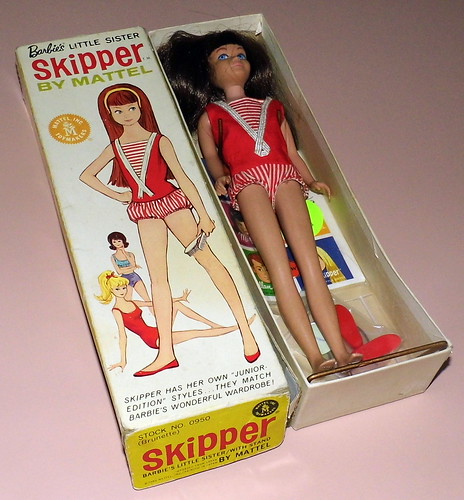
In “Barbie and Action Man: Adult Toys for Girls and Boys, 1959-93,” Judy Attfield* discusses differences in two popular dolls, Barbie and Action Man (known in the U.S. as G.I. Joe). She points out that Barbie has very few joints–basically at her shoulders, hips, neck, and perhaps the waist) and is thus very limited in what you can do with her. Her arms are either entirely straight or permanently bent at the elbow. Some versions have slightly bendable knees.

Action Man, on the other hand, were designed with a number of joints in their arms and legs. Original models (available from the 60s until 1984) were marketed with an intentional emphasis on the movement the joints allowed:

Here’s the recent version of the character General Hawk, I believe from G.I. Joe: The Rise of Cobra (from Pulse Figures):

At least some dolls in the current G.I. Joe line have joints in their hands so it’s easier to make them hold things.

Attfield’s argument is that the design of these dolls illustrates assumptions about gender. She says, “…the Action Man figure embodies the increasing possibility of complex movement. Conversely, the simplicity and minimal number of joints in Barbie suggests the priority given to posing rather than action” (p. 82). She is, essentially, for dressing up and looking at, but that’s about all (and getting outfits on over those stiff arms was often quite the task).

The New Living Barbie, which came out in 1970, has more bendable joints and was advertised with the line “as posable as you are”:

So even when a Barbie was introduced to have more flexibility, the emphasis was still on posing–the box doesn’t say “as active as you are,” after all.

Thus, according to Attfield, “…the cliché of ‘feminine’ as passive and ‘masculine’ as active is literally embodied in the design of toys” (p. 85). (She also points out that while doll lines aimed at boys include “bad” characters that serve as the enemies of the protagonists, those marketed to girls, such as Barbie, have yet to include “bad” characters. There’s no evil Barbie who tries to steal Ken away.)

I thought of this when I saw the image Brian Brock sent in (found at Tennis Forum) of a new Barbie meant to represent tennis player Kim Clijsters and her daughter, Jada. Unlike other Barbies, this one clearly has multiple joints that would allow a wider range of motion (though she’s still on her tiptoes, of course):

In this case, some of the design elements that allow more movement in G.I. Joe-type dolls have been incorporated into a Barbie, making her more able to hold things, swing a racket, appear to be running, and so on.

As it turns out, however, this Barbie won’t be available in stores. It’s a showcase model to be shown at toy fairs and the like. So we have a Barbie designed to be less passive…but she’s not actually for kids to play with.

UPDATE: Reader Holly points out that Mattel has experimented with more “action” oriented Barbies before with the WNBA line:

They were actually available in stores. However, I don’t think this really undermines the overall point. There’s no reason that ALL Barbies couldn’t be built like this and still fit into the regular Barbie clothes. But the increased flexibility is incorporated only into “special” Barbies that seem to be sports-related, not the main Barbie line.

* From The Gendered Object, edited by Pat Kirkham. 1996. NY: Manchester University Press, p. 80-89.

Helping Robot is, Unremarkably, Female

Lynn S. sent us a link to a Carnegie Mellon story about a new robotic “nurse” for the elderly.  Her name is “Pearl.”

It should go without saying that robots do not need to be gendered male or female and that, in this case, gendering the robot female reproduces a wasp’s nest of stereotypes about who is responsible for caring for others.

I say it should go without saying but, in fact, it mostly does, in the most bizarre way.  The article is about trying to maximize Pearl’s effectiveness as a helper by testing various configurations of appearance, mannerisms, expressions, etc.  But they never address why she is female.  From the article:

To that end, a multidisciplinary team of roboticists, social scientists and interaction designers has drawn on theories of emotion from cognitive science and the principles of aesthetics to explore what happens when human characteristics are added—or taken away—from Pearl’s “persona.”

Appearance has a strong impact on a person’s expectations. Researchers want to learn whether facial characteristics will factor into the emotional reaction of people who interact with her. Pearl’s configurable head, the size and spacing of her eyes and the shape of her lips are all important elements in projecting a “persona.”

In the caption to this image, they mention the importance of her “configurable head” for her “persona,” but her gender remains conspicuously unexamined.

Only once in the entire article do they mention gender.  They say that they are “…studying people’s responses to a robot’s perceived gender by changing Pearl’s lips and voice.”  But they named her Pearl, so they seem to have rushed to a conclusion there.  It’s as if, despite the incredible range of concerns and experimentation, scientists are not seriously questioning her sex. 

And I think they should!  Not only because it’s good science, and not only to avoid sexist assumptions, but because the robot is being designed for senior citizens, who are disproportionately women, most of whom have spent a lifetime caring for children and husbands; I’d bet they’d find a nursebot named Peter to be quite a treat!

Joblessness by Race, Age, Gender, and Education Level

As a white woman between 25 and 44 with a college degree, I am the least likely category of person to be unemployed according to an interactive graphic detailing the joblessness rate for people according to their race, education level, age, and sex (since Jan. ‘07).  It is a rather devastating look at social inequality.  I recommend visiting the site to see for yourself, but below are some screen shots with some comparisons.

For comparison, the overall joblessness rate which, as of Sept., was at 8.6 percent:

The joblessness rate for white people (notice it is lower by 1.4 percent):

The joblessness rate for black people is almost twice that of whites:

Let’s add education level.

The joblessness for whites who have not yet graduated from high school is 17.5 percent:

The joblessness for comparative blacks is 10 percentage points higher.  Notice that the scale on the right hand side has changed from 0-20 percent (above) to 0-50 percent:

If we look at young blacks (15-24 years old) who haven’t been able to complete a high school degree, the joblessness rate is 42.7 percent:

If we restrict the numbers to young black men without a diploma, we see a whopping joblessness rate of 48.5 percent.

For comparison, here is the same kid, but white (the joblessness rate is cut in half, but is still huge, even by recession standards):

Ever wonder why young men turn to the underground economy?  Well, this is why.  Somewhere between 25 and 50 percent of them can’t get a job in the “above ground” economy.  What’s a kid to do?  Add in the rational choice of choosing work that pays more than minimum wage, and you’ve got a whole group of young people who participate in illegal activities.

Then, of course, we police black neighborhoods more aggressively than white neighborhoods, convict black people more frequently than white people, and send them to prison more often and with longer sentences (see also this post).

And, too add insult to injury, after all is said and done, a black person without a criminal record is less likely to get a job interview than a white person with one.  A black person with a criminal record: his chance of getting a call back after dropping off a resume (even at a place like McDonalds) is something like five percent.  No I’m not joking.

<sarcasm>Oh, but if they just had a good attitude and learned to talk right, they too could be successful in this life.</sarcasm>

It’s almost too much to bear.

—————————————–

Via Matthew Yglesias.

Diversity in Beauty Apparently Measured in Inches (NSFW)

Bri A. alerted us to the marketing strategy for Love magazine’s current issue.  They posed the eight women “generally acknowledged as the most beautiful in the world” in identical poses.  The effect, editor-in-chief Katie Grand asserts, is to demonstrate “how much they differed physically from one another, which is why we also printed their measurements…”  You tell me.

Oh, maybe not safe for work, so after the jump…

(more…)

The Burqa, Fashion, and Measures of Freedom

Tilly R. sent in the clip below of Bill Maher attempting to illustrate the oppressiveness of the burqa by staging a fake fashion show in which every model comes out in an identical burqa. You only need to watch the first couple models to get the idea (starts at about .20 sec.):

The comedy is tasteless, at best. And it brings out two interesting assumptions: that measures of women’s liberation include (1) the right to show skin and/or your body’s shape and (2) the choice to express your individuality through your clothes.

It is with a focus on the latter that I introduce a website submitted by K.L. The website, Zarina, sells burqas. While most of the burqas we see in Western media are blue or black, this website sells burqas of all stripes.

A blue, embroidered burqa:

A “hot pink” burqa:

A saddle brown burqa:

A Turkish flag burqa:

An Afghan flag burqa:

An American flag burqa:

A camouflage burqa:

I have no idea if this website is legitimate (though it seems to be) and I have no idea whether women in (which) different burqa-requiring/encouraging societies can actually choose to wear these. I really have no idea.

But I do think it prompts us to interrogate our own assumptions about what women’s liberation looks like and if being able to choose your own style really is a good measure of it.

I’d bet that most Western women feel like being able to choose her clothes is a central part of her sense of freedom. Does that translate in this context? That is, if women were required to wear burqas, but could wear any burqa they like, does this mediate how oppressive the burqa seems to you? Conversely, does the seeming freedom that comes with choosing your clothes become less convincing once you think about it in this context?  I know this is tough to think about, but I think it’s an interesting thought experiment.

————————————

For related posts asking us to think about the relative freedoms represented by the burqa and the power of the male gaze, see here, here, and here.

Celebrate Black History Month by Relaxing Your Hair

In honor of Black History Month I thought I’d post this Family Dollar ad from last February, sent in by Gloria K.:

As Gloria says, “I guess nothing honors African-American heritage quite like cream relaxer.” Indeed. If only they’d included some skin lighteners, we’d really be set.

[Random advice: As a person with super, extremely, extraordinarily curly-for-a-White-person hair, I am telling you: do not let anyone convince you that you should try these products to straighten your hair. This stuff will burn the shit out of your scalp. You will feel like it is on fire. I can't imagine that it doesn't feel about the same for Black women. This is a product invented to torture people.]

What Was in the 1941 College Woman’s Closet?

The New York Public Library posted a page from the first issue (September 1941) of Design for Living: The Magazine for Young Moderns that I thought was sorta neat for bringing some perspective to the increase in the amount and variety of clothing we take as normal today–but also, to my relief, the acceptance of a more casual style of dress. The magazine conducted a poll of women at a number of colleges throughout the U.S. about how many of various articles of clothing they owned. Here’s a visual (larger version here) showing the school where women reported the highest and lowest averages (the top item is a dickey, not a shirt):

Overall the women reported spending an average of $240.33 per year on clothing.

Hats for women were apparently well on their way out of fashion:

Can you imagine a magazine aimed at college women today implying that you might be able to get away with only three or four pairs of shoes, even if that’s what women reported?

At the end of the article they bring readers’ attention to the fact that they used a sample:

I can’t help but find it rather charming that a popular magazine would even bother to clarify anything about their polling methods. So…earnest!

“Mother’s Hours”

Catherine L. sent in the following picture of a (gramatically incorrect?) ad in the window of a sportings good store in Wellesly, MA:

“Mothers’ hours” refers to those hours during which kids are in school.  The term reveals the assumption, or prescription, that it is women who take care of kids after school. 

Of course, that a company is offering work to primary caretakers is actually quite nice and supportive of families.  But it would be entirely easy to instead say “parents’ hours” instead.  Still, it’s possible that employers would be suspicious of any man who wanted to work only part time and assume they were both bad fathers and bad workers.  Employers are known to discriminate against men who do not put their job before their family.

Asian = Exotic

Alexandra N. sent in some images of a line of fingernail polish to be released February 3rd by OPI. The line is called Hong Kong:

Names of the colors all play on words or images associated with Asia in general or China more specifically:

Many of the ads and shelves for the polish feature alluring Asian women:

I couldn’t find a website for OPI, so I don’t know how the company is describing the Hong Kong line.

I think Alexandra sums it up well:

It is interesting to me that OPI has taken a color pallet and marketed it as exotic and exciting simply by calling it the Hong Kong collection.

[Update:  Reader Anny immediately found their website. Why it didn't come up when I googled it, I don't know. They don't have anything up about the Hong Kong collection yet from what I saw, but they've apparently done similar lines based on Spain (with flamenco dancers) and France (I don't know what about those women is supposed to look French). There are others as well. So apparently OPI has a running theme of picking a place and playing on stereotypes and puns commonly associated with it, and not just Hong Kong. So my initial linking of collections specifically to Asians wasn't quite on target, as it appears to be their "thing" to do stuff like this.]

It’s a common ploy: references to Asia, and particularly Asian women, are an easy way to broadcast the idea that your product is exotic and mysterious. And Asian women like being tied up. And they make people hungry. Groups of Asians make good background props or dancers too.

At least the ads don’t have cherry blossoms.

“We’re Only Protecting Them From Themselves”

In a patriarchy, masculinity is considered superior to femininity. Requiring women to perform that denigrated identity is one way that they are subordinated. But the flip side of that is the requirement that men must eschew everything tinged with femininity, lest they, too, be denigrated. This means that men’s daily lives are absolutely filled with things they are not supposed to do. (Whereas women can do masculine things, as long as they balance that behavior with feminine things, because masculinity doesn’t carry the same polluting effect.)

We’ve offered many examples of this policing of men’s behavior. It’s everywhere, in sports (see here and here), cartoons, schools (see here and here), and Cosmo, and in advertising for McCoy CrispsHungry ManSoloChevydog foodMiller beerbeef jerky, alcohol (see hereherehere and here), cell phones, and Dockers.  See also: “how to give the perfect man hug” and “how I sit on the bus”.

This one, sent in by Kelebek, is another great example. It’s an Australian ad for Toyota in which they are trying to re-brand Toyota as a masculine vehicle. It begins: “It’s a hard country.  And we want to keep it that way.  Nothin’ soft gets in.  That’s our motto.”

So, in these two minutes, we learn that men are not allowed to use hairspray, put their polo collar up, drink lattes, have fuzzy little dogs, be urban, eat tofu or soy sausages, carry a man bag, be a metrosexual, drink sparkling water, have designer luggage, wear cologne, have a sweater around your neck, wear crocks, shave your chest, use lip balm, or eat crossaints.

UPDATE! Reader Jeff Kaufman added a class analysis (in the comments) that I think is spot on:

We’re misinterpreting the toyota ad. It’s not primarily about gender. It’s about the urban / rural divide. The setting is an (imaginary, of course) border crossing from urban to rural australia. At the checkpoint there are rules about what can be brought in from the city. The claim is that the outback is no place for people, pets, and objects that are fragile, soft, faddish, environmentalist, or useless people. The outback is a harsh place where you need a tough vehicle, which toyota would be happy to sell you.

So I disagree with the summary that the toyota ad is saying “men are not allowed to use hairspray, put their polo collar up, drink lattes, have fuzzy little dogs, be urban, eat tofu or soy sausages …” Primarily, it’s saying that in rural australia, none of this is allowed for anyone. A customs official takes away a fluffy little dog from a little girl riding in a car with her parents!

There *is* a men-should-conform-to-gender-roles message here too, but it’s complex. It’s saying that one aspect of urban culture which is not allowed in the outback is men being concerned with health or appearance. Rural people considering urban men to be dandies and fops is nothing new, though, and has its parallel in urban people considering rural women to be unladylike.

Steve W. also sent in this Dodge Charger commercial with the same theme. It, too, lists a whole slew of things that men are supposed to eschew:

Patriarchy: nobody wins.

Men: “Be Stupid”

We talk about a lot on this blog about how things that having nothing to do with genitals are, nonetheless, gendered. Some sociologists are noting that a cluster of ideas related to intellectualism–liking school, studying hard, being smart, reading, and even caring about ideas–have become feminized. As a result, boys and men express less interest in and invest less in school, and girls and women are kicking their asses, scholastically speaking.

We previously featured an advertising campaign for Wrangler that told men to “stop thinking.” And this week Monika P. and Kat B. sent in an ad campaign for Deisel with the slogan: “be stupid.”

There’s a whole commerical (embedded below), but the general thrust is that smart people are doin’ smart stuff, but Diesel is “with stupid”:

Because “stupid is the relentless pursuit of a regret free life.”  And while smart people may have “the brains,” stupid people have “the balls”:

Besides, they say, “if we didn’t have stupid thoughts, we’d have no interesting thoughts at all.”

Which doesn’t make the slightest bit of sense, but whatever.

And in case that doesn’t convince you, they concede that “smart has the authority,” but stupid has “one hell of a hangover”:

Sign me up.

Ultimately the message is that smart people are repressed and confined, they have no fun, and nothing exciting ever happens to them.  So being smart is framed as (but isn’t) the opposite of all these things.   They leave you with this thought:

No, no I suppose you can’t.

Here is the “philosophy” that I borrowed from above; below are some of the print ads:

To be fair, some of their print ads included women (like the one above), so maybe this isn’t an example of the gendering of intellectualism… maybe it’s an example of the promotion of widespread gender-neutral anti-intellectualism.  In that case: Yay?

But a lot of the ads that do include women include them in bikinis or sexually-suggestive situations (see below; plus there’s the whole “balls” comment), so I think I’m going to go on record and say that this is still aimed primarily at men.

UPDATE! That said, Reader Kyle Munkittrick offers a compelling rebuttal at his blog, Pop Transhumanism.

Guest Post – Jersey Shore: On Beauty and Not Even Looking Italian

Please welcome Guest Blogger Irin Carmon. Carmon is a reporter at Jezebel.com, from where we’re super pleased to have borrowed the post below.  Her work has also appeared in the New York Times, Boston Globe, The Village Voice, and others; more information is at www.irincarmon.com.  Her evaluation of Jersey Shore is very different from one we posted recently, so we thought we’d add it to the mix.

————————————–

Jersey Shore has come to end, we’re (genuinely) sad to say. We know we had fun. But is it possible we also saw something, dare I say it, subversive about beauty, gender and sexuality? I think so.

A panel discussion on the show and “Guido culture” at Queens College yesterday (you read that right), included New York State Senator and Jezebel heroine Diane Savino, who knows from stinging cultural analysis.

[Savino] explained, “‘guido’ was never a pejorative.” It grew out of the greaser look and became a way for Italian-Americans who did not fit the standard of beauty to take pride in their own heritage and define cool for themselves.

When she was growing up, everybody listened to rock; girls were supposed to be skinny with straight blonde hair (like Marcia Brady on “The Brady Bunch”); guys wore ripped jeans, sneakers and straggly hair.

The 1977 film “Saturday Night Fever” marked a turning point. “It changed the image for all of us,” Ms. Savino said. As Tony Manero, John Travolta wore a white suit, had slicked short hair, liked disco music and was hot. “It was a way we could develop our own standard of beauty,” she added.

In the same way, Virginia Heffernan writes in this weekend’s New York Times Magazine, Italian-Americans in the Northeast originally disdained their own accents until movies like “Mean Streets, Saturday Night Fever, Working Girl and, of course, Taxi Driver.” Those representations, she says, led to a “hammy” reclamation of an identity that had been mirrored back to them through Hollywood. These were second and third generation immigrants, who had mostly reached the middle class but maybe didn’t feel wholly a part of the mainstream, who telegraphed their identity through stylized symbols like Italian flags and red sauce that felt potent but no longer limited their social mobility.

That goes for the ladies too. Female beauty that took on a showily “ethnic cast” was distinct from what was already being sold. As Regina Nigro recently put it on The Awl:

We (I) laugh at bon mots like “You don’t even look Italian!” (the insult that Sammi “Sweetheart” flings at the blonde blue-eyed “grenade” …) but, ridiculous as it is, that assessment betrays a value system: Skinny blonde pale WASP princesses are deemed not attractive when measured by the JS aesthetic. And this seems curious and laughable to us.

“You don’t even look Italian!” is crazy funny but is the underlying judgment (dark hair/olive skin/Italian-looking = pretty; the inverse = not pretty) any worse than any other standard of beauty? It’s an alternative perspective, one that I suspect is so funny partly because it is so unfamiliar.

Of course, there is plenty about the Jersey Shore sexual aesthetic that is broadly familiar. The worst insult is to call a woman fat (or a “hippo”); big, exposed boobs are a baseline requirement, and the men are judged by the attractiveness of the women they acquire. (The other guys repeatedly mock The Situation about the looks of the women he brings home; Ronnie taunts him that he hasn’t brought home a girl anywhere near as pretty as Sammi).

And yet it’s oddly refreshing how much artifice itself is celebrated, with everyone participating mightily, and openly, in becoming the ideal Guido. No one is just born one, or supposed to make it look effortless. There are communal visits to tanning salons and unblinking references to fake breasts, and everyone takes hours to get ready. Vinny describes a girl admiringly: “Fake boobs, nice butt, said she was a model.”

Heffernan, writing about regional accents being reinforced by the show, uses Sammi as an example: “Every part of Sweetheart’s identity – including her skin color, which on the show is not an inborn marker of ethnicity but a badge of achievement (in the tanning bed) – is the product of intense calculation.” And Heffernan didn’t even get to Sammi’s hair extensions, which are brandished for emphasis.

No character more desperately self-produces than The Situation and his third-person pronouncements. Men are not inscluded [sic] from all this ritual artifice. In the last episode, J-Woww practically goes into heat when she sees some “juicehead gorillas” on the beach, and she lists “Human Growth Hormone” among the attractions. This, by the way, leads The Situation to mumble defensively, “Big is out and lean is in.”

That’s because on The Jersey Shore, men’s bodies are just as scrutinized as women’s, and their beauty rituals are as elaborate, expensive, and time-consuming as those of the women. Maybe even more so — in addition to blowouts, tanning sessions, and agonizing over which appliqued shirt will set them apart from the gelled masses, they spend hours at the gym, something we never see the girls do.

As much as the cast performed all this around the clock during the show’s taping, the audition tapes seen here and in the video below are even more extreme, mixing ethnic calculation with the general famewhoring savviness reality producers have become accustomed to.

Looking at this through what we know now: Sammi calls herself a “hookup slut” but aside from a few flirtations, turned out to be conventionally monogamous on the show. Vinny, in straight-up costume, claims he has to take off his pants “to really show you the magic,” but turned out to be the mildest-mannered cast member, one who unashamedly adores his doting mother. Underneath playing to the producers, though, is a more personal kind of construction, and a more particular one. And ironically, although the cast members’ self-creation was one of the most entertaining parts of the show, some underlying sense of unembarrassed authenticity, even wholesomeness, made it most worth watching.

Adultifying Kids in a Mini Daddy Video

Victoria G. sent in the video for the reggaeton song “El Niño Mas Bonito” by Mini Daddy, aka Adriancito of Monterrey, Mexico. Victoria says, “this video makes me cringe.” See why:

The adultification of kids…the little girls serving as stage props for his performance…right there at the end, is the way his hand moves suggestive of a crotch grab or am I crazy?

I’m cringing so much I’m probably going to get a cramp in my shoulder.