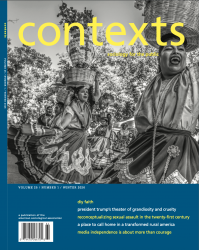
Author Guide
Contexts is the public-facing quarterly magazine of the American Sociological Association, where our goal is to curate and promote the most trailblazing and newsworthy sociological research to a general audience of nonacademic readers. Our editor, David Grazian, Professor of Sociology and Communication at the University of Pennsylvania, leads an all-star editorial team of sociology faculty from the University of Amsterdam, Chicago, Cornell, Massachusetts, Notre Dame, and Rhode Island College, along with a cadre of talented doctoral students from Penn, including our truly indispensable managing editor, Elena van Stee.
As the public face of sociology, Contexts delivers crisp, jargon-free writing, engaging research findings, reviews, and photography to its readers. We welcome contributions from fellow sociologists at any career stage, including undergraduate and graduate students, college and university faculty members (including adjunct, part-time, full-time, and emeritus faculty in research and/or teaching positions), and sociology degree-holding practitioners working in adjacent fields in applied research, data analysis, consulting, policymaking, and other related professional areas.
Please note that we accept two kinds of submissions for publication consideration: 3,000-word peer-reviewed features, and shorter contributions to the magazine’s five specialized sections (Culture, Books, Policy, Trends, and In Pictures), which our section editors directly evaluate and select for publication. Our proposal and submission processes are different for each type of contribution. For notes on style, please skip to the end of this piece.
features
We publish sharply penned features written without jargon, footnotes, or formal citations for a broad public audience. Given our attention to readability, relevance, and newsworthiness, our features share much in common with long-form journalism and creative nonfiction. However, given that we are one of sociology’s flagship publications, our authors research and prepare their submissions by drawing on the most current sociological approaches, concepts, methods, and ideas offered by our field. Please learn more below about the proposal and development process and the production process.
proposal and development
Each Contexts feature begins as a proposal, or pitch. Authors submit their pitches online through ScholarOne. Please follow this link: https://mc.manuscriptcentral.com/contexts
No more than two pages long, feature pitches must include the following in a single document:
- Name, institutional affiliation, and a brief bio for each author. (See the notes on style section below for our specific bio format).
- A proposed title and 50-word summary. Authors should not prepare a formal, technical abstract as they would for a traditional scientific journal. Instead, in simple language, please walk the reader through your central argument, the data you used to arrive at your findings, and the impactful takeaway of your piece.
- The opening 3-5 paragraphs of the proposed feature, all written with style, persuasion, and clarity. Prepare your pitch to illustrate your understanding of our vision for Contexts—a sociologically-informed, public-facing magazine that delivers the most important current research to a general audience of nonexpert readers. In doing so, your pitch should demonstrate the proposed submission’s immediate freshness, relevance, newsworthiness, and urgency to the public in a jargon-free manner.
- Five recommended resources written by fellow sociologists to help curious nonacademic readers learn more about our field. This should not look like a traditional academic bibliography or set of citations, but a genuine resource to invite lay readers to learn more about sociology through your specific topic and lens. (See formatting guidelines below.)
- Three to five keywords for your feature. Please do not resort to scholarly jargon here, but use words and concepts easily searched online by nonspecialists to help direct them to your contribution.
Upon receipt the editorial team will quickly review your pitch, and if approved we will send you a memo inviting you to submit a completed 3,000-word manuscript through ScholarOne, usually within 30 days. Our memo will often include suggestions for the overall direction your feature should take to ensure compatibility with the magazine’s public-facing aims.
After receiving your full manuscript, we will first review it in-house for approval. If it is not quite ready for review, we will either decline the submission outright or ask you for a pre-review revision. If eventually approved, we will immediately send your manuscript out for external peer review. Based on those reviews and our own assessment of the manuscript, we will determine whether to accept the piece for publication, decline it, or invite a revision. Although multiple rounds of reviews and revisions can certainly feel burdensome to authors, reviewers, and editors alike, please recognize that features often require this back-and-forth process of constructive collaboration to ensure they reach their full potential.
production process
Although the American Sociological Association sponsors our work here at Contexts, please bear in mind that our production process dramatically differs from any other ASA publication. After we accept a feature, our hardworking staff will subject it to a professional, line-by-line editorial treatment as befitting an award-winning magazine like Contexts approaching its 25th year in (now virtual) print. After completing multiple rounds of editing, revising, and polishing, and its authors have officially signed off on their contribution’s finalized version, the editors will take the manuscript into production. This entails the selection of images (whether illustrations, photographs, or a data visualization) accompanied by written captions, the development of captivating titles and navigable subheadings, approval of all recommended resources, and a final round of copyedits. While we sincerely strive to honor the wishes of our authors in these matters to the best of our abilities, please note that all final decisions rest entirely at the discretion of our editorial team, as they would at any other professional magazine.
Authors will eventually review page proofs of their contribution after our production team at Sage has designed its graphic layout according to their own set of internal guidelines. Upon receipt, please give all page proofs a careful, character-for-character reading with an eye toward correcting only typos or egregious errors of fact. (In other words, authors should not confuse this valuable but time-sensitive opportunity as an invitation to rewrite their contribution.) Upon publication online, we will work to publicize your feature through our digital digest, coordinated outreach efforts, targeted emails and social media campaigns, and the ASA’s own substantial communications apparatus.
For every submission, we strive to complete our external peer-review process and issue a decision within two to three months of receiving a full manuscript from our authors. We will endeavor to edit, polish, and publish all accepted manuscripts in our queue as soon as possible, depending on the number and type of manuscripts progressing through our magazine’s constantly churning pipeline.
specialized sections
Whereas our features usually run about 3,000 words, Contexts also publishes shorter contributions in five specialized sections, which include culture, books, policy, trends, and in pictures.
culture
Our culture section broadly publishes sociological pieces (1,300-1,500 words) on how humans make meaning in everyday life. We welcome contributions on a wide range of topics, including food, media, art, music, fashion, technology, politics, and descriptive observations of social behavior and public life. Send a 2-3 paragraph proposal to Ashley E. Mears at a.e.mears@uva.nl.
books
For our books section we especially encourage review essays of books not typically considered sociological texts, per se—literary novels, plays, and short fiction; biographies, memoirs, long-form journalism, and other genres of creative nonfiction; and a diverse array of all other kinds of trade books and print media. (For book reviews of more scholarly works of sociology, please consult the ASA journal Contemporary Sociology.) Contributions should place these media in conversation with larger sociological ideas, concepts, and approaches. Send book and topic suggestions in a 2-3 paragraph proposal to Jonathan Wynn at wynn@umass.edu.
policy
This section publishes contributions (1,300-1,500 words) that offer sociologically informed approaches to public policy, broadly considered, as well as its effects on society at large. Send a 2-3 paragraph proposal to Chad Broughton at cebrough@uchicago.edu.
trends
Our trends section presents data-driven articles (1,300-1,500 words, accompanied by 2-3 charts or graphs) that contextualize the most innovative and creatively collected and analyzed quantitative research designed to share compelling, perspective-shifting stories with our public readership. Send a 2-3 paragraph proposal to Cristobal Young at cristobal.young@cornell.edu.
in pictures
Essays prepared for the in pictures section are nuanced visual explorations of sociological themes, concepts, and ideas. To pitch an essay idea, authors should compile (1) three choice images they would center in their submission, and (2) a one-paragraph proposal that states the sociological argument they wish to make, while at the same time articulating how the images they selected might contribute to that argument. Send proposals to Terence McDonnell at tmcdonn2@nd.edu. If invited to prepare a completed essay for consideration, full submissions should have 8-10 images (high-resolution JPEG files, must be at least 1MB per file) with accompanying captions, along with a 750-word introductory essay.
notes on style
With few exceptions, Contexts adheres to official ASA style, which generally conforms to the guidelines set forth in the Chicago Manual of Style, 18th edition. We also encourage authors to write in a more conversational tone than that exhibited in most academic writing, and to hyperlink instead of formally citing their sources. See our following tips below, all intended to assist authors preparing to submit to Contexts.
jargon: We do not use jargon, academic-speak, or esoteric language in Contexts. Examples of words to avoid when writing for us might include (but are not limited to) the following: “hegemony” or “hegemonic,” “normative,” “affordance,” “habitus,” “performativity,” “heuristic,” “interpellation,” “hermeneutic,” “phallocentric,” “agentic,” “regression,” “stochastic,” “multinominal,” and the use of the word “gender” as a verb (“gendered,” “gendering”). The list surely goes on.
voice: Whenever possible we use the active instead of the passive voice in our writing. This often means revising sentences that use linking verbs (such as “is,” “are,” and “was”) to make them clearer and more direct by emphasizing the subjects performing the actions in question. For example, one should revise “The Manifesto of the Communist Party was written by Marx and Engels in 1848,” to read “Marx and Engels wrote the Manifesto of the Communist Party in 1848.”
identification: The first time someone is mentioned (whether a scholar, celebrity, or another public figure), briefly indicate who they are: “French sociologist Pierre Bourdieu,” “Amazon cofounder Jeff Bezos,” “Beatles’ lead guitarist George Harrison.”
commas: In keeping with ASA/Chicago style, we use the Oxford or serial comma, and we will use it tomorrow, the day after, and for all time.
citations: We do not use full, formal citations, but instead use hyperlinks and fold citation information into the text of each piece.
- Example: In their 2020 American Sociological Review article, sociologists Seth Abrutyn and Anna Mueller wrote…
- Example: During a recent interview with conservative commentator Hugh Hewitt, President Trump weighed in on California water policy.
recommended resources: Rather than a bibliography or reference list, we ask features authors to include a set of up to five recommended resources along with a one-sentence descriptor for each. When doing so, please adhere to the following:
- In keeping with our mandate to promote sociology to the public, recommended resources should meet at least one of the following criteria: (1) authored by one or more sociologists, (2) appear in a sociology journal, (3) include an interview with one or more sociologists, or (4) profile the scholarship of one or more sociologists. Exceptions may include publicly available reports released online by U.S. government agencies, NGOs, or research centers. Please check with the magazine’s editors in cases of confusion.
- In keeping with our mission of prioritizing access to the public, lists of recommendations should prioritize resources that can be easily located and accessed by nonprofessional readers. In other words, whenever possible, choose books in print and non-paywalled journal articles instead of conference papers, white papers, book chapters appearing in edited scholarly volumes, or reports generally unavailable online.
Meanwhile, descriptors should briefly explain why the resource might suit the interested nonexpert reader who wants to learn more about our exciting field. Each recommended resource should include a full citation (see examples below) followed by a single sentence describing its content or contribution.
- journal article: Curtis Child. 2021. “How to Sell a Friend: Disinterest as Relational Work in Direct Sales,” Sociological Science 8. This article shows how sellers obscure their economic interests when recruiting friends.
- newspaper or magazine article: Jessica McCrory Calarco, “Why Rich Kids are So Good at the Marshmallow Test,” Atlantic 1 June 2018. This magazine article provides a sociological challenge to experiments in social psychology that assume that one’s ability to delay gratification is shaped by an innate sense of willpower rather than conditioned by their experience of economic hardship or affluence.
- book: Michael Sierra-Arévalo. 2024. The Danger Imperative: Violence, Death, and the Soul of Policing. Columbia University Press. This penetrating and provocative book introduces the concept of the “danger imperative” to examine how police culture shapes officers’ perceptions and practices of violence.
author bio: Contexts bios follow a three-part formula:
- first sentence: State your current role and institutional affiliation.
- second sentence: List up to three research interests.
- third sentence (optional): If you are a book author, you may include your book title here. Please do not list your book if it already appears in the recommended resources section. Do not include the publisher or year.
Examples:
- faculty: David Grazian is Professor of Sociology and Communication at the University of Pennsylvania. His research interests include urban culture, popular entertainment, and the public life of cities. He is the author of American Zoo: A Sociological Safari.
- graduate student: Elena van Stee is a PhD candidate in the Department of Sociology at the University of Pennsylvania. She studies families, inequality, and economic sociology.
titles and subheadings: While short, snappy titles and subheadings aren’t usually associated with academia, the magazine-inspired look and feel of Contexts demands them. We suggest aiming for five or six words per title or subheading. We implore you: No colons, no quotes, no question marks, and no exclamation points. Again, while we strive to honor the wishes of our authors regarding titles and subheadings, please understand that all final decisions rest entirely at the discretion of our editorial team to ensure that we publish a magazine of the highest possible quality.
questions
All questions related to pitches, submissions, and the editorial process can be directed to our managing editor Elena van Stee at elena@contexts.org.