Author Guide
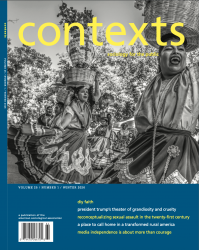
contexts
Contexts is a quarterly magazine that makes cutting-edge social research accessible to general readers. As a journal of the American Sociological Association, it’s also the public face of the discipline. We aim to talk about society with society.
The editorial team is helmed by editor David Grazian and managing editor Elena van Stee, both at the University of Pennsylvania.

Contexts is full of crisp, jargon-free writing and engaging stories, as well as artwork and photography that brings it all to life. Just imagine—an academically rigorous journal that your friends and family will enjoy as much as scholars and policy professionals! Our issues are at their best when they’re dog-eared and worn, passed along to students, referenced by members of the media, and shared as coffee table reading.
We welcome contributions from social scientists, journalists, K-12 teachers, and anyone else who writes incisively, thinks sociologically, and has a dynamite analysis, dataset, or takeaway point that simply must be shared. Please see below for our author guidelines, noting that the proposal and submission process is different for pieces intended for our peer-reviewed features section and for the magazine’s other departments. For notes on style, please jump to the end of this piece.
feature articles (3,000 words maximum)
Our feature articles are cleanly and clearly written for a broad audience, with no jargon, footnotes, or formal citations. They have much in common with the best of long-form journalism: They’re empirically and theoretically driven, teach readers new stuff, and help us think differently about why the world is the way it is (and how it got that way). Before submitting, look over some recent Contexts features: Why is the disparity between the average income of a one percent household and an average household in the 99% so stark? Are “hookup” apps leading, ironically, to a revival of dating culture on college campuses? How did algorithms spur the rise of America’s “alt-right”? Learn more below about the proposal and development process and the production process.
feature articles: proposal and development
All Contexts features start as a “pitch.” If we like it, we’ll greenlight your pitch, inviting you to develop it into a full, 3,000-word feature essay. All pitches are now submitted online through ScholarOne. If you want to send us an idea for a feature, please follow this link: https://mc.manuscriptcentral.com/contexts.
Feature pitches should be no more than two pages long. Include all of the following in a single document:
- A 50-word summary of your main argument (*not* an abstract). Tell us the big picture story, the data you employ, and your impactful takeaway.
- Your lede and first 3-5 stylish, persuasive, and clear paragraphs meant to entice readers. Populate your narrative to show us that you understand who we are: a magazine that platforms the best sociological work for public audiences. Your pitch must make clear why your piece matters to the general public as well as why it’s newsworthy. Avoid jargon!
- Five recommended resources (*not* a bibliography) to help interested, non-academic readers learn more about your topic.
- Don’t forget your bio! Our readers want to know who you are (see examples below in the notes on style section).
- Up to 5 keywords for your piece.
The editorial team will review your pitch. If we like it, we will send you a “greenlight” memo, inviting you to submit a full manuscript, usually within 30 days. This will occasionally include notes on the directions we think would be most exciting or help your article to fit with the rest of the content we are developing. All these interactions, including the submission of your full essay, will happen on ScholarOne.
Here’s what happens after we receive your full manuscript: First, we will review it in-house. If it’s not quite there yet, we will either decline the article or ask you to revise. If we decide it’s ready for prime time, we will send it out for external review. Next, based on the reviews and our own assessment, we will determine whether to reject, accept, or ask for revisions. We are generally loath to subject our features to multiple rounds of reviews and revisions, but sometimes, that’s what an article needs to make good on its promise and potential.
feature articles: production process
Contexts is an official publication of the American Sociological Association, but our production process is unique. For instance, even after we accept a feature essay, it will still go through a professional, line-by-line, magazine-style polish by our senior managing editor and one of our co-editors. It is a delicate, collaborative process in which we work to harmonize your voice with the tone of our magazine.
After all that editing is finished, and once you have signed off on the piece, your manuscript will go into production. This is an exciting stage! As a magazine, Contexts is beautifully full of striking photographs and images. While we will attempt to license and use any images that our authors suggest, the final choice is entirely at the discretion of our editorial team.
You will review a PDF of your article once it’s laid out. Please give your proofs a careful, character-for-character reading, with an eye toward correcting only sneaky little typos or errors of fact (this is not the time to rewrite). You do not need to write an abstract; we use the copy from the issue’s table of contents in place of a traditional abstract.
Upon publication, you will receive a PDF of your article, and we will work to publicize your piece. And, of course, you will receive an almost embarrassing amount of adulation from the sociology community (not that you don’t already)!
Our aim is to complete the external review process and issue a decision within three months of full manuscript submission. Accepted manuscripts will be edited, polished, and published within one year (usually much less), depending on the number and type of manuscripts in progress.
That’s it! Or maybe you find yourself thinking, “That’s a lot!” Either way, we promise that you will love the final product.
departments
in pictures
Nuanced, visual explorations of sociological themes, these submissions should have 8-10 images (high-resolution jpeg files, must be at least 1MB per file) and accompanying captions, along with a 750-word introductory essay. Send proposals to Terry McDonnell at tmcdonn2@nd.edu.
trends
Data-driven pieces of 1,300-1,500 words and 2-3 charts or graphs, trends articles contextualize the numbers to tell a perspective-shifting story. Send a 2-3 paragraph proposal to Cristobal Young at cristobal.young@cornell.edu.
culture
Making meaning of people making meaning, this section deals with, well, culture. That’s really broad, and for good reason. Food, media, technology, politics—it all fits. Submissions should be 1,300-1,500 words and should not include formal citations or a bibliography. Send a 2-3 paragraph proposal to Ashley E. Mears at a.e.mears@uva.nl.
policy
Sociological—and actionable—reflections regarding policy effects, recommendations, and initiatives, submissions for the policy brief should be 1,300-1,500 words, sent to Chad Broughton at cebrough@uchicago.edu.
books
We’re mainly interested in reviews that place two or more recent books in conversation with each other and in specifically sociological reviews of books not typically considered “sociology texts” (these could be novels, memoirs, or trade books). Send your topic suggestion and a 2-3 paragraph proposal to Jon Wynn at wynn@umass.edu.
notes on style
Contexts is largely formatted in ASA style, with a few particularities. For instance, you’re encouraged to write in a more conversational tone (you can even use contractions!) and to “fold in” rather than formally cite your sources. Below, some tips and definitions to help you along the way.
commas: We’re all about the Oxford comma! For reader clarity, we use what is also called the serial comma, including a comma before the final item in a series.
citations: We do not use full, formal citations, but instead “fold” citation information into the text of each piece. Aim to include at least two identifying pieces of information so that the interested reader can easily search out the source.
Example: In Amin Ghaziani’s book Sex Cultures, the author argues…
Example: In their 2020 article “Grief, Care, and Play,” sociologists Seth Abrutyn and Omar Lizardo write…
recommended resources: Rather than a bibliography or reference list, we ask features authors to include a set of up to 5 recommended resources along with a one-sentence descriptor for each. That descriptor should briefly explain why the resource is a good one for the interested reader who wants to learn more. Note: We privilege books, articles, and non-paywalled websites, but podcasts, archives, and other resources are acceptable, too. Each recommended resource should include a full citation (see examples below) followed by a single sentence describing its content or contribution.
-
- Journal article: Curtis Child. 2021. “How to Sell a Friend: Disinterest as Relational Work in Direct Sales,” Sociological Science 8. This article shows how sellers obscure their economic interests when recruiting friends.
- Newspaper or magazine article: Erica L. Green. 2023. “How Educators Secretly Remove Students With Disabilities From School,” New York Times. This journalistic piece highlights the experiences of students with disabilities who have been informally removed from their schools.
- Book: Michael Sierra-Arévalo. 2024. The Danger Imperative: Violence, Death, and the Soul of Policing. Columbia University Press. This penetrating and provocative book introduces the concept of the “danger imperative” to examine how police culture shapes officers’ perceptions and practices of violence.
- Edited volume: Clarissa Smith, Feona Attwood, and Brian McNair, eds. 2017. The Routledge Companion to Media, Sex and Sexuality. Routledge. A comprehensive set of chapters on how sex and sexuality are mediated across platforms.
- Chapter in an edited volume: Christopher Pepin-Neff and Aaron Cohen. 2022. “President Trump’s Transgender Moral Panic.” In The Trump Administration, edited by Toby S. James. Routledge. This chapter shows how Trump acted as a moral entrepreneur in stoking a moral panic against trans people through his tweets.
- Podcast series: Podcast series: The Weeds. Accessible episodes on inequality, meritocracy, and economic policy that connect public narratives and policy. Find it here.
- Podcast episode: Podcast episode: “The Social Acceptance of Inequality,” 2024. International Horizons. A global look at public attitudes toward inequality. Find it here.
author bio: Contexts bios follow a three-part formula:
First sentence: State your current role and institutional affiliation.
Second sentence: List up to three research interests.
Third sentence (optional): If you are a book author, you may include your book title here. Please do not list your book if it already appears in the recommended resources section.
Examples:
Faculty: David Grazian is Professor of Sociology and Communication at the University of Pennsylvania. His research interests include popular culture, urban sociology, and ethnography. He is the author of American Zoo: A Sociological Safari.

Graduate student: Elena van Stee is a PhD candidate in the Department of Sociology at the University of Pennsylvania. She studies families, inequality, and economic sociology.

titles: Short, snappy titles aren’t usually associated with academia, but they are key to the magazine-inspired look and feel of Contexts. We suggest aiming for five or six words. No colons, no question marks! And yes, we’ll always help out with suggested titles.
questions
All questions related to pitches, submissions, and the editorial process can be directed to editors@contexts.org or to our managing editor Elena van Stee at elena@contexts.org.